
Adopting digital ordering in your restaurant can lift revenues and reduce labour pressure, but only if you design for failure, not the vendor’s best-case scenario. Most operators choose a channel, deploy it, and wait for the order values to climb. What they don’t build is a plan for the Saturday lunch service when that channel goes down.
Every digital ordering channel creates a hard dependency on your IT infrastructure. That dependency doesn’t disappear because the deployment went smoothly. It sits in your operation, invisible until a connectivity fault, a POS integration failure, or a third-party outage makes it very visible indeed. Getting the channel choice right is only half the job. Getting the infrastructure right is the other half, and it’s the half most operators skip.
Designing for Failure, Not Just Adoption
In March 2024, McDonald’s experienced a global outage caused by a routine third-party configuration change that brought down ordering systems across the UK, Australia, and Japan simultaneously. It wasn’t a cyberattack. It was a standard infrastructure update that cascaded through an integrated system with no effective isolation. The failure lasted hours and was immediately public.
That’s the shape of the risk, and it’s not unique to large chains. The same cascade failure can happen in a 12-site casual dining group running QR table ordering from a single cloud provider, or a fast-casual restaurant operation whose kiosks have no offline fallback mode.
Designing for failure means three things in practice. Every channel needs an offline protocol, a defined, practised fallback that staff can execute without escalation. The infrastructure underpinning each channel (connectivity, POS integration, device management) must be treated as mission-critical. For multi-site restaurant operators, a failure at one site should never cascade across the estate, and that requires deliberate architecture decisions at the network level, not just a conversation with your broadband supplier.
None of this argues against digital ordering. The revenue case is real. Self-service kiosks consistently produce average order value uplifts of 10–30% in quick service environments, driven by reduced social inhibition and structured upsell prompts. QR code ordering in well-configured casual dining environments produces measurable increases in average spend and table turnover. These are gains worth protecting, which is why the technology infrastructure behind them deserves proper investment before you go live, not after the first failure.
The IT Infrastructure Dependencies Most Restaurant Operators Underestimate
Each channel carries distinct infrastructure requirements. Understanding them before you commit saves significant operational pain later.
Kiosks
Strengths
- Consistent, structured upsell at every transaction, no variance in how add-ons are presented
- Faster throughput in counter-service and queue environments; reduces order errors in noisy kitchens
- Generates transaction-level data that feeds directly into menu and pricing decisions
Weaknesses
- POS integration is the single most common failure point. When it breaks, kiosk orders may stop reaching the kitchen, or continue without the kitchen knowing
- Menu changes, including 86’d items mid-service, must propagate to each unit in real time; failures here create guest-facing errors at the worst possible moment
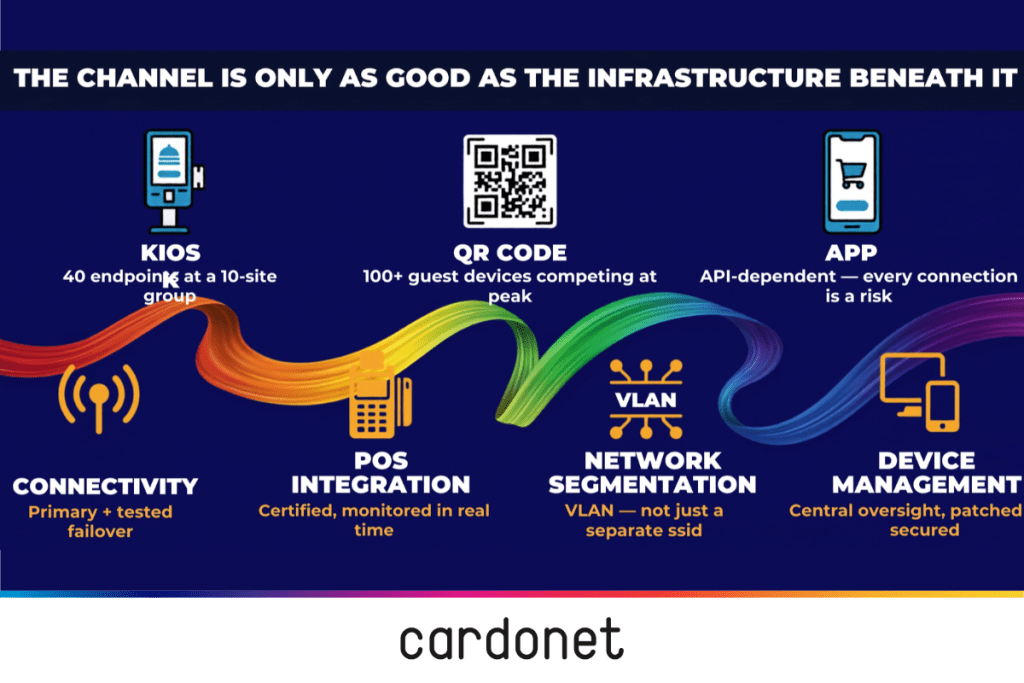
- For a ten-site restaurant group running four kiosks per site, that’s forty managed endpoints requiring consistent configuration, security patching, and hardware maintenance. An overhead most restaurant operators significantly underestimate before deployment
Opportunities
- Order value uplifts compound as upsell prompts are refined using transaction data
- Kiosk deployment frees floor staff to focus on hospitality rather than order-taking, which improves the guest experience in the right concept
Threats
- A kiosk offline mid-service with no practised fallback creates visible queue disruption. A cracked screen or card reader fault has no quick fix without a replacement protocol already in place
- PCI DSS requirements mean kiosk payment flows must be properly isolated from other network traffic; restaurant operators who deploy without reviewing network segmentation inherit a compliance exposure they may not know about
QR Code Ordering
Strengths
- Low deployment cost compared to kiosk hardware; menu changes push centrally without touching individual units
- Removes the friction of flagging down a server for additional orders, which increases mid-meal spend and supports table turnover when payment is integrated into the same flow
Weaknesses
- The entire channel depends on your guest Wi-Fi network performing reliably under load. In a 60-cover restaurant at full service, you may have 100+ guest devices competing for bandwidth simultaneously, ordering, browsing, streaming, at exactly the moment you need the system to perform. Restaurants that deploy QR ordering without upgrading their wireless infrastructure consistently experience degraded performance during peak service
- That degradation is rarely obvious. Guests find the menu slow to load, give up, or flag a server. The failure is silent from an operational dashboard until it surfaces in reviews
- NCSC guidance on network segmentation is clear: restaurant guest traffic and payment traffic must be isolated using proper VLAN architecture, not just a separate SSID on the same router
Opportunities
- First-party data capture at the point of order, if the QR platform integrates with your CRM or loyalty system
- Effective channel for large terrace and beer garden environments where maintaining staffing ratios is harder
Threats
- Brand mismatch risk in premium settings. Guests at higher spend-per-head occasions are not looking to order from their phone, and deploying QR there signals the wrong thing about service intent
- A connectivity outage mid-service removes the channel entirely; a team that has reorganised floor staffing around QR ordering is not positioned to switch back without a rehearsed plan
Branded Apps
Strengths
- First-party guest data collected under consent. Unlike aggregator platforms, you own the ordering relationship and the behavioural data it generates
- Loyalty mechanics, personalisation, and push notifications become possible at scale
- Strong margin protection: orders through your owned channel avoid the commission rates that delivery aggregators charge — Deliveroo and Uber Eats both charge around 30% per order, which on a £30 order means £9 going to the platform before a single ingredient cost is covered
Weaknesses
- An app is an ongoing software maintenance commitment, a security obligation, and an API-dependent system connecting guests to your menu, kitchen, payment processor, and loyalty platform simultaneously. When any of those connections degrades, the guest experience breaks, and unlike a kiosk failure in your dining room, an app failure is often invisible to your floor team until reviews appear
- ICO guidance on consent management and data minimisation applies fully to guest data collected through a restaurant app. Restaurant operators must be confident their infrastructure meets GDPR obligations before scaling the channel
Opportunities
- Subscription and membership mechanics are easier to sustain through an owned app than through third-party platforms
- Data from a well-maintained app compounds in value, informing menu development, promotional targeting, and site-level performance analysis
Threats
- Low download rates for single-site independents or high-tourist-volume restaurants with limited repeat visit frequency. The economics only work for restaurant brands where guests return often enough to make downloading an app worthwhile
- App store policy changes, OS updates, and third-party API changes all create maintenance obligations that are easy to underestimate at the point of commissioning
Matching the Channel to Your Restaurant Concept
The operational case for each channel shifts significantly depending on your restaurant service model and guest demographic. Getting this wrong doesn’t just produce a poor return on investment, it produces active friction in an environment that can’t afford it.
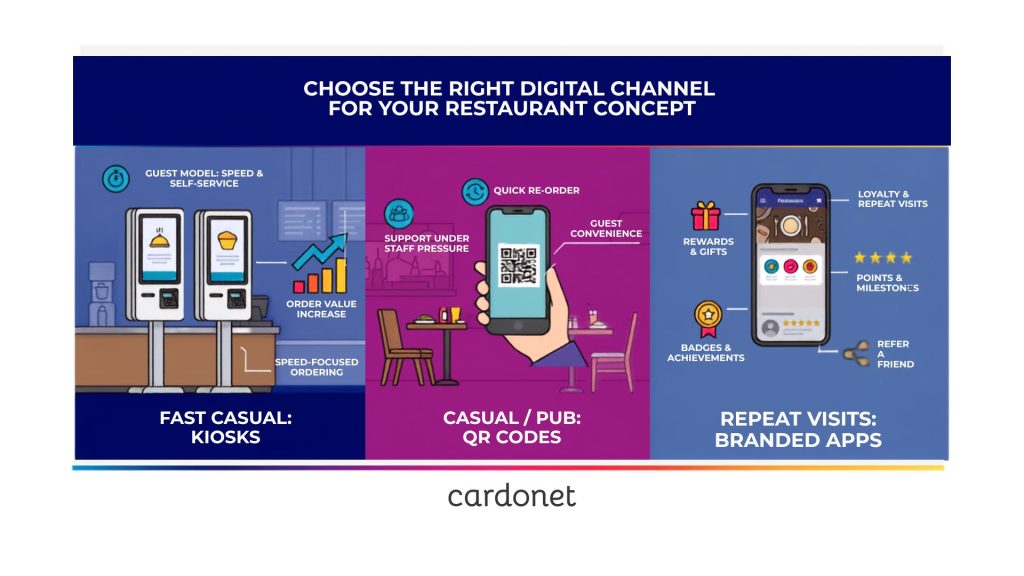
Kiosks belong in counter-service and fast-casual restaurant formats where guests are already in a self-directed, transactional mode. The reduced social inhibition that drives the order value uplift works because the guest expects to make choices at speed. Deploying a kiosk at the entrance of a full-service restaurant where hospitality is the core product creates the wrong first impression.
QR code ordering fits mid-market casual dining and pub-restaurant formats with table service, particularly where staff-to-cover ratios are under pressure. It works best framed as guest convenience, through the ability to order another round or add a side without waiting rather than a replacement for the service interaction. For premium casual or fine dining, QR at table is a brand mismatch regardless of how well it’s configured technically.
Branded apps make most commercial sense for restaurants with a genuine repeat-visit mechanic: a loyalty programme, a subscription model, or a visit frequency that makes the download worthwhile for the guest. A single-site independent with high tourist volume and low repeat visits is unlikely to generate the adoption that justifies the build and maintenance investment.
For most restaurant groups, the answer is a deliberate channel mix phased around their restaurant concept. A fast-casual group might run kiosks at counter, QR ordering in a terrace overflow, and a branded restaurant app for loyalty members. A casual dining estate might lead with QR table ordering and hold the app decision until a loyalty programme is in place to support it.
Building a Channel Mix Your Restaurant IT Estate Can Actually Support
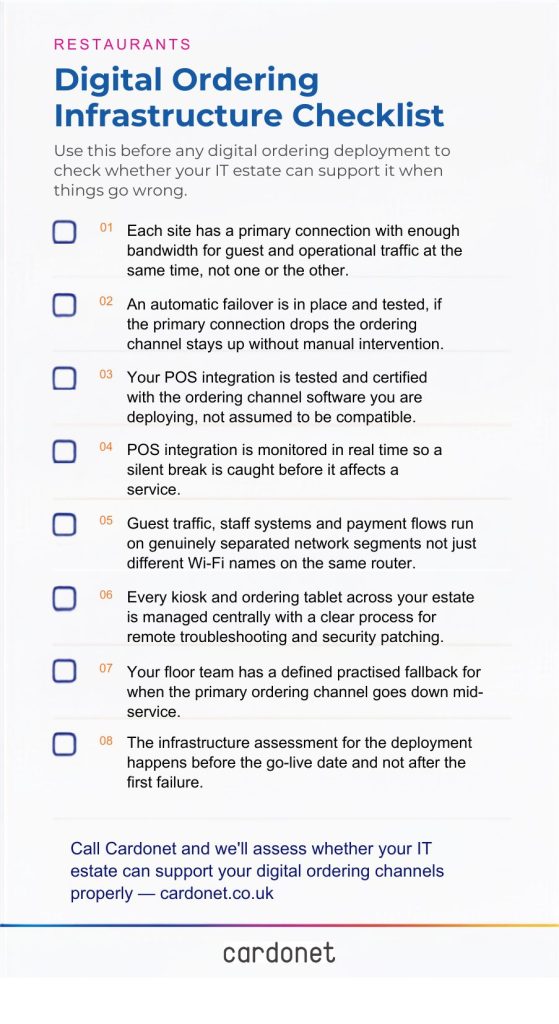
The channel decision and the infrastructure decision cannot be made in isolation. Before committing to any channel, the honest question is whether your current IT estate can support what you’re deploying, at every site, under service load, when something goes wrong.
In my experience, most restaurant groups reach out to an IT partner after a deployment has already run into problems. A kiosk integration breaks on a Friday afternoon and nobody knows who owns the fix. QR ordering slows to a crawl every Saturday from 1pm and the broadband supplier says the line is fine. The app stops syncing with the POS after a menu update and orders are missed for two hours before anyone notices. These aren’t unusual events, they are the predictable consequences of deploying digital ordering channels without first assessing the infrastructure they depend on.
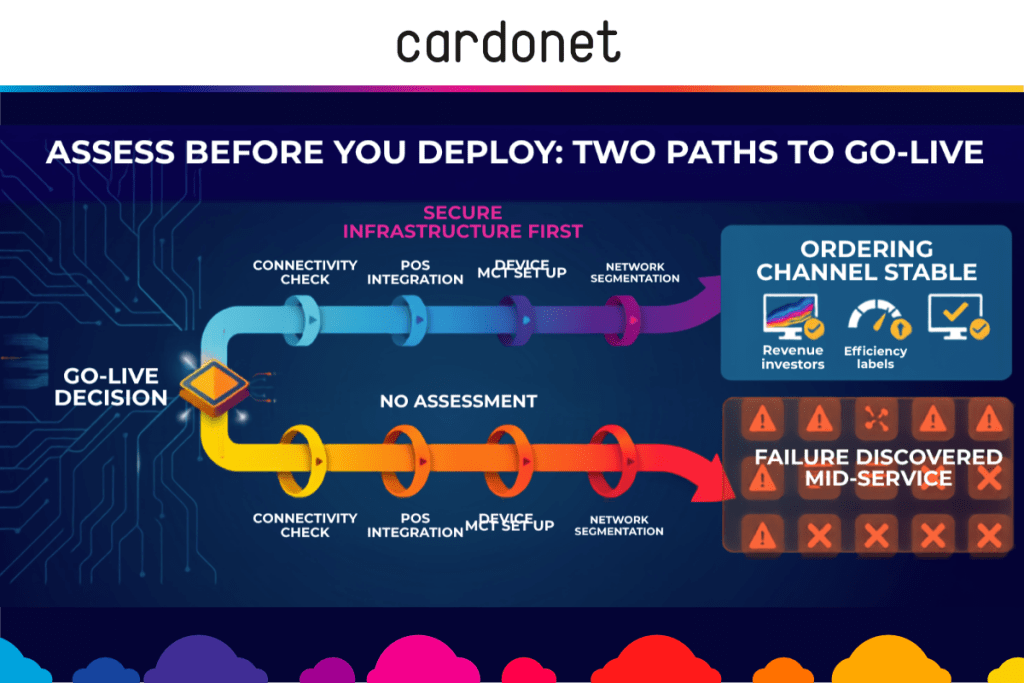
That assessment covers four areas:
- Connectivity: Does each restaurant site have a primary connection with sufficient bandwidth and a failover that activates automatically when the primary drops? A digital ordering channel built on a single consumer-grade broadband line at a revenue-critical site is not a resilience posture.
- POS integration: Is your POS platform tested and certified with the ordering channel software you’re deploying, and is that integration monitored in real time so a silent break doesn’t cost you covers?
- Device management: Do you have a centralised way to push updates, monitor health, and remotely troubleshoot every kiosk and ordering tablet across your estate? At scale, this is not optional.
- Network architecture: Are guest, staff, and payment traffic properly segmented so a failure or compromise in one zone can’t take down another? This is a PCI DSS requirement as well as an operational one.
If the answer to any of those questions is uncertain, the right next step is not to delay the channel deployment, it is to fix the foundation first.
Done properly, restaurant digital ordering channels deliver measurable revenue uplift, reduce labour pressure, and generate guest data that compounds in value over time. The operators who extract that value consistently are the ones who built the infrastructure to support it, and who planned for failure before they went live.
If you are reviewing your digital ordering channels and want a clear picture of whether your IT estate can support them, talk to Cardonet. We work with restaurant groups across the UK to assess connectivity, POS integration, network architecture, and device management. Call us and we’ll take you through exactly what that looks like for your operation.
1. We already have a separate guest Wi-Fi network. Is that enough to protect our payment systems when we add QR ordering?
A separate SSID on the same physical router is not the same as network segmentation. Guest devices and payment terminals need to sit on genuinely isolated network segments, with controlled traffic between them, so that a compromised guest device cannot reach your POS. If your current setup is a second Wi-Fi name on the same piece of kit, it needs reviewing before you go live.
2. How do we keep kiosks running if the POS integration goes down mid-service?
Most operators don’t have a plan for this until it happens. You need a defined offline protocol giving staff clear instructions on switching to manual order-taking without creating a queue crisis. That protocol needs to be practised, not just written down, and the POS integration should be monitored in real time so a silent break is caught before it costs you covers.
3. Does a branded app make sense for a single-site restaurant, or is it only worth it for groups?
The economics depend on repeat-visit frequency. For a neighbourhood restaurant with a loyal local following, the margin and data benefits of an owned ordering channel can justify the investment. For a site with high tourist volume and low repeat visits, download rates are unlikely to reach the threshold that makes it worthwhile, and an underfunded app creates more reputational risk than it removes.
4. What should we look for in a connectivity setup before deploying any digital ordering channel?
Each site needs a primary connection with enough bandwidth for guest and operational traffic simultaneously, and an automatic failover that cuts in without manual intervention. A single consumer-grade broadband line is not an adequate foundation for a revenue-critical ordering channel. The connectivity assessment should happen before you commit to a channel, not after the first outage.
5. We’re considering QR ordering for our terrace. What are the practical risks?
Outdoor environments amplify the Wi-Fi dependency that underpins all QR ordering, and a terrace at capacity puts maximum strain on wireless coverage at peak service. If the channel drops, a floor team reorganised around QR is not well-positioned to revert without a rehearsed fallback. Pressure-test the wireless coverage across the outdoor area under realistic load before going live.

You must be logged in to post a comment.