
A membership body’s infrastructure is tested continuously as the organisation grows, and the associations that handle growth well are the ones that check their systems against each new stage rather than waiting for something to break. We’ve found that most membership bodies discover this the hard way: a renewal process that worked fine for years suddenly starts dropping people, a chapter’s numbers stop reconciling with head office, or a task that used to take ten minutes now eats an afternoon. Nothing dramatic happens on the day it breaks, but strain comes from systems carrying more than anyone specified them for.
Where informal systems break
Growth generally shows up gradually rather than as a single event and whatever’s been holding an organisation together informally gets stretched past what it can reasonably do. A few of these moments tend to matter more than others for membership bodies specifically:
- Crossing from a few hundred members into a few thousand, the scale where manual processes start to buckle.
- Taking on the first paid member of staff, which forces work that lived in one volunteer’s head to be handed over and documented.
- Opening the first regional chapter, which almost always arrives faster than the systems meant to support it.
None of these are precise thresholds – they’re examples of a wider pattern. What matters is whether the infrastructure keeps working while the organisation’s shape keeps changing.
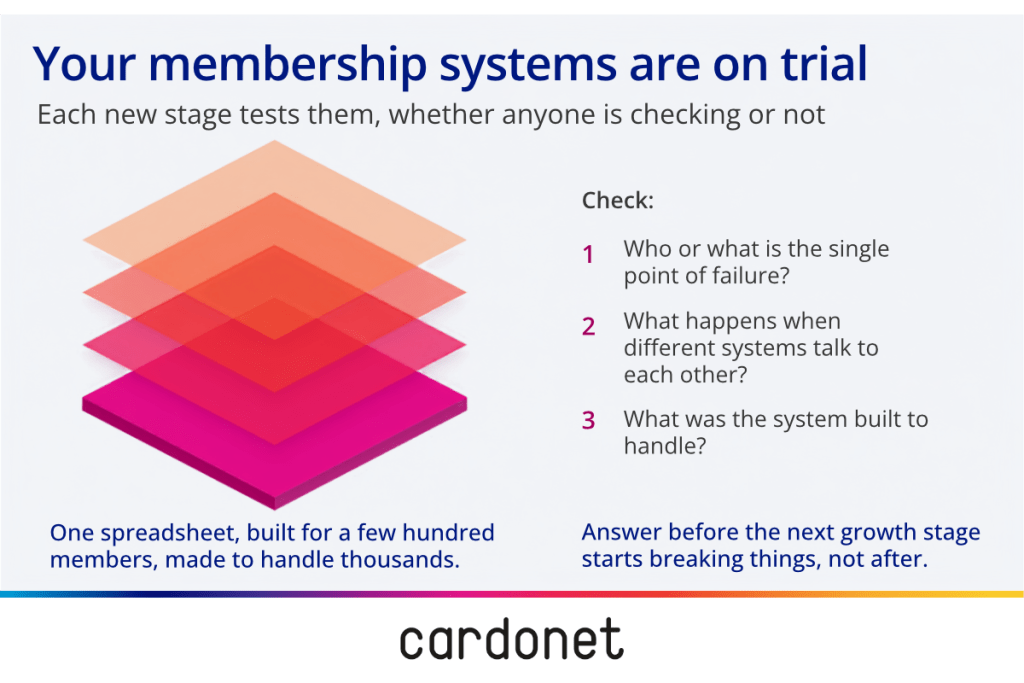
The pattern is the same each time: something that worked fine at the previous scale (a spreadsheet, one person’s inbox, or a shared drive) gets asked to do more than it was built for, until the gap becomes impossible to ignore.
Global research from the 2026 iMIS benchmark report offers a useful marker of where most associations currently sit: 71% now have or will invest in membership management software. The leading challenge the same research identifies has moved on from missing software to disconnected software – systems that don’t talk to each other, the kind of fragmentation a properly planned managed cloud strategy is designed to prevent, though the underlying decision is organisational, and technical fixes alone won’t resolve it.
Chapter growth carries its own version of this. One published guide for national bodies, produced by a membership software vendor rather than as independent research, puts the recognition point at roughly a dozen chapters, each running its own payment processor, its own spreadsheet, and its own way of doing things, before anyone at the centre notices how fragmented the picture has become.
Three questions worth asking before the system is tested
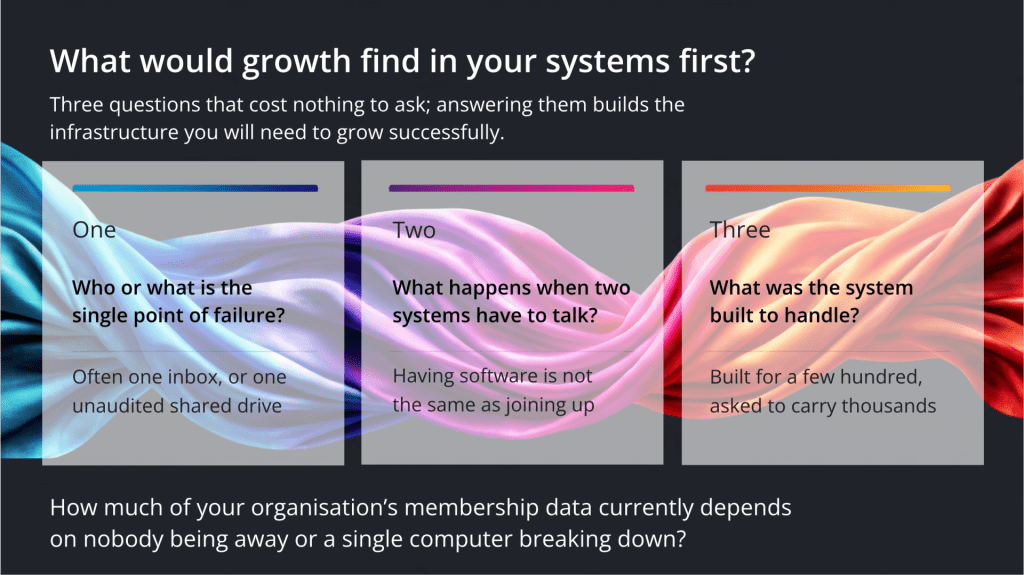
Three questions are worth asking about any system before growth stretches it further, rather than after it has.
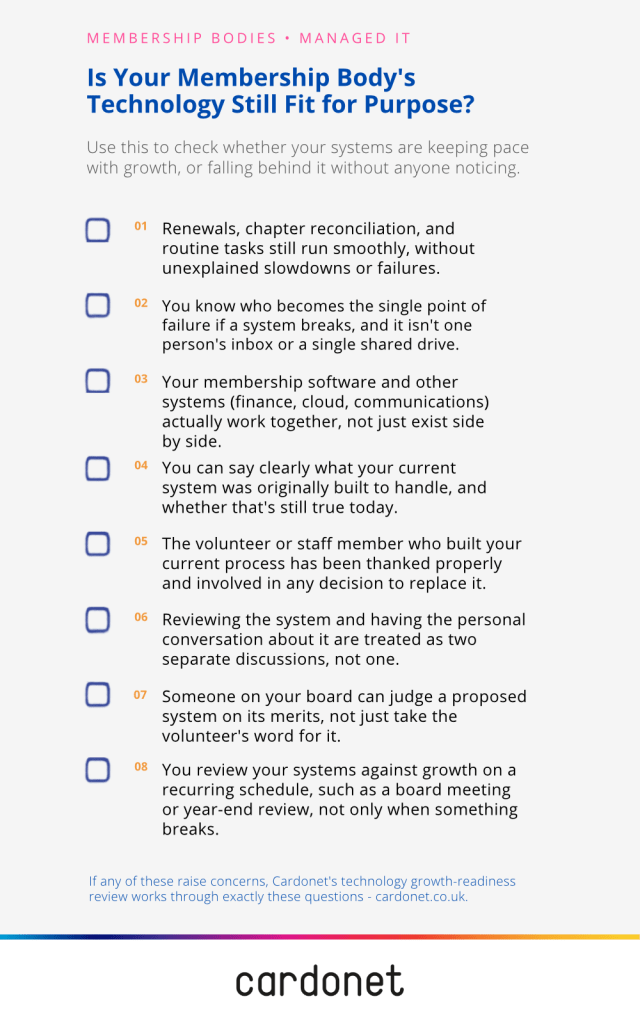
- Who or what becomes the single point of failure if this breaks? If one person’s inbox, or a single shared drive, is the only place a process genuinely lives, growth will eventually find that weak point – the same blind spot a managed cybersecurity review exists to find, before it is exploited or breaks under pressure. That usually happens at the worst possible moment, when whoever holds the knowledge is unavailable and nobody else knows where to look.
- When two systems need to talk to each other, what actually happens? Most membership bodies already run some kind of membership software; the constraint has shifted from having a system to making the systems that exist actually work together. That gap is exactly the failure mode the iMIS research points to – a form of fragmentation that shows up repeatedly once an organisation outgrows its first system.
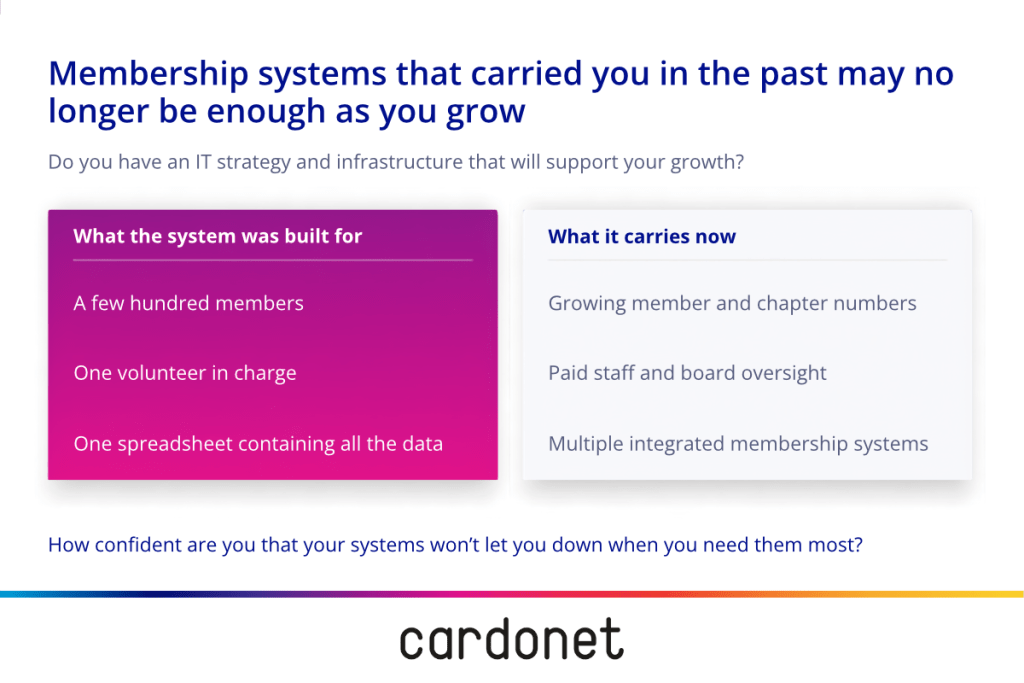
- Finally, what was the system originally set up to handle, and is that still true? A process built for a few hundred members rarely survives contact with a few thousand without significant change, even if nobody consciously decided to redesign it. The demands grow and the design stays where it was.
None of this costs anything beyond asking the questions honestly, before the system is tested rather than after. The organisations that do this well have built the habit of asking, consistently, and long before they need to.
The conversation nobody wants to have
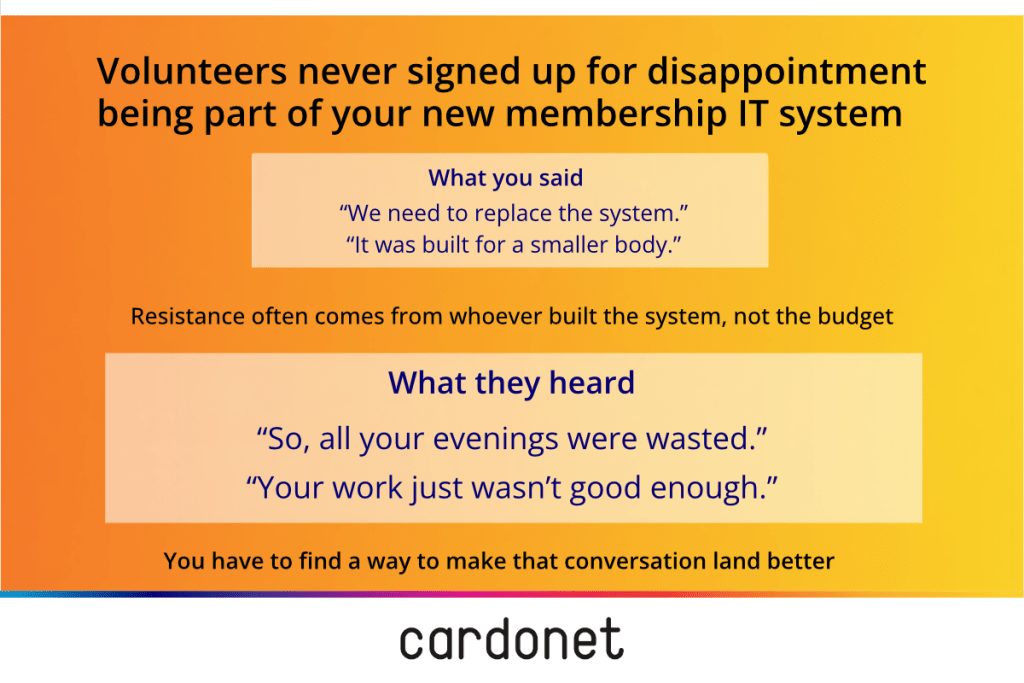
The technical side of this problem is, in most cases, the easier half to solve. The harder half is that the real resistance to replacing an informal system usually comes from whoever built it, not from the budget line.
For a membership body, that’s often a volunteer, the person who took on renewals, events, or reporting because nobody else would, unpaid, evenings and weekends included. Telling that person the system they built isn’t good enough any more rarely lands as a process critique; it lands as a verdict on years of unpaid effort, a slap in the face whatever language is used to soften it. That’s a harder conversation to have with a volunteer than with paid staff, and it’s part of why so many membership bodies delay a change everyone privately knows is overdue.
Beyond emotional discomfort, there’s a structural cause too. The 2026 Charity Digital Skills Report, based on 807 UK charity responses, found that 46% don’t have a trustee or board member with digital skills – 49% among smaller organisations. On many boards, nobody in the governance layer can independently judge whether a proposed system solves the problem, leaving the volunteer who built it as the only person in the room who properly understands it.
A few things tend to make that first conversation land better:
- Say thank you properly and specifically before any conversation about the system starts – it’s true, and it’s owed.
- Bring that person into choosing what replaces the system rather than presenting a done deal – their judgement is exactly what a board without digital expertise of its own is missing.
- Frame the change as the organisation outgrowing the system – worth saying plainly to the person who ran it, more than once if needed.
- Keep the system review and the personal conversation apart – they can start to feel like the same discussion if you’re not careful.
Getting this right is a trust decision as much as a technology one. Handling the technology alone almost guarantees resistance to the change, and no amount of software selection compensates for skipping the conversation.
Building the habit of checking
The membership bodies that handle growth calmly tend to share a habit that has nothing to do with sophisticated systems: they check their setup on a schedule, not just when something breaks. It’s a small operational habit, but the effect compounds over time, the same way a missed renewal or a fragmented chapter compounds if nobody’s checking for it.
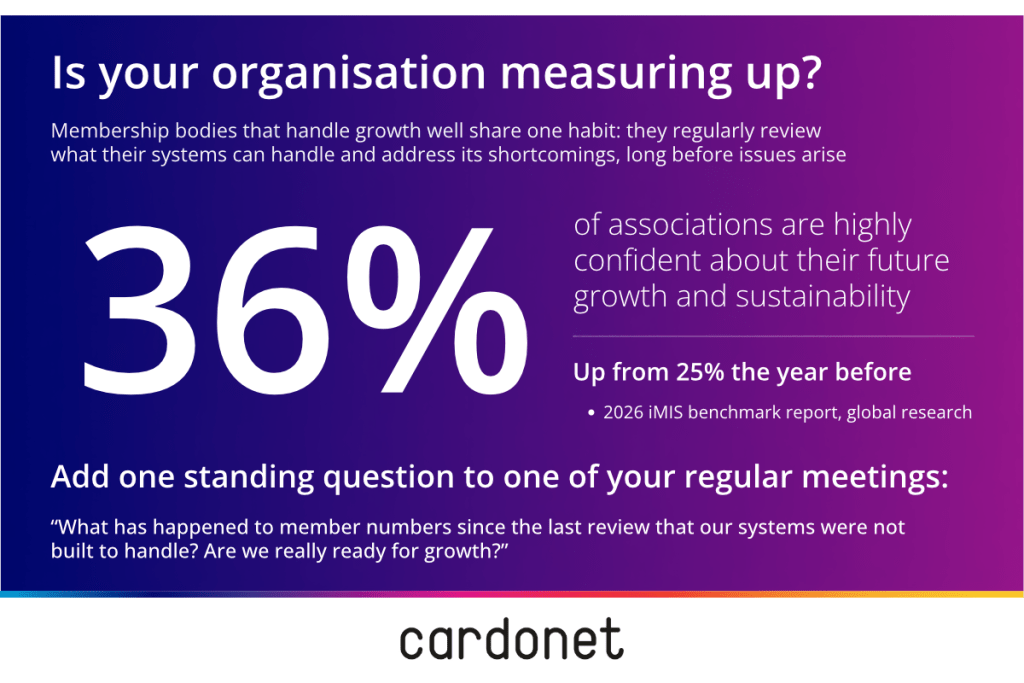
That habit shows up in the numbers. The 2026 iMIS benchmark report, which surveys associations globally, found that only 36% are highly confident about their future growth and sustainability. This is up from 25% the year before, but still well under half. The gap reflects a planning habit many associations haven’t built yet, and regular checking is what closes it.
A simple version of that habit costs nothing to start. Pick a recurring point already on the calendar such as a board meeting or a year-end review and add one standing question to it: what’s changed since the last review that our systems weren’t built for? Write the answer down honestly, even when nothing needs to happen yet. Revisit it at the next one because repetition is what makes the habit work, rather than a single well-intentioned attempt that fades after the first try.
Nothing here needs a project or a budget line, only the discipline of asking on a schedule rather than in a crisis.
Where this leaves growing membership bodies
The technology decisions in this piece matter, but they’re rarely the hardest part. The harder part is asking the right questions before growth forces the answer, and having the human conversations that go with it honestly, rather than avoiding them.
Would asking these three questions today turn up a single point of failure nobody’s named yet, or a volunteer conversation that’s been avoided for a year? For many membership bodies, that answer is worth more than any specific member count or chapter total.
If that’s a conversation worth having properly, a Cardonet technology growth-readiness review is built around exactly this: the three diagnostic questions, the trust conversation, and a clear look at whether your systems are still doing what they were originally set up to do.
FAQs
1. How do we know if our membership system has outgrown us, rather than the other way round?
Watch for the moments this article names directly: crossing from a few hundred members into a few thousand, taking on a first paid member of staff, or opening a first regional chapter. If a renewal process starts dropping people, a chapter’s numbers stop reconciling with head office, or a task that used to take ten minutes now eats an afternoon, that’s usually the system being asked to do more than it was built for, not a one-off glitch.
2. We already have membership management software. Why does it still feel fragmented?
Most membership bodies have moved past the stage of having no system at all, and the constraint has shifted from having software to making the systems that exist actually work together. A properly planned managed cloud strategy is designed to close that gap, but it’s worth being honest that the underlying decision is organisational as well as technical, so a new tool on its own won’t fix it.
3. How do we raise this with the volunteer who built our current system, without it landing badly?
Start by thanking that person properly and specifically, since the system they built has usually run on unpaid evenings and weekends for years. Bring them into choosing what replaces it rather than presenting a finished decision, and keep that conversation separate from the practical system review so the two don’t blur into one.
4. How often should we actually be reviewing our membership technology?
Regularly, and on a schedule rather than only when something breaks, is the pattern this article points to. A simple version costs nothing to start: attach one standing question to a recurring point already on the calendar, such as a board meeting or year-end review, and write down honestly what’s changed since the last one.
5. We’re about to open a new chapter or take on our first paid member of staff. What should we check first?
Both are named in this article as the moments most likely to expose whatever’s been holding things together informally, so it’s worth asking the three diagnostic questions before either change lands: who becomes the single point of failure, what happens when systems need to talk to each other, and what the current system was actually built to handle. Getting honest answers before the change happens is cheaper than finding out afterwards.



You must be logged in to post a comment.