
It’s a busy Friday evening. Eighty covers are booked, the kitchen is running hard, and the POS terminal freezes mid-transaction. Card payments stop. The kitchen display goes dark. Your front-of-house manager reaches for the support line, and gets a message saying the office is closed until Monday.
Restaurant IT support that only operates during business hours is not IT support, it is a false sense of security that costs you money when you can least afford it.
This is not a hypothetical example designed to make a point. It is the structural reality of running an always-on business with a part-time IT safety net. Friday and Saturday evenings are where most restaurants make a disproportionate share of their weekly revenue. The IT support model most operators run was designed for Monday-to-Friday offices with tolerance for next-day recovery. For a restaurant, next-day recovery means the service is already done, and the revenue gone.
When Restaurants Are Actually at Risk
Technology failures in restaurants don’t cluster around Tuesday mornings. They happen during the service periods when systems are under maximum load with high transaction volumes, multiple concurrent connections, kitchen displays firing continuously, and payment terminals processing card after card. That pressure exposes weaknesses that quiet periods don’t.
Network outages can be triggered by ISP-side faults, a switch that has been running hot for months finally giving up, or a broadband line that degrades under sustained traffic. POS systems can corrupt during a routine background update, payment terminals can lose their connection to the payment gateway without warning and kitchen display systems can drop entirely mid-service if the network they depend on loses stability.
None of these failure patterns are unusual. According to research by FreedomPay and Dynatrace, UK hospitality businesses report an average of over five major payment system outages each year, with 61% of those failures occurring during peak trading periods. The question is not whether technology will fail during a service period but whether anyone is watching closely enough to catch the warning signs before the failure affects service.
The Cost Calculation Most Operators Miss
The immediate revenue impact of a technology outage during peak service is real and quantifiable, but the downstream effects compound in ways that don’t show up on the till report.
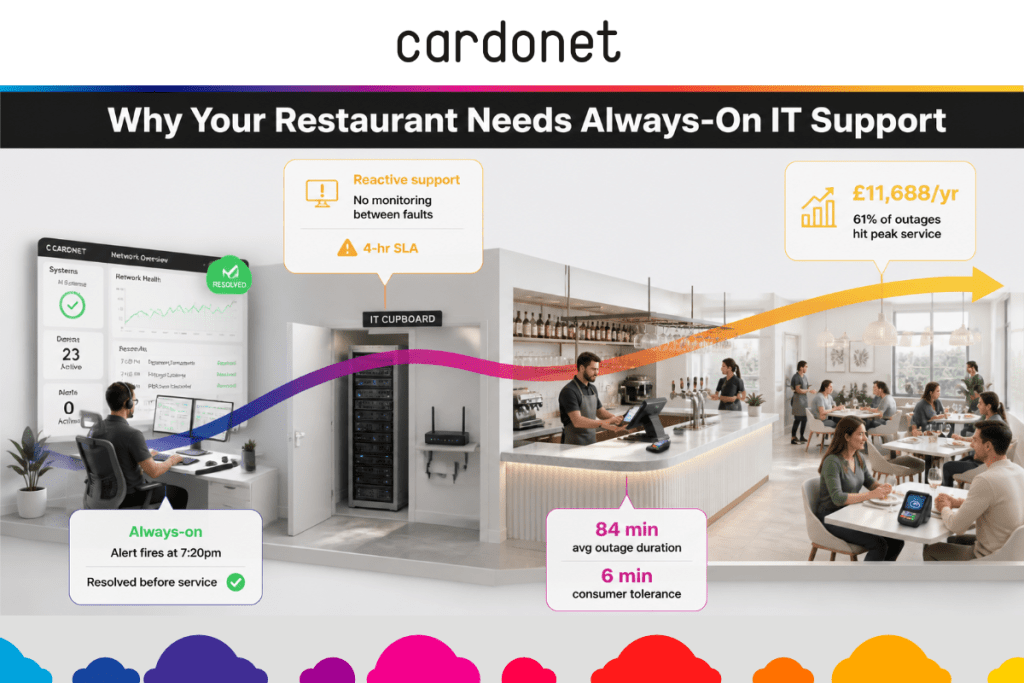
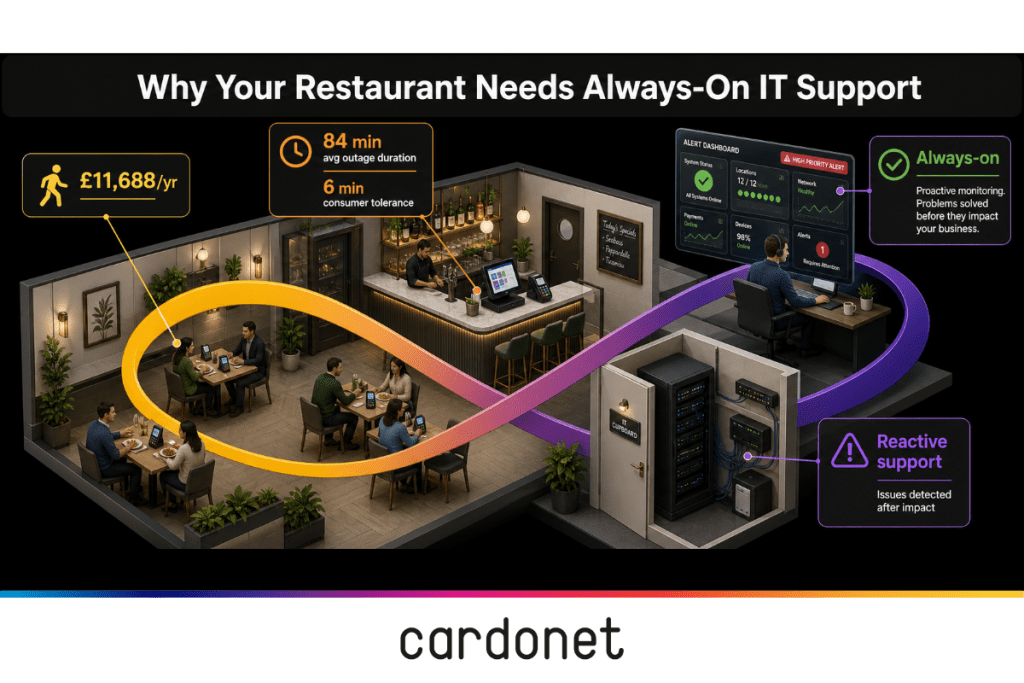
The same FreedomPay and Dynatrace study found that consumers will only tolerate up to six minutes of payment disruption before frustration sets in, yet the average payment outage lasts 84 minutes. For a restaurant mid-service, that gap between consumer tolerance and actual recovery time is where covers walk out and bad reviews get posted.
Sector-level figures reinforce the point. Payment system failures cost UK retail and hospitality businesses an estimated £1.6 billion annually, with the hospitality share estimated at around £494 million. At the individual operator level, a Dojo report published in 2026 found that UK hospitality venues lose a mean of £11,688 per year from payment technology failures alone, with almost a third experiencing weekly payment failures. IT downtime is simultaneously a revenue problem, a compliance problem, and a guest experience problem. The cost of a single significant outage typically exceeds any reasonable monthly investment in always-on managed IT support.
There is also a compliance dimension that often goes unconsidered. When POS systems fail and restaurants attempt workarounds to keep taking payments, PCI DSS requirements, the framework governing how card data must be handled, can be inadvertently breached. The financial and reputational consequences of a PCI compliance failure extend well beyond that evening’s lost revenue.
Why Reactive Support Fails
The structural flaw in break-fix and reactive IT support is that the burden of fault detection sits entirely with the restaurant team. A manager in the middle of a busy service has to notice something is wrong, locate the emergency contact number, explain the fault to a support agent who has never seen the system before, and then wait while the agent attempts remote diagnosis. Each step costs time, and delays are measured in covers lost.
Even contracts that advertise an out-of-hours emergency line often work this way in practice. They are reactive, dependent on the fault being reported clearly, and start the clock only once the call is logged. The engineering response that follows is being applied cold, without system knowledge, without prior familiarity with the specific configuration. Resolution times that look OK on paper translate into very different outcomes during the busiest services.
The deeper problem is that reactive support, by definition, addresses problems that have already materialised. It cannot prevent them.
What Always-On Restaurant IT Support Actually Looks Like
Genuine 24/7/365 restaurant IT support is built around continuous monitoring with systems being watched in real time and engineers being alerted when performance starts to degrade rather than after the system has failed. For a well-configured restaurant environment, this means managed IT monitoring that simultaneously covers network performance, POS connectivity, server health, and payment terminal status. A significant proportion of potential failures are caught and resolved remotely before anyone at the site is aware a problem exists.
When something does fail, the response architecture matters as much as the response speed. Documented system knowledge (stored configurations, escalation paths, known dependencies) means that any engineer picking up the call at 9 PM knows what they’re working with, rather than starting from scratch. SLAs need to be calibrated to reflect the urgency of a fault during dinner service, not the tolerance of an office environment. A four-hour response window means something entirely different at 11 AM on a Tuesday than at 7:45 PM on a Friday; any support package that does not differentiate between the two has not been designed with restaurants in mind.
The monitoring layer also enables proactive maintenance in a way that purely reactive support cannot. Patch cycles can be scheduled outside busy service windows. Hardware showing signs of degradation can be replaced before it fails. This kind of ongoing housekeeping is what separates a restaurant IT support partner from a break-fix contractor.
Making the Business Case
The cost objection to always-on support usually doesn’t survive a straightforward comparison – 24/7 managed support obviously costs more than a business-hours contract. The important question is how that monthly investment compares to the cost of a single significant service-period outage, including lost revenue, the indirect operational disruption, and the compliance/legal exposure.
At an individual venue level, the numbers already tell a clear story. Hospitality venues losing a mean of £11,688 per year to payment failures alone even before accounting for the wider IT incidents that don’t involve payment systems. This is the direct comparison to any managed support fee. UKHospitality’s data shows that a third of hospitality businesses are currently operating at a loss, with operators facing significant cost pressures across the board. In that context, unmanaged technology risk is not a background concern. It is a direct threat to viability.
There is also a longer-term commercial argument. Restaurants that operate on a stable, well-monitored IT foundation are better positioned to take advantage of digital channels such as integrated delivery platforms, cloud-based reporting, and real-time multi-site visibility that increasingly separate high-performing operators from the rest. Those capabilities depend on infrastructure that is actively maintained and consistently reliable. Without dedicated IT support covering the hours when the business actually operates, that foundation is only as strong as the last time something went wrong and happened to be fixable quickly.
What to Review in Your Current IT Support Setup
The easiest way to stress-test your existing IT support arrangement is to look at what your contract actually covers in terms of specific hours and response commitments for out-of-hours faults. Most operators who do this for the first time find the gap between what they assumed they had and what the contract actually provides is significant.
The second question to ask is whether your systems are being monitored continuously or only when you report a fault. Proactive monitoring and reactive support are fundamentally different models. If no one is watching your systems between incidents, you are not protected, you are simply waiting for the next problem to surface during a service you cannot afford to disrupt. Combine that with an honest review of your SLA response times against your actual peak operating hours, and the picture of your current exposure becomes very clear, very quickly.
For a full review of your restaurant IT support model, covering current coverage gaps, your specific operating hours, and what always-on managed support would look like in practice for your operation then contact the Cardonet Restaurant IT Support team.
FAQs: 24/7 Restaurant IT Support
What does 24/7 IT support actually mean for a restaurant?
It means engineering support, monitoring, and fault resolution are available continuously – not just during business hours. In practice, this combines proactive monitoring that identifies issues before they cause service disruption, a staffed service desk available through evenings and weekends, and remote resolution capability for the majority of common faults without requiring an engineer on-site.
How much does restaurant IT downtime actually cost?
At a sector level, payment system failures alone cost UK retail and hospitality businesses an estimated £1.6 billion annually, with 61% of those failures occurring during peak trading periods. At an individual operator level, UK hospitality venues lose a mean of £11,688 per year from payment technology failures. The full picture, including wider IT incidents beyond payment systems, is larger still.
Is 24/7 IT support only relevant for multi-site restaurant groups?
No. Single-site operators are often more exposed to technology failure than larger groups, because there is no fallback site and typically no dedicated IT resource on-site. A managed IT partner covering restaurant hours acts as the IT function most independent operators cannot justify employing in-house.
What’s the practical difference between 24/7 support and an out-of-hours emergency line?
An emergency line is reactive – you notice the problem, call the number, explain the fault to someone unfamiliar with your systems, and wait. Genuinely always-on managed support includes continuous monitoring that flags issues before they become visible, documented system knowledge so any engineer has immediate context, and SLAs that reflect the urgency of an evening service rather than office-hours tolerance.
How do I evaluate whether a managed IT support provider genuinely covers restaurant service hours?
Ask for the actual staffing model behind any claim of 24/7 availability. Ask what percentage of out-of-hours faults are resolved remotely versus requiring an on-site visit. Ask for average response and resolution times specifically for evening and weekend calls rather than an overall average. Any provider with genuine restaurant sector experience should be able to answer those questions directly.

You must be logged in to post a comment.