
Succession planning in most private offices means legal structures, trusts, voting rights, and investment committee membership. It rarely extends to the thing that determines whether a successor can actually run the office on day one: who has access to which systems, and who understands how any of it actually works. Governance succession for a private office isn’t complete when authority transfers on paper. That happens when system access, data ownership, and institutional knowledge transfer along with it.
Why the technology layer gets left out of succession planning
J.P. Morgan Private Bank’s 2026 Global Family Office Report, based on a survey of 333 single family offices across 30 countries, found that 86 per cent still lack a clear succession plan for decision-makers, even as governance around investment decisions has become considerably more formal, with 64 per cent of respondents now operating a formal investment committee. Governance, in other words, has developed unevenly. It tends to start with investment oversight, because that’s what most family offices were originally created to manage, and only gradually extends outward to other areas of the office’s operation, if it extends there at all.
A separate 2026 review of family office best practices puts a finer point on where this leaves most offices: documented policies for accounting, vendor management, and risk monitoring exist specifically to reduce key-person risk, yet many offices, especially newer or first-generation ones, still lack formal succession mechanisms altogether. The same analysis notes that next-generation preparation, including structured education and gradual involvement in decision-making, consistently scores among the lowest satisfaction areas in family office surveys.
Governance frameworks are being built, but the handover of actual operational knowledge lags.
This gap matters because private offices, unlike most businesses, tend to concentrate technical and institutional knowledge in very few people. The J.P. Morgan report found that over-reliance on individual providers or people ranks among family offices’ top five risks to long-term continuity, cited by a third of respondents as a genuine concern. When that individual is the one person who understands how the office’s systems, logins, and data actually fit together, succession planning that stops at legal structure leaves the most operationally critical risk completely unaddressed.
What happens when authority shifts without access
The typical pattern is not a dramatic failure. It is a quiet mismatch that surfaces gradually. A successor gains formal decision-making authority, including board membership, investment committee voting rights, and signing power, while the underlying systems continue to run exactly as they did before, administered by the same person, accessed through the same logins, understood by the same one or two people who set them up years earlier.
The result is a successor with legal authority but no operational visibility. They can approve a transaction but can’t see the document trail behind it without asking someone else to retrieve it. They inherit responsibility for the office’s privacy and continuity obligations (see Parts 2 and 3 of this series) without inheriting the administrative control needed to enforce them. Governance has moved forward on paper while the technical foundation underneath it has stayed exactly where it was.
Equiom Group’s 2026 analysis of family office governance trends frames this precisely as the difference between governance as documentation and governance as decision-making discipline: effective governance in 2026 is defined not by the existence of policies, but by how decisions are actually made, evidenced, and carried out in practice. A family office can have a fully formal governance structure, investment committee, family council, documented bylaws, and still have a completely undocumented, single-person-dependent system of access and technical knowledge sitting underneath it, unaffected by any of the formal structure above.
Building governance into the technical foundation
Closing this gap requires treating system access and institutional knowledge as governance assets, not background administrative detail.
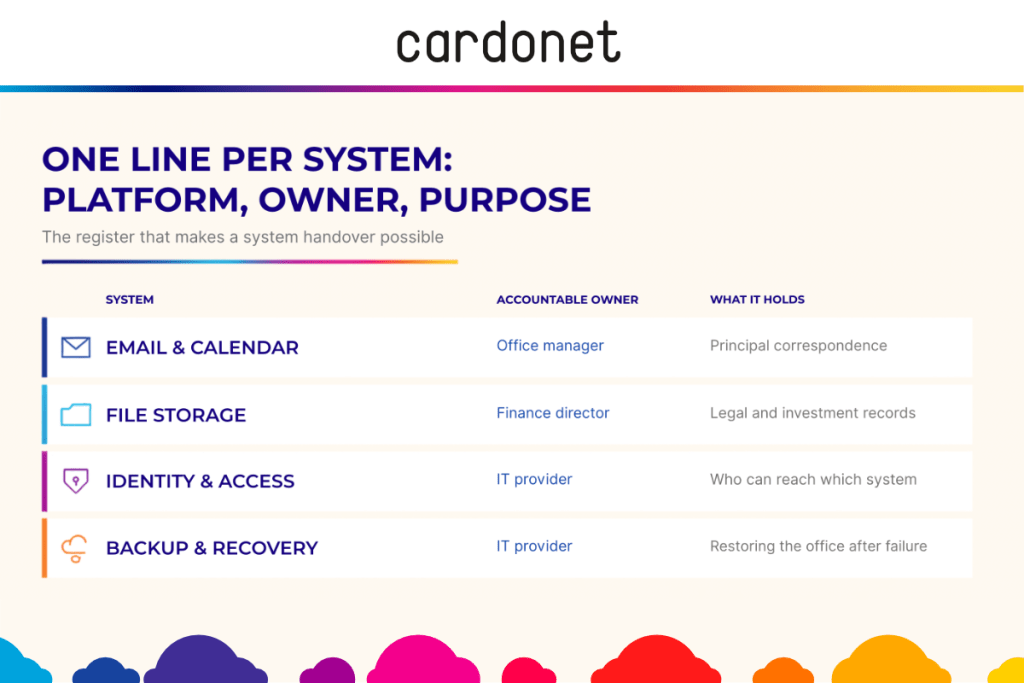
- Documented system ownership. Every system a private office relies on, email, file storage, identity management, backup and continuity infrastructure, should have a named owner and a written record of what it does, how it’s configured, and who else can operate it. In practice, this means a simple systems register: one line per system, naming the platform, its owner, its purpose, and where the access credentials and setup documentation are held. This is the same discipline behind Part 2’s access classification and Part 3’s recovery objectives: information that lives only in one person’s head is not a system, it’s a liability waiting for that person to be unavailable at the wrong moment.
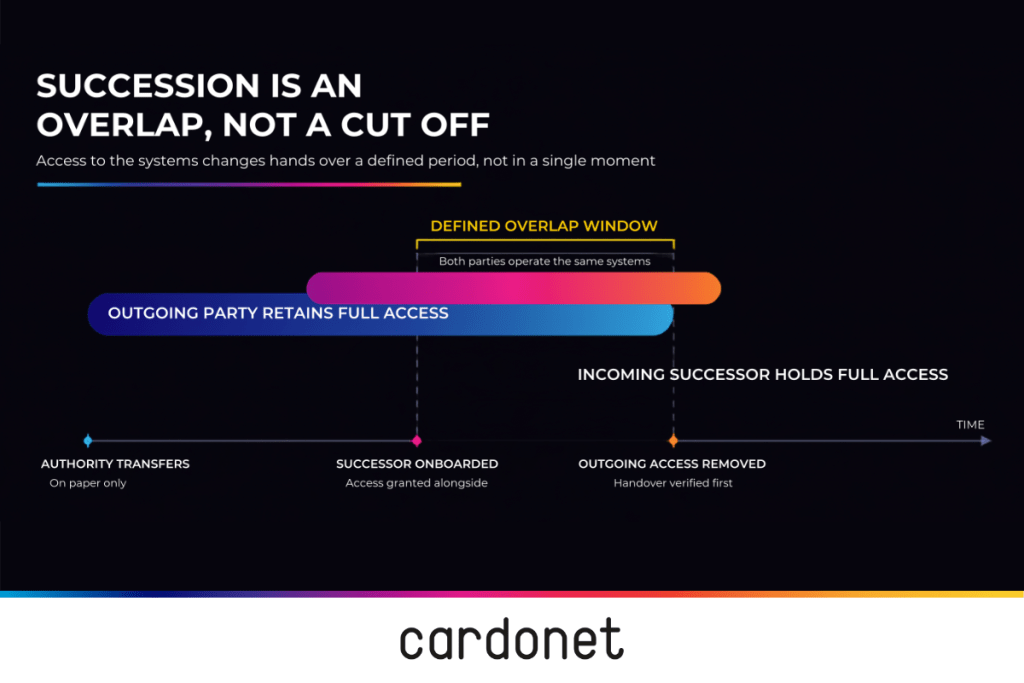
- Phased access handover, not an overnight switch. When a principal steps back or a successor takes on more responsibility, access should shift gradually and deliberately, with a defined overlap period where both the outgoing and incoming party can operate the systems together before full authority transfers. This mirrors the graduated engagement approach the J.P. Morgan reportfound family offices already use for investment education, more than three-quarters of families actively engage the rising generation before handing over full decision-making responsibility. There’s no reason system and data access should follow a less careful process than investment authority does.
- Governance that includes the technical layer explicitly. Family councils, investment committees, and formal bylaws should extend to naming who is accountable for privacy standards, backup verification, and system access review, not leaving these as informal tasks handled by whoever happens to be technically minded. Equiom’s research notes that independent oversight from fiduciaries, independent directors, and external advisers strengthens governance because it provides challenge and continuity beyond any single individual. The same principle applies to the technical foundation: an external partner who documents and maintains the systems provides continuity a single internal person cannot.
Where an IT partner fits without taking over
None of this requires a private office to build an internal IT governance function or add technical literacy to a succession committee’s job description. It requires a partner who treats documentation and access continuity as a permanent discipline, not a one-time handover exercise.
That is the role we take on at Cardonet for private offices. We maintain a documented systems register for every platform we manage through our managed IT services, so knowledge never lives in one irreplaceable person’s head. We run phased access transitions through our IT security services when a principal steps back or a successor takes on responsibility, giving both parties real operational overlap rather than a single abrupt cutover. And through our backup and continuity services, we sit as the external, documented layer that keeps privacy, access, and continuity standards, the foundations built across this series, intact regardless of who holds legal authority at any given moment.
What we don’t do is decide who should hold that authority, or how a family structures its governance. That remains entirely the family’s decision. We make sure that whoever holds it next can actually run the office the moment they need to, with full visibility into the systems, data, and access that authority is supposed to control.
A foundation built to outlast any one person
Across this series, the pattern has been consistent: privacy, resilience, and now governance all fail in the same quiet way, not through a dramatic breach or a single catastrophic event, but through knowledge, access, and responsibility that were never properly documented, tested, or transferred. A private office that gets these four disciplines right doesn’t just protect against today’s risks. It builds a technical and operational foundation that survives the one certainty every family office eventually faces: the people running it will change, and the systems need to be ready when they do.
With 86 per cent of family offices still lacking a clear succession plan, this gap tends to surface at the worst possible moment, during an unplanned transition rather than a chosen one, which is exactly when there is the least time to fix it.
Cardonet has managed phased leadership and system transitions for lean teams for over two decades, including for private offices navigating exactly this kind of handover.
A short review of your current systems register and access documentation is a practical way to see how prepared the office actually is before a transition forces the question.
This is Part 4 of a four-part series on how MSPs like Cardonet support the private offices of high-net-worth families. Part 1 looked at why private offices have become prime cyber and privacy targets, and why institutional-grade protection matters even for a tiny team. Part 2 turned to privacy and confidentiality in practice, where family data actually sits, and how to control it without turning daily life into a compliance exercise. Part 3 focused on uptime and resilience, covering the recovery objectives, tested backups, and genuine 24/7 support a private office needs to keep functioning through disruption. This final instalment closes the series by looking at governance and succession: how the technical, privacy, and continuity foundations built in Parts 1 to 3 need to change hands deliberately as family leadership shifts, rather than quietly falling apart.
FAQs
1. Why doesn’t legal succession planning cover IT and data access?
Because governance in most family offices develops around investment oversight first, since that’s typically what the office was created to manage, and only gradually extends outward. J.P. Morgan’s 2026 Global Family Office Report found 86 per cent of family offices still lack a clear succession plan for decision-makers, even where investment governance is well established.
2. What does “documented system ownership” actually look like in practice?
A simple systems register: one line per system, email, file storage, identity management, backup infrastructure, naming the platform, its owner, its purpose, and where access credentials and setup documentation are held. This ensures no single person’s memory is the only record of how a system works.
3. Should access transfer immediately when a successor takes over?
No, a phased handover with a defined overlap period works better. Both the outgoing and incoming party operate the systems together before full authority transfers, mirroring the graduated approach family offices already use for investment education, where over three-quarters engage the rising generation before handing over full decision-making responsibility.
4. Can a family office have strong governance and still have a technology succession gap?
Yes, this is a common and easy-to-miss situation. A family office can have a fully formal governance structure (investment committee, family council, documented bylaws) while still running on a completely undocumented, single-person-dependent system of access and technical knowledge underneath it.
5. What role does an MSP play in governance succession?
An MSP like Cardonet maintains a documented systems register, runs phased access transitions when leadership changes, and provides continuity for privacy and backup standards regardless of who holds authority. The family retains every decision about who holds that authority, the MSP ensures whoever holds it next can actually operate the systems from day one.


You must be logged in to post a comment.