
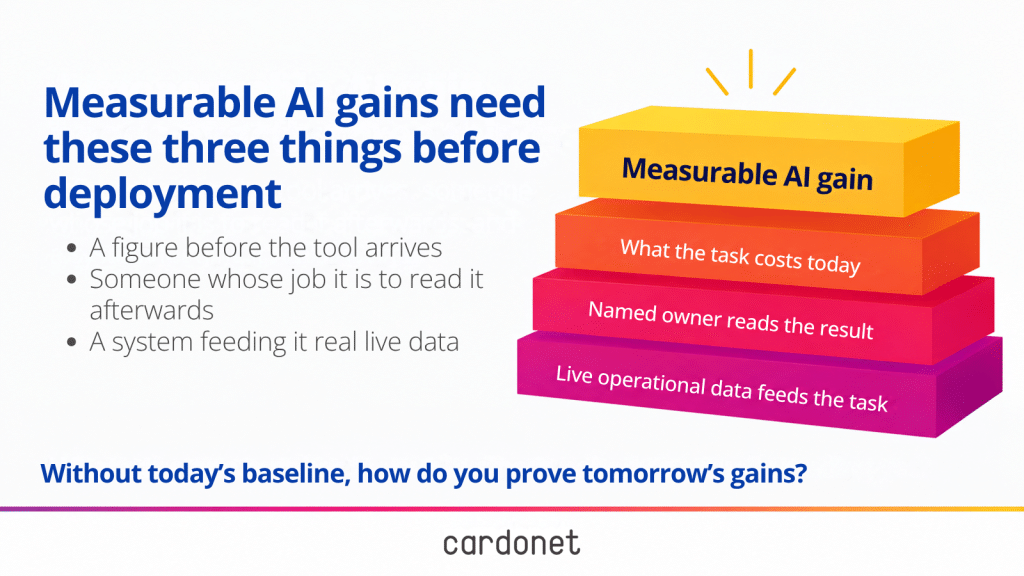
Much of the AI that hotels and restaurants are buying in 2026 will be hard to judge, because few businesses set a baseline, a named owner and clean data before they start. Put those three in place first and you can measure the return. Without them, you are paying for a subscription on trust.
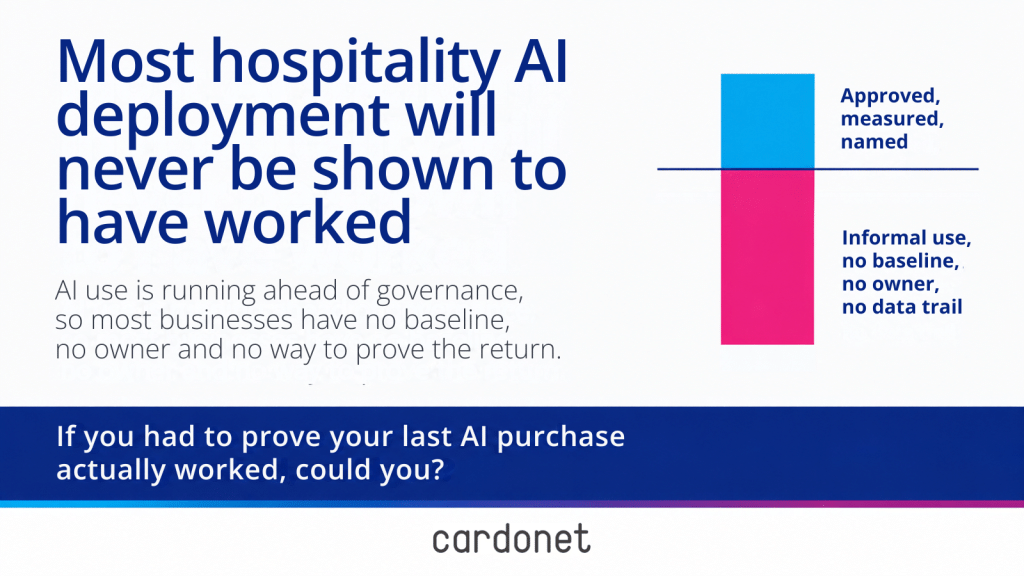
AI use is running ahead of governance
The Office for National Statistics (ONS) found that around 35% of UK businesses with 10 or more people report using at least one AI technology. The average adopter uses around 1.6 tools, and only 10% of adopters use AI extensively.
Individual use is much higher. The same ONS analysis finds that 55% of workers in Great Britain use AI for work or education, and it lists accommodation and food services among the industries reaching AI mostly through free software rather than a paid, managed tool.
Research commissioned by Microsoft and run by Censuswide in October 2025 found that, of 2,003 UK workers surveyed across sectors, 71% had used an unapproved consumer AI tool at work and 51% still did so every week. Only 32% were concerned about the privacy of the company or customer data they put into it.
Why that makes spending hard to judge
Taken together, those figures suggest AI use in hospitality is running well ahead of the rules around it. Most of that use has no baseline, no named owner reading the result and no record of what data went where, so nobody can say whether the tool made anything better.
There is a security cost too. IBM’s Cost of a Data Breach Report 2025, based on 600 breaches worldwide, found that breaches involving unsanctioned AI use added around $670,000 USD to the average cost. They exposed customers’ personal data in 65% of cases, against 53% across all breaches. The study is global and covers many sectors, although a hotel holding payment and identity data is the kind of business those figures describe.
Where guest data goes
A consumer AI tool takes whatever someone pastes into it. In a hotel that can be a booking export, or a complaint reply carrying a guest’s name and room number, going into a personal account under consumer terms with no log you can read afterwards. Your property management system (PMS) and point of sale (POS) permissions stop at the edge of each application, so they never see it happen. Where guest records go after they leave the PMS belongs in your General Data Protection Regulation (GDPR) compliance review.
What the best published evidence shows
The strongest support for this argument comes from a reinforcement-learning pricing system tested at a budget hotel chain, reported in the peer-reviewed Journal of Operations Management. It is one of the few published tests of an AI pricing tool run against a control group, rather than a supplier’s own before-and-after comparison. The system read booking and cancellation data and recommended discounts, which were turned into room allocations across guest segments.
Measured against a synthetic control across a pilot of five hotels in Shanghai, revenue per available room rose by 11.80% on average, which the researchers found statistically significant. Average daily rate and occupancy also rose, although neither was significant on its own.
Why the results varied by hotel
One hotel gained mainly through occupancy and another mainly through room rate, and the size of the gain differed from hotel to hotel. The researchers trace that spread to differences in each hotel’s demand pattern and decision-making, since the algorithm was identical at all five sites.
The pilot ran in 2015 at a Chinese budget chain, so it is old, outside the UK and outside the segment most of our hotel clients operate in. It is still the best published evidence I know of. It suggests that a tool given a baseline, a control group and live data can produce a measurable gain, and that the size of the gain depends on how each hotel acts on its recommendations.
Start with a baseline
If you cannot say what a task costs you today, in a unit you already track, a tool has nothing to be measured against. Our guide to measuring AI return sets out one way to write that baseline down before you spend anything.
Who answers for what a chatbot says
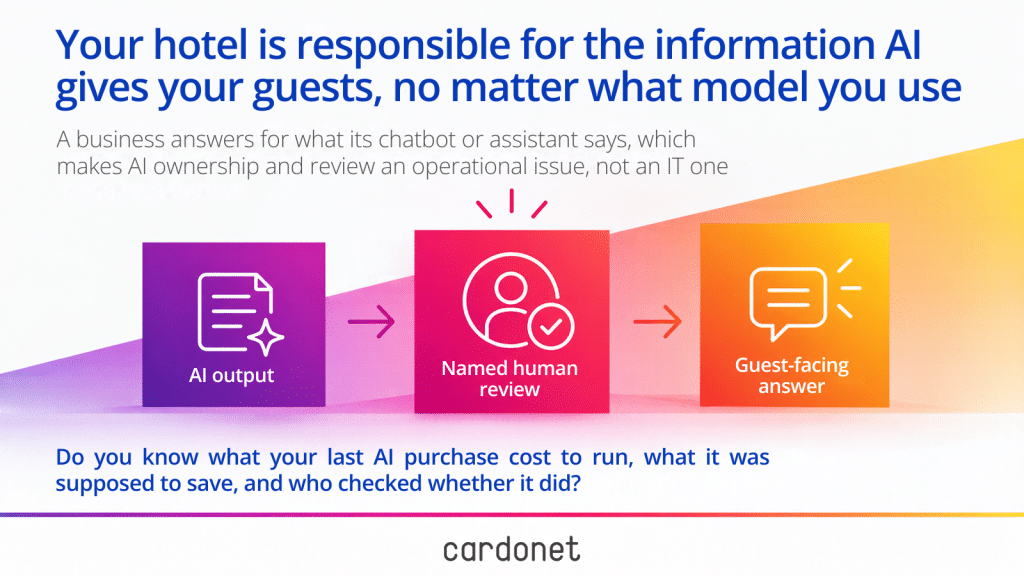
Skipping ownership also creates legal exposure. In 2024, a Canadian tribunal held an airline responsible for what its website chatbot told a customer about bereavement fares, and rejected the argument that the chatbot had made its own, separate statement. The ruling comes from a small-claims tribunal in British Columbia and does not bind UK courts, although its reasoning is easy to follow: a business answers for what its own website says, whoever built the model behind it.
A booking assistant that misquotes your cancellation policy falls under the same reasoning, and so does one that tells a guest with a nut allergy that a dish is safe when it isn’t. In both cases, nobody was assigned to check the output before a guest saw it.
Joined-up data comes before AI
Tools sold on a single view of the guest run into a similar gap. Guest history sits in one system and spend in another, and each holds a different idea of who the guest is. A tool asked to reconcile those records on the fly will return confident answers built on mismatches nobody has caught, because matching the records is integration work.
Our hotel IT support and restaurant IT support teams do that work directly, getting your PMS and POS to exchange data as designed before anything AI-branded goes live on top.
Five questions to ask before you sign
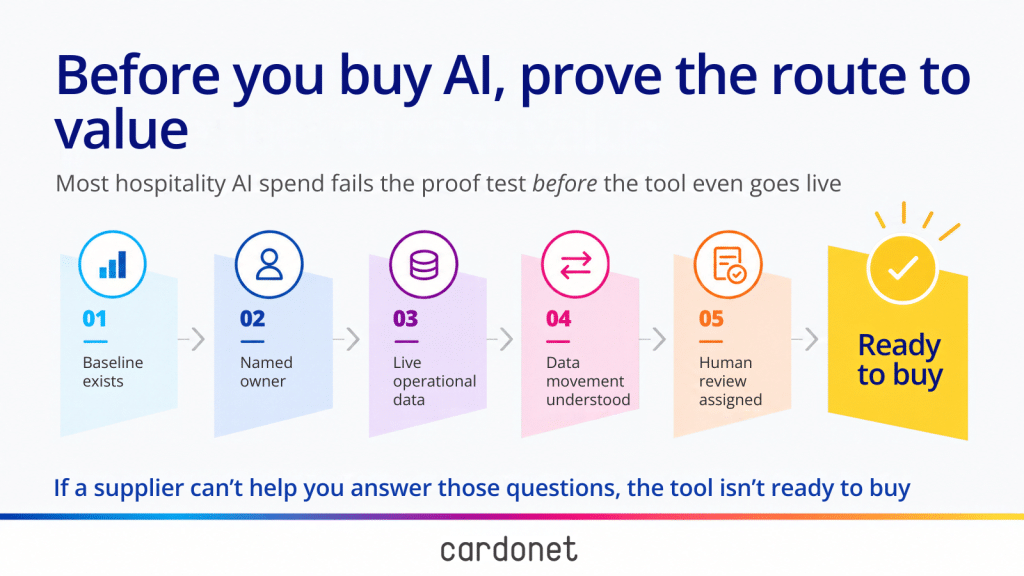
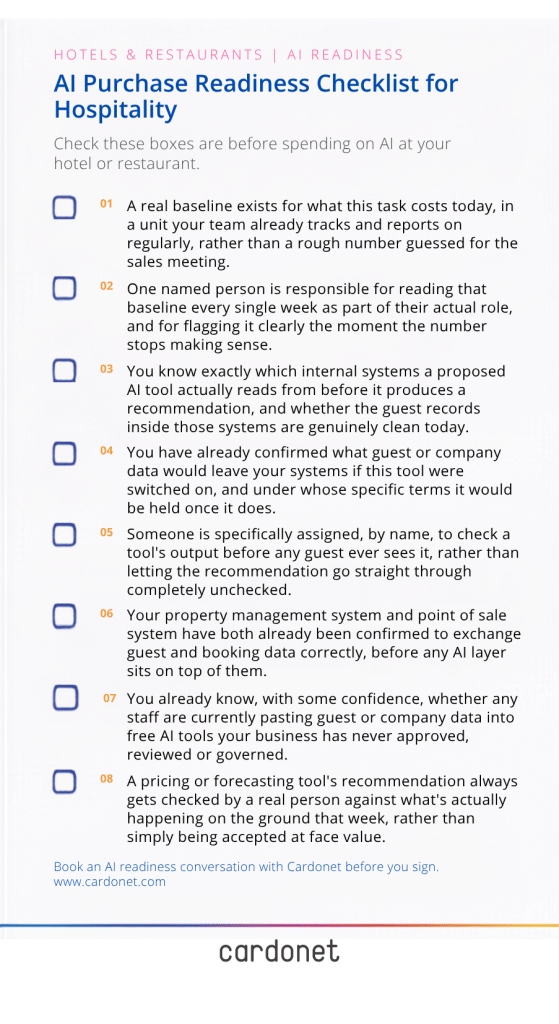
Before you buy, a supplier should be able to help you answer these five questions. If they can’t, the tool isn’t ready to buy.
- What does the task cost today, in a unit you already track?
- Who owns that number and reads it every week?
- Which systems does the tool read from, and how clean are their records?
- What guest or company data leaves your systems, and under whose terms?
- Who reads the output before a guest sees it?
Unsanctioned use fails all five before you spend anything. Microsoft’s research suggests people reach for free tools largely because no approved option exists. The fix is to provide one, on terms you have read and with access you control, so you have a record of who uses what and what goes in.
What we can and can’t promise
Nobody can promise you a competitive advantage from AI, and I would be wary of anyone who does, because the same tools are on sale to your competitors, often through the same supplier.
What we can do is help you put the baseline, the owner and the data record in place, so that whichever tool you buy, you can see whether it paid for itself. Book an AI readiness conversation with Cardonet before you sign your next technology contract, and we will start with the tools your teams already use.
Do you know what your last AI purchase cost to run, what it was supposed to save and who checked whether it did?
Frequently Asked Questions
1. Why do you say much AI spending in hospitality will be hard to prove?
Because most AI use has no baseline, no named owner and no clean data attached to it, so there is nothing to compare the result against. ONS figures put business adoption at around 35%, while individual use runs far ahead of that, mostly informal and outside any approved tool.
2. Which AI tasks are worth paying for?
The ones with a baseline figure before the tool arrives, a named owner who reads the result and a system feeding it live data. A peer-reviewed study of an AI pricing tool at five hotels found the same algorithm produced different results at each site, depending on each hotel’s demand and decision-making.
3. Could our hotel or restaurant be liable for something an AI chatbot tells a guest?
A UK court has not ruled on this directly, but in 2024 a Canadian tribunal held a business responsible for what its website chatbot told a customer. The safer assumption is that you answer for anything a booking or guest-facing assistant says on your site, as you would for a member of your team.
4. Should we block our team from using unapproved AI tools?
Blocking rarely closes the gap, because people reach for free tools largely when no approved option exists. Replacing the free tool with an approved one, on terms you have read and with access you control, closes the gap without assuming the usage will stop.
5. What should we check before signing an AI contract?
Ask what the task costs today in a unit you already track, who owns that number and checks it every week, and which systems the tool reads from. Then ask what data leaves your systems and under whose terms, and who reads the output before a guest sees it. If a supplier can’t help you answer those, the tool isn’t ready to buy.
Related articles by Raphael Waller
- Hotel Revenue Management Technology: As Important as Your PMS, From Day One
- 24/7 Restaurant IT Support: The Case for Always-On
- Break-fix is broken: why restaurant IT support must go proactive
- Restaurant Franchising and Technology: How a Brand Standard IT Model Protects Your Brand Across Every Location

You must be logged in to post a comment.