
Trustees answer to members for the promises a membership body makes, and technology carries nearly all of them. Five questions connect each promise to the cost line that pays for it.
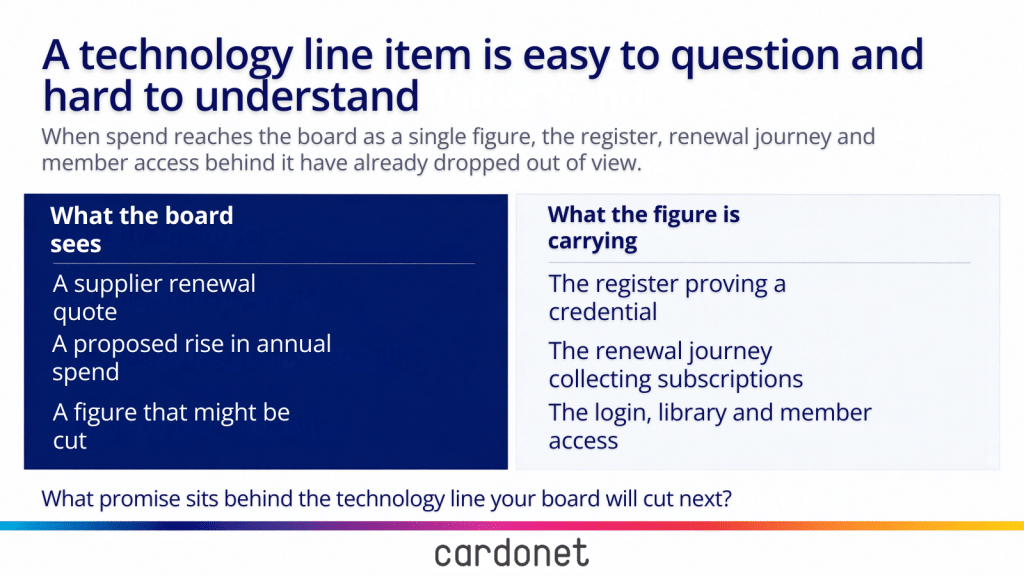
When technology reaches a board agenda, it usually arrives as a figure, such as a renewal quote, a supplier invoice or a budget line with a proposed increase. The discussion tends to focus on that figure, because every trustee can question a number: has it gone up, and could a cheaper supplier do the same job?
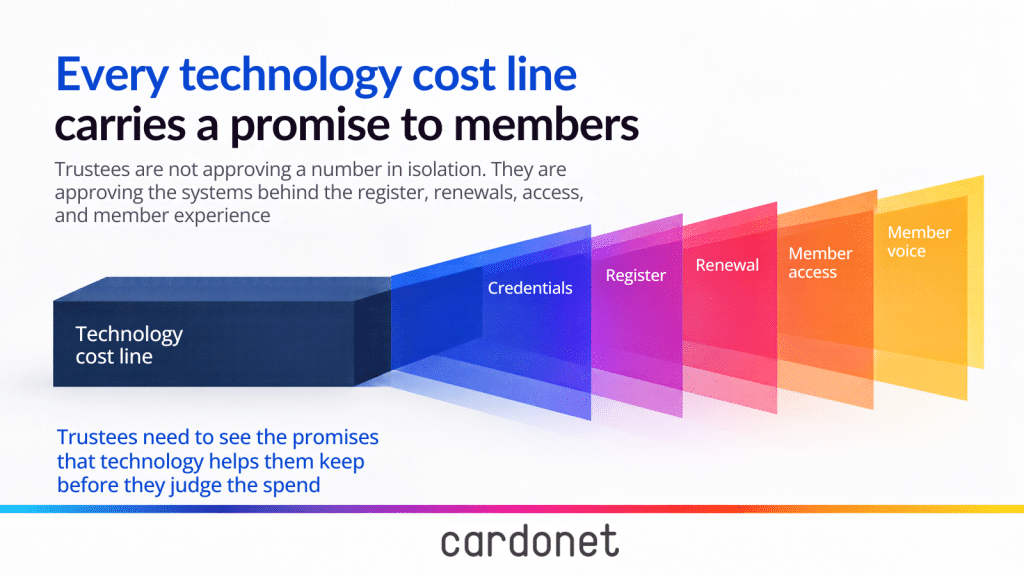
Both are fair questions, although neither shows what the money pays for. Behind the figure may sit the register that proves a member’s credential, the renewal process that collects subscriptions, the login that opens the member library or the mailing list that carries the body’s voice. Each is a promise the body made to the people who pay to belong to it.
What your members were promised
A membership body makes a small number of promises. A professional body promises a credential that employers accept and a register that proves it, while a trade association promises a voice with government and a view of its market. For a learned society, the promise is access to research and to the people doing it.
Each of those now runs through a system. The credential depends on accurate records, the register on a public page that stays online, the voice on a mailing list that reaches the right members and access on a login that works first time.
Four moments in membership carry most of what a member experiences: joining, the first login, reaching a benefit and finding community. If a member cannot log in on the morning a renewal window closes, the body has broken a promise, and that member will remember it when the next invoice arrives.
Why the cost line gets the attention
BHP’s summary of the Charity Digital Skills Report 2026, which draws on responses from 807 charities, reports that squeezed finances are the biggest barrier to digital transformation, affecting 63% of charities. The same summary finds that almost half lack a trustee with relevant digital expertise.
Under that pressure, and without a trustee who knows the systems, a board receives technology in the one form it can read, which is money. Its options then narrow to approving the figure or trimming it, and trimming tends to look like the careful choice.
How the promise drops out of the board pack
The executive team shapes this without intending to. A finance director prepares the board pack in the language of budgets, a chief executive turns a supplier conversation into a recommendation, and the risk register reduces a system to a name and a rating. By the time the item reaches trustees, the member promise behind it is rarely mentioned.
Where accountability sits
The Charity Governance Code, a voluntary good-practice framework for charities in England and Wales, was revised in late 2025. Trowers & Hamlins’ summary of the revision says the board is responsible for looking after the charity’s resources and identifying risks to its aims. It adds that the new edition suggests charities hold a policy on the use of technology and AI tools. Many membership bodies have other legal structures with duties of their own, although their boards carry the same practical responsibility to members.
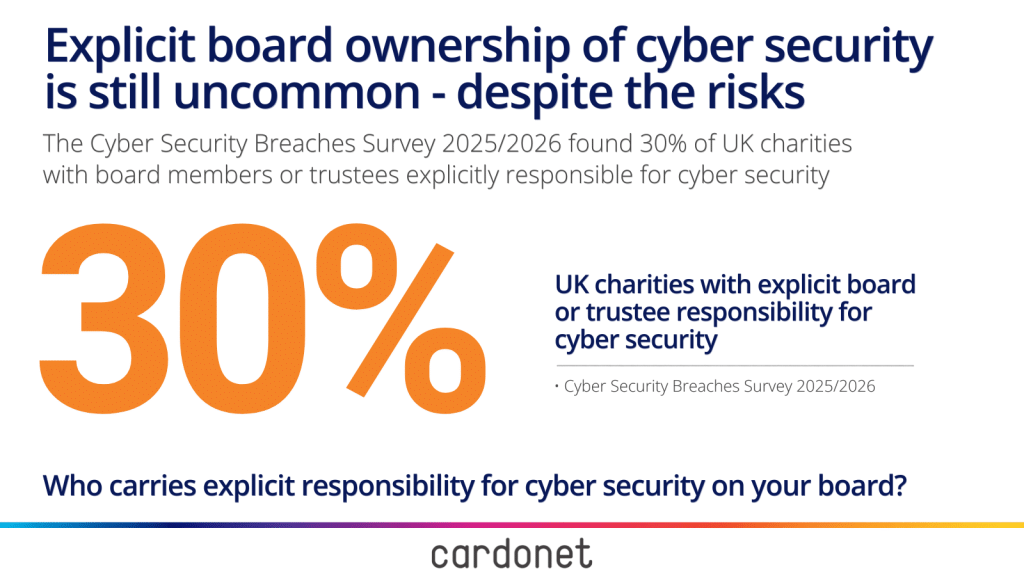
Government data shows how thinly responsibility for cyber security is held. In the Cyber Security Breaches Survey 2025/2026, 30% of UK charities had board members or trustees explicitly responsible for cyber security, a share that has held steady for three years. The proportion of charities calling cyber security a high priority for senior management fell from 68% to 60% in a year, driven by low-income charities.
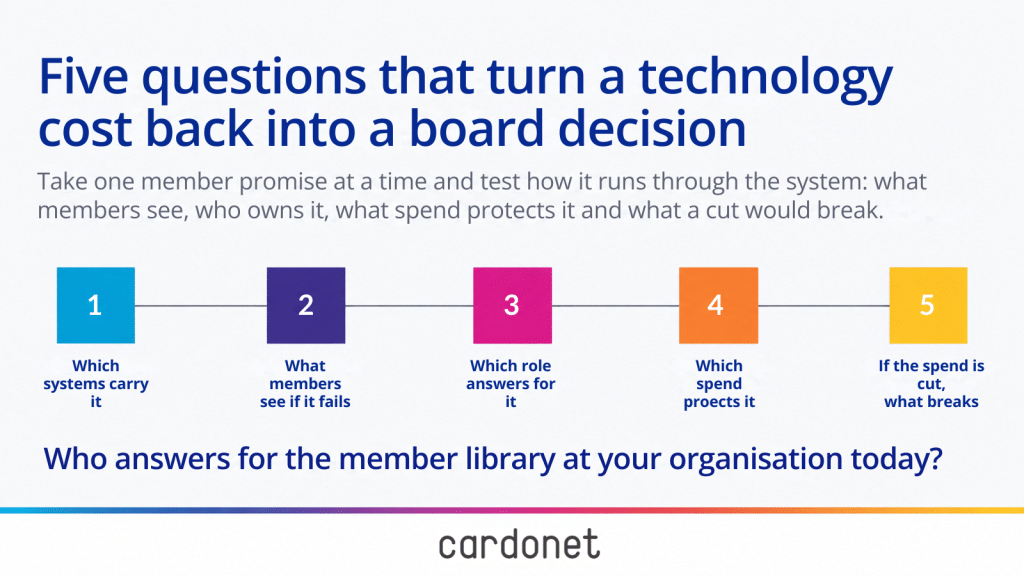
Five questions for each promise
Take one promise at a time, such as renewal or the register, and put these five questions to your executive team. None needs technical vocabulary.
- Which systems carry this promise? A renewal runs through the membership database, the payment provider, the reminder email and the login.
- What does a member see when it fails, and how soon? A broken renewal form shows within minutes, while out-of-date register entries can go unnoticed until an employer checks.
- Which role answers for it? The answer should be a named post inside the body, with a deputy.
- Which part of the cost protects the promise? Backups, monitoring, support hours and security controls often share a budget line with software subscriptions and hardware.
- If the spend is cut, which promise does the body stop making or accept breaking? The board should hear the answer before it votes.
When the cost line comes back
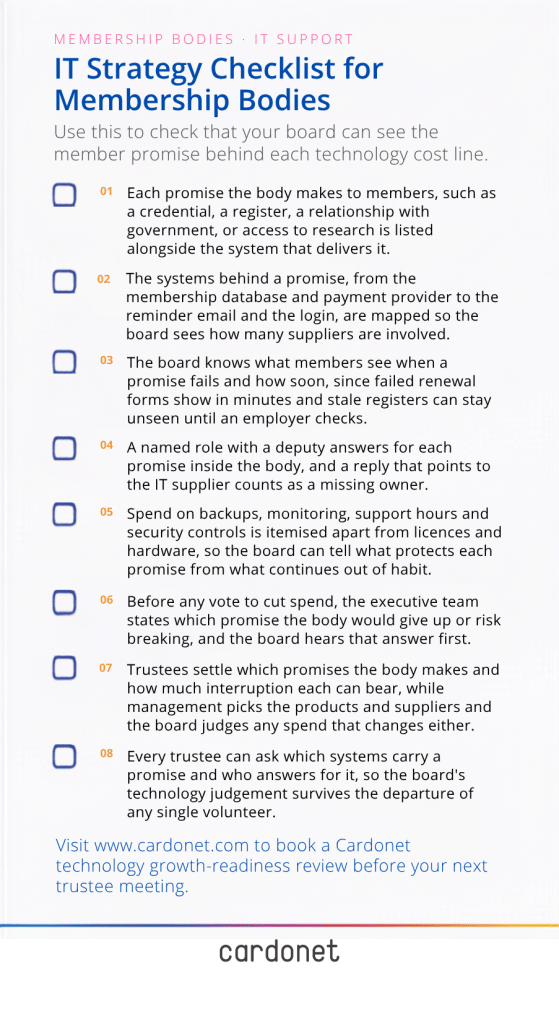
Once the promises are mapped, the cost line returns to the agenda as a decision. The board can see that a renewal quote protects the register and that a support contract stands behind the member portal, so trimming either means naming the promise that goes with it. That gives the board something specific to explain to members if it does decide to cut.
The board decides what the body promises, how much interruption each promise can bear and whether spend that changes either is justified, while management chooses the product and the supplier. Keeping those roles apart lets trustees ask hard questions without taking over the work. Whoever runs the system, you still answer to members for what the body promised them.
When a promise costs too much
Some answers will show that a promise costs more to keep than the body can afford. In that case the clearer course is to narrow the promise and tell members, even though members will notice and some trustees will resist it.
A board short of digital skills can add a technology trustee, which fills the gap but leaves the board’s technology knowledge with one volunteer, and the board loses it if that person steps down. Teaching every trustee to ask the five questions spreads that knowledge across the board, although it takes longer. A third route is Cardonet’s Virtual IT Director service, which gives the board an experienced IT lead to call on without adding a trustee.
Before your next trustee meeting
If the payment provider stopped responding on the last day of the membership year, which trustee could say what members were seeing, which role was working on it and how long the board had agreed that promise could stay broken?
Our IT strategy and advice service and IT support for charities cover the mapping and the support behind it. Book a Cardonet technology growth-readiness review before your next trustee meeting, and bring the five questions as the agenda.
Frequently asked questions
1. Does a board need a technology specialist to hold its technology spend to account?
No. Any trustee can ask which systems carry a member promise, what members see when one fails and who is responsible for it, because none of those needs technical vocabulary. A technology trustee adds skills but leaves the board’s technology knowledge with one volunteer, while teaching every trustee to ask the questions takes longer and spreads it.
2. Who is accountable when a supplier runs the system behind a member promise?
The board, because members hold the body to what it promised, whoever does the work. Naming a responsible role inside the body for each promise gives it an owner, and an answer that points to the supplier shows where an owner is missing.
3. Does the Charity Governance Code matter to a membership body with a different legal form?
The Code is written for charities in England and Wales, and other legal forms carry duties of their own. The board of any membership body still answers to its members for the promises it makes, so the Code is a useful reference. A body unsure of its position should take advice on its legal structure.
4. Where should a board start when reviewing the technology behind its member promises?
Go through the promises one at a time, such as the member library, the register or subscriptions and renewal. For each, ask the executive team which systems carry it, what a member sees when it fails, who answers for it, which part of the spend protects it and what the body would give up if that spend were cut.
5. Can a board still cut technology spend after asking what each cut would put at risk?
Yes, and the decision is better informed. When the board hears which member promise a cut would affect before it votes, trustees can act knowing the consequence and explain the choice to members. Where a promise proves too expensive to keep, the clearer course is to narrow it and say so.
Related articles
- Why Membership Bodies Underfund Technology
- From Spreadsheet to Scale: The Technology Turning Points Every Growing Membership Body Hits
- The Legacy System Trap: How Yesterday’s Membership Solutions Become Tomorrow’s Crisis
- Membership Bodies and Cyber Risk: Why You are a Target
- Cyber Essentials Certification for Membership Bodies: A Practical Roadmap



You must be logged in to post a comment.