
Why creative agencies need a different kind of IT support
If your agency keeps running into the same IT issues, the cause is usually structural. Most IT support is built for a steady, predictable office, while your agency is built to produce work under deadline pressure.
When tickets go missing, the Wi-Fi drops or a render fails overnight, the usual response is tighter change control and a stricter ticketing process. Six months later you are still dealing with the same urgent requests, because neither change touched the cause.
Many managed service providers (MSPs) design their service around predictability, with a fixed ticket queue, scheduled maintenance windows and change requests approved a week ahead. That model suits a business whose workload looks much the same from one week to the next. A creative agency can sit quiet for three weeks and then take on two pitches, a shoot and a client launch within the same two weeks.
Deadlines arrive in bursts
Creative production doesn’t move at a constant pace, and more process documentation won’t change that. A pitch deadline compresses weeks of planning into 48 hours. On a shoot day you need every workstation, every terabyte of storage and the render farm working at once, although the following week you may need almost none of it. When a client launch goes live, a quiet Thursday can become the most important afternoon of the quarter.
A fixed queue works through tickets in the order they arrive. If your render deadline sits behind someone’s printer fault because the ticketing system cannot tell that the render matters more today, the delivery date slips and your client sees the work late.
Workarounds become the support model
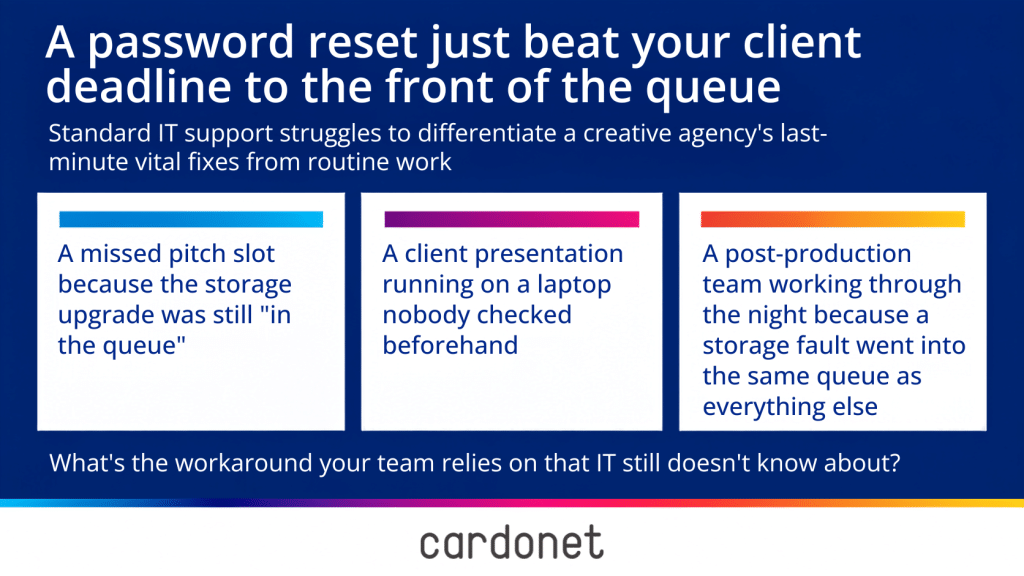
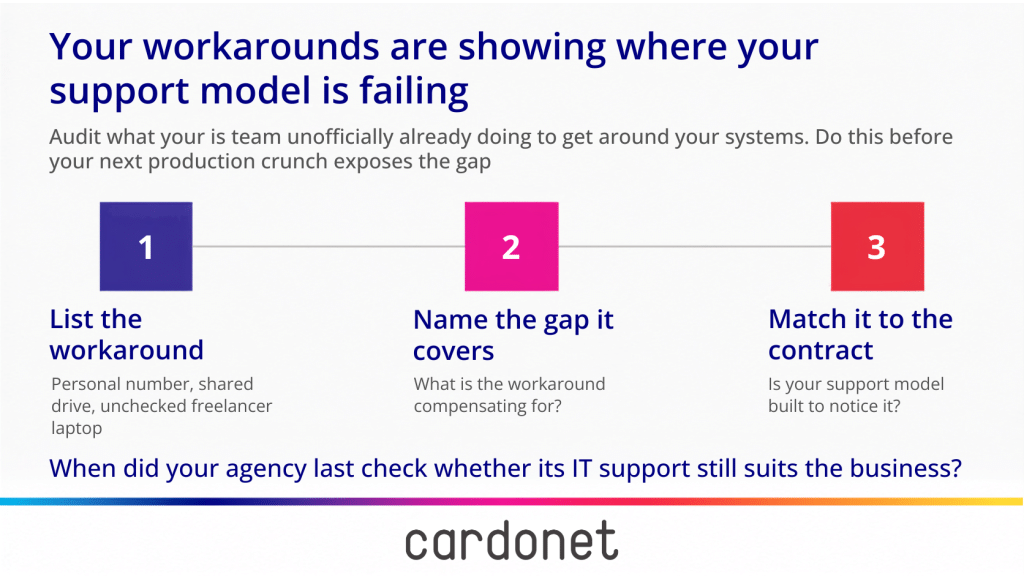
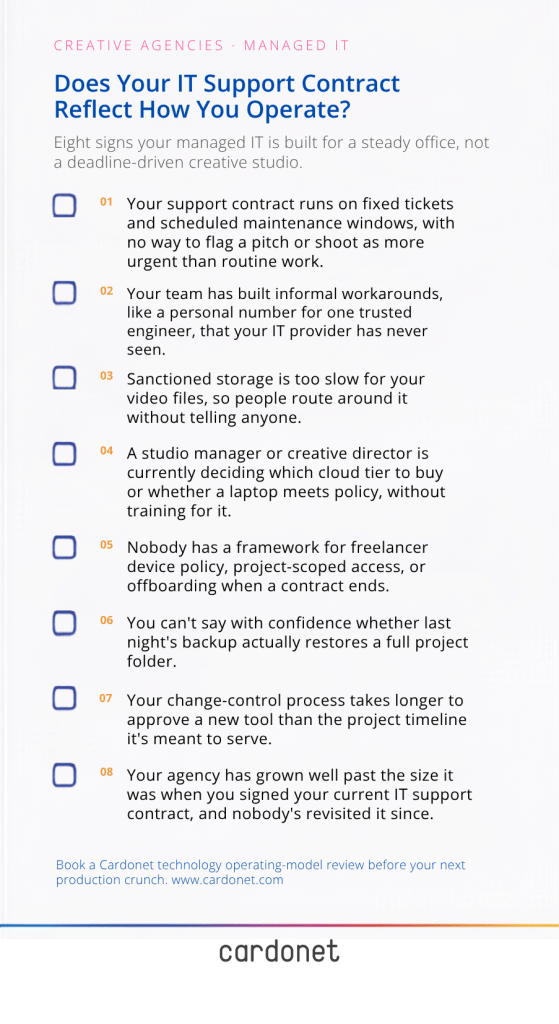
Agency teams usually deal with this themselves, through informal workarounds their IT support company never sees. Your studio manager keeps a personal number for the one engineer who will take an urgent call outside the queue, and people learn which requests to raise formally and which to handle another way. Over time those workarounds become the support your agency relies on, even though nobody responsible for IT can see them.
The cost shows up as missed pitch slots, client presentations run on a laptop nobody checked beforehand and post-production teams working through the night because the queue treated their job like any other ticket. Most agencies write that off as a bad week, when the cause is a support model that counts tickets closed and has no measure for whether the work went out on time.
Why your team works around IT
Shadow IT means any tool or service your team adopts without IT’s approval, such as a personal cloud account or an unapproved file-sharing service. In most agencies it starts because an approved system could not do what a project needed in the time available, so someone found a tool that could. The same few gaps tend to push teams there:
- Approved storage is too slow for large video files
- Change control takes a week to approve a tool for a project that runs for three days
- A security policy written for a fixed office has no quick route for a freelancer who joins on Monday and needs access that morning
Fix the reason behind each workaround
Each workaround looks small on its own. Together they leave your agency running production work on tools nobody vetted, backed up or secured, so the protection of your creative assets depends on whichever tool someone picked that week.
You can ban the workarounds, but bans rarely hold unless you also fix the reason each one exists. In practice that means storage that copes with the file sizes you work with, approvals measured in hours and a documented route for adding a freelancer quickly.
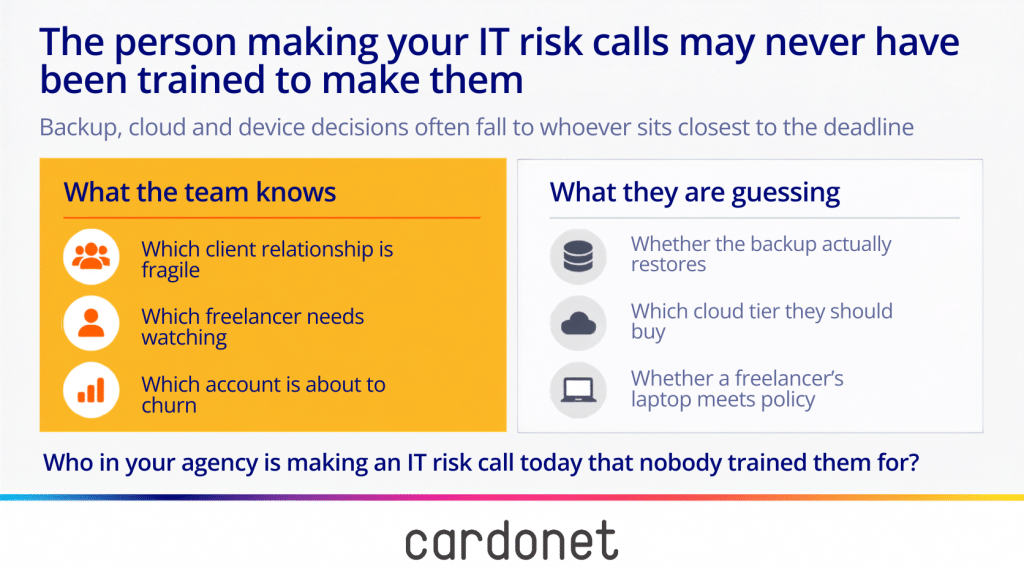
Your studio manager is making IT decisions
In most creative agencies a studio manager or creative director ends up making technology decisions they were never trained to make, such as:
- Which cloud storage plan to buy
- Whether a freelancer’s laptop meets policy
- Whether last night’s backup ran
- Which unapproved tool to allow because the deadline won’t wait
They make good calls under pressure because that is their job, although weighing IT risk takes a different set of skills and nobody trained them for it.
Your studio manager can tell you from memory which client relationship is fragile and which freelancer needs watching on a deadline. Whether last night’s backup would restore a full project folder is a different matter, and often nobody has tested it. Your IT partner should test that restore on a schedule, so you know the answer before you need it in a crisis.
Freelancers multiply those decisions
Just under a third of the UK creative workforce is freelance, close to double the rate across the wider economy. As we cover on our onboarding and offboarding page, each of those freelancers needs a decision about their device, access limited to the project and an offboarding step when the contract ends. Someone in your building is making those calls today, usually without a framework.
IT support built around production
Support that fits a creative agency follows your production schedule. At Cardonet that means:
- Engineering time planned around your shoots, pitches and launches, with less booked in quiet months
- A 24/7 service desk staffed by our own engineers, so a launch-day outage at night reaches someone who can fix it
- Mac-fluent engineers who take on the decisions your studio manager shouldn’t carry alone, from freelancer device policy to whether last night’s backup can be trusted
- Change control fast enough to approve a tool within the life of the project that needs it
Of our 76 people, 62 are technical experts, which means the person who answers your call can usually fix the issue themselves. Across more than 140 clients, our service level agreement (SLA) achievement is 98%.
Structure and speed still trade off
None of this removes the tension at the heart of running technology for a creative business. Structure slows experimentation down at times, and a security policy that protects your client’s intellectual property (IP) will occasionally stop someone installing the plugin they wanted for tomorrow’s pitch. You and your IT partner have to decide where that friction is worth it and where it slows the work more than the risk justifies.
The right answer depends on your size and the work you take on. A 50-person agency living on 48-hour social turnarounds can run looser change control than a 150-person agency holding client payment data and IP under an enterprise retainer.
Getting the balance wrong costs you whichever way it tips. With too little structure, one lost laptop can become a breach conversation with a major client, while too much structure leaves your team fighting the approval process in launch week.
Check whether your IT still fits your agency
Most agencies inherit these settings from a standard support contract and never revisit them. An agency that has grown from a five-person studio into a 50-person business with three enterprise retainers is often still running the IT it set up as a studio, and the mismatch usually goes unnoticed until something breaks.
If your workload changes from week to week and your IT support does not, book a technology review with us before your next production crunch. We will show you where your current setup is costing you time and what it would take to fix it.
FAQs
1. Why doesn’t a standard managed IT contract work well for a creative agency?
Many managed service provider (MSP) contracts are built around predictability, with fixed ticket queues, scheduled maintenance and change requests approved a week ahead. A creative agency’s workload swings from quiet weeks to a pitch, a shoot and a client launch landing within two weeks, and a fixed queue has no way to treat that spike as more urgent than routine work.
2. What is shadow IT, and why do creative teams use unapproved tools?
Shadow IT is any tool or service a team adopts without IT’s approval. In creative agencies it usually shows up as personal cloud storage or an unapproved file-sharing service, and it happens because approved systems and change control are too slow for projects measured in days.
3. Who typically ends up making IT risk decisions inside a creative agency?
Usually a studio manager or creative director, because most agencies have nobody whose job covers infrastructure. They are skilled at judging production risk, although weighing IT risk takes different skills and nobody trains them for decisions like device policy or backup testing.
4. Does an agency’s use of freelancers affect its IT support needs?
Yes. Just under a third of the UK creative workforce is freelance, close to double the rate across the wider economy, according to DCMS figures for July 2020 to June 2021. Every freelancer joining a project needs a device decision, access limited to the project and an offboarding step, so that volume of one-off decisions needs a framework agreed before deadline pressure hits.
5. What does IT support built for a creative agency’s production cycle look like?
It includes engineering time planned around shoots, pitches and launches, a 24/7 service desk that treats a launch-day outage as urgent, and change control fast enough to approve a tool within the life of a project. Structure and speed still trade off against each other, so the aim is to decide deliberately where an approval step is worth the delay.


You must be logged in to post a comment.