
AI and Your Team: Addressing the Fear Before the Rollout
The people whose work artificial intelligence (AI) does best have the most reason to worry and to hide the fact that they use it. They are also the people who handle the invoices, payroll files and the lists of guests a hotel can least afford to lose. Telling them what will change, before you announce any rollout, lets you see the tools already in use. If you say nothing, the people who worry the most will decide for themselves what to do with those tools.
Exposed tasks add up to exposed jobs
Because a job is a bundle of tasks, a task that AI can do is a task your team could lose, and they already know it. In May 2025 the International Labour Organization (ILO) scored thousands of tasks for how much of each generative AI could do, and clerical occupations came out with the highest exposure worldwide. In a hotel, that describes matching supplier invoices to purchase orders, preparing the payroll run, drafting rate and availability emails, and writing guest follow-up mailings.
When most of a role’s hours sit in tasks like those, the owner will eventually ask whether the role itself needs the same hours. That question tends to be answered as a vacancy that goes unfilled or a part-time contract that stays that way.
The ILO adds a limit, since its index measures potential exposure and it expects most jobs to change shape because most jobs still contain tasks that need a person. Even so, a job that changes shape can still need fewer hours, and your team can work that out for themselves.
Which hotel roles are exposed
I found no UK source that ranks hotel roles specifically, so I used an April 2026 Hospitality Net report which asked eleven hotel and technology executives which roles AI would shrink or reshape first.
Most pointed to two areas, reservations with guest messaging, and back-office finance and administration. Several added revenue analysts, and one named the coordinator roles in sales and marketing. Two of them said physical and kitchen work, such as housekeeping, maintenance, banquets and chefs, would stay human longest. These are executives’ opinions, and two of them expected little change in hotel headcount in the near term.
Together with how a hotel runs day to day, that evidence points to three groups.
- Reservations and guest messaging teams, accounts payable, payroll and other finance and human resources (HR) administration, revenue analysts and the sales and marketing coordinators are the most exposed.
- Revenue managers, finance managers and general managers are likely to be reshaped, because two of the executives expected AI to produce the numbers while these roles question them.
- Housekeeping, maintenance, banquet teams and the kitchen are the least exposed.
The executives disagreed about what will happen with the reception function, so I have left it out of these groups. One expected kiosks and phone-based check-in to shrink it in city hotels, and another expected the first changes to land elsewhere.
Which hotel roles work around your rules
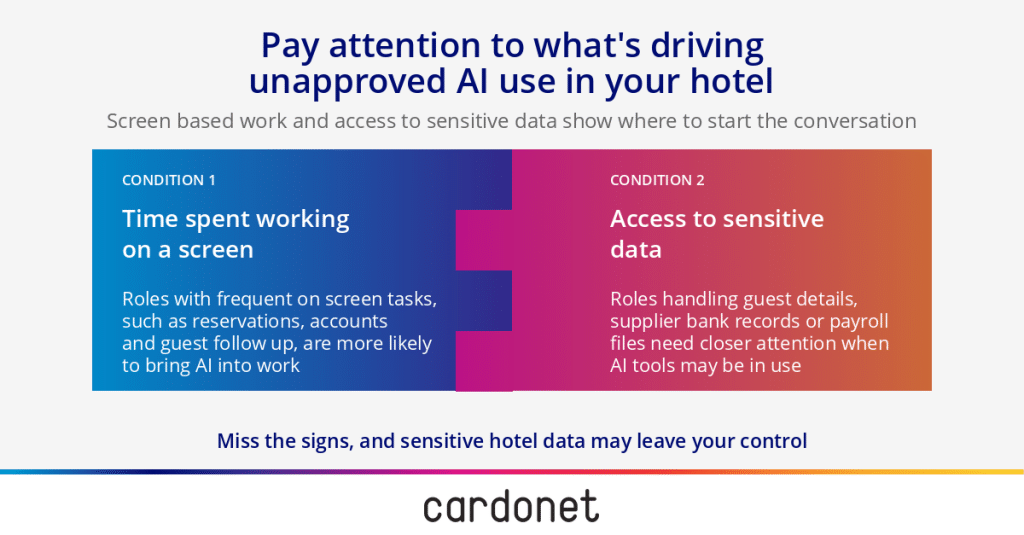
People work around rules when they have two things, time at a keyboard and access to data. That makes the most exposed roles, and the managers above them, the main risk.
TrustedTech surveyed 2,001 people in the UK and US. The survey, reported in September 2026, found unapproved AI tools in use among 59% of people in finance and 58% in HR, against 73% in information technology and telecoms. TrustedTech also asked whether people would keep using the tools if their employer banned them and breaking the ban could lead to discipline. In finance 41% said they would, against 21% in retail, catering and leisure, which is the closest the survey comes to hotel front-line work and the group least willing to ignore a ban. None of the figures covers hotels alone.
Microsoft’s October 2025 survey of 2,003 UK workers, conducted by Censuswide, found 71% had used consumer AI tools that their employer had not approved. They used them to draft and respond to workplace communications (49%), to draft reports and presentations (40%) and for finance-related tasks (22%). In a hotel that means the accounts clerk’s replies to suppliers, the sales coordinator’s proposals to corporate accounts and the revenue manager’s rate commentary, which is where the data sits.
What those roles hold
Those roles also hold the most sensitive data. Sales holds guest and corporate-account contact details and negotiated rates, accounts holds supplier bank details and statements, and payroll holds names, salaries and tax details. Once any of it is pasted into a consumer service, it is likely to leave your control, which is the mechanism the National Cyber Security Centre (NCSC) described in a September 2026 blog. Consumer AI services may store the information, retain it or use it to improve the service, outside the controls you have set. Cardonet’s hotel cyber security service and our guidance on safeguarding guest data cover the protection side of those files. We hold ISO 27001 information security and Cyber Essentials certification.
Why the fear produces hiding
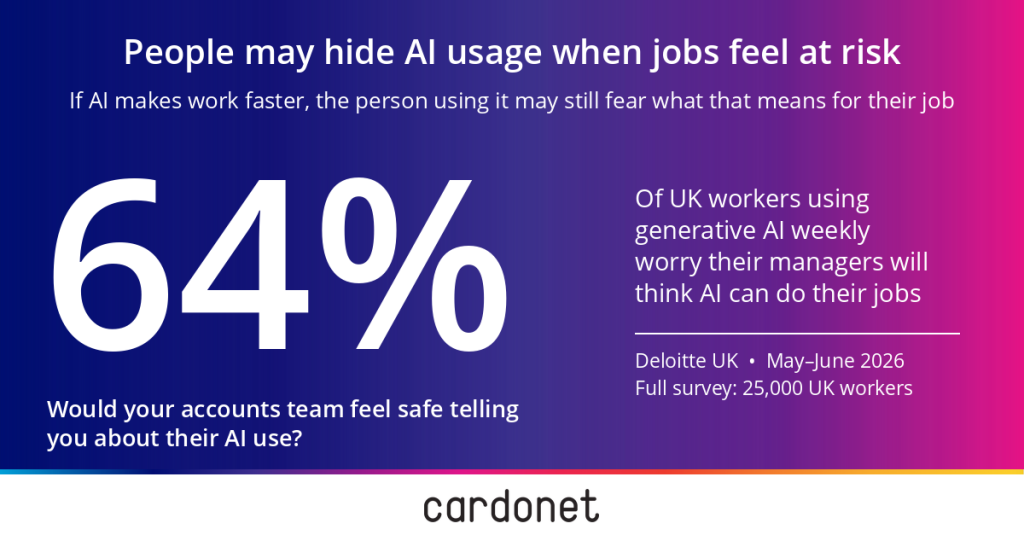
In May and June 2026 Ipsos fielded Deloitte’s survey of 25,000 UK workers, which Deloitte published that September. It found that 64% of people who use generative AI weekly worry their managers will think the tool can do their jobs. It also found that 31% of people using it do so without their employer’s knowledge, and that most of the time saved goes on doing more work for the same employer. Deloitte’s chief AI officer says workers who feel a stigma around the tools are more likely to conceal their use.
Those findings can meet in one person in a hotel office. A clerk who clears supplier queries in a fraction of the old time gains the most from the tool. Because a manager who hears how quickly the work was done may start counting hours, that same clerk may expect to lose the most by saying so.
How to run the change
The Chartered Institute of Personnel and Development (CIPD), the UK professional body for HR and people development, published guidance on AI skills planning in April 2026 that treats AI as a change to manage. I have applied it to a hotel in five steps.
1. Ask who wants to try AI before you test anyone’s skill
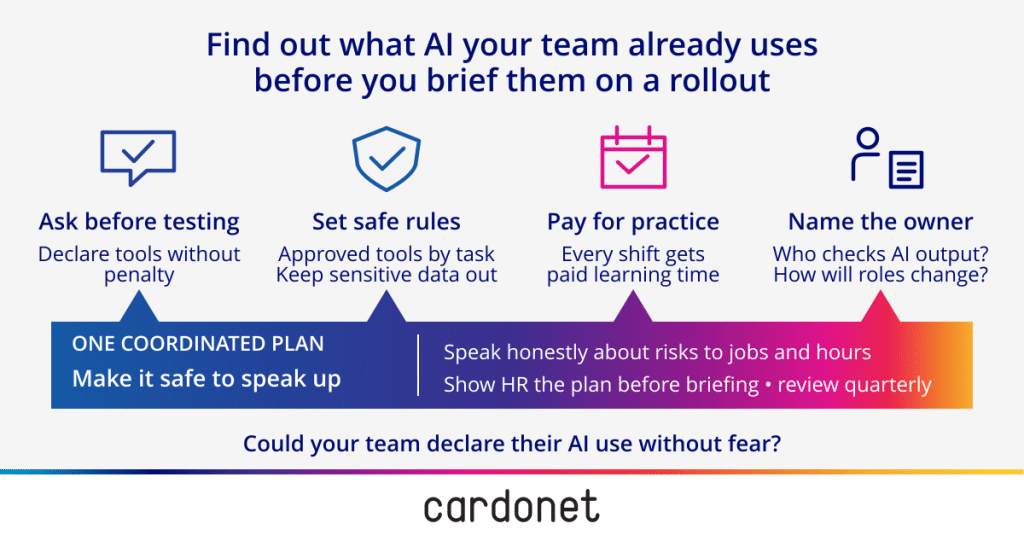
CIPD advises running an informal audit built around the question “who wants to try out AI?”, because a skills test can signal that the decision to adopt AI is already made. The same audit shows who is already using AI in secret. In a hotel, start with the accounts, payroll, reservations and sales teams, and offer a set period in which anyone can declare a tool they already use without penalty. Before you announce anything, agree the terms, because people will trust that offer only after the first person to declare has come through it unharmed.
2. Publish a short rule and an approved tool for each task
List the approved tools and the data that must never go in, which means guest payment details, supplier bank details and payroll files. CIPD advises light rules with clear no-go areas for personal data. The NCSC’s September 2026 advice is to find out why people use unapproved tools and give them an approved alternative, because use is unlikely to disappear completely and the goal is to reduce the risk. In Microsoft’s October 2025 survey, 41% said the tool is what they use in their personal life and 28% said their company provides no approved option.
3. Give everyone a safe place to try the tools, on paid time
CIPD recommends approved practice spaces on company time, open to people who are not already confident with technology, so that everyone in the building gets the same chance to learn the tools. Night and weekend shifts miss daytime sessions, so put the practice into each shift’s schedule.
4. Name the tasks, the owner and the new job
Say which tasks the tool will take on, such as invoice matching or the payroll run, and name the person who answers for its output. CIPD warns that training people on a tool changes little if the job around it no longer makes sense. In a hotel, decide what the accounts payable job becomes once matching is automated, with exception handling and checking the tool’s output as the likely answers. The junior ledger role needs a plan too, since it teaches the next finance manager the trade and CIPD notes that automating entry-level work removes that route up.
5. Say what you do not yet know, and set a review date
CIPD advises having a management position ready on automation and job losses, and ideally a published policy on support for tasks that change or go. Because AI change now moves in months and quarters, it warns that an annual plan is likely to be out of date before it is finished, and it suggests reviewing every quarter.
Employment terms sit outside my remit. The Advisory, Conciliation and Arbitration Service (Acas), the UK public body that advises on workplace relations, noted in guidance published in April 2025 that expecting certain roles to start using AI could mean a change to their terms and conditions. Before it reaches the team, I would show the plan to your HR specialist.
If you would like a second view before you announce anything, we can run an AI readiness conversation with you, alongside our 24/7 IT support, cyber security and cloud services. We would start with the tools your teams already use and the tasks you expect the new one to take on. Book an AI readiness conversation with Cardonet before you tell your team a rollout is coming.
What stays open
The hardest part of those steps is saying what you do not yet know about hours. If you cannot yet say whether hours will change, saying so may confirm what your accounts team most feared, and a few will keep using free tools anyway. Saying nothing leaves the same fear in place and gives people no stated terms to judge it by. I cannot point to a study showing which message keeps hidden use lower for longer in a hotel, and by the time one exists the tools will have moved again.
When you name the tasks that will change, which will you say aloud first, the invoice matching or the payroll run, and who in the room will hear it as a verdict on their job?
Frequently asked questions
1. Which hotel roles are most exposed to artificial intelligence (AI)?
When an April 2026 panel of eleven hotel and technology executives named the roles AI would shrink or reshape first, most pointed to reservations with guest messaging and to back-office finance and administration. Accounts payable, payroll, revenue analysts and sales and marketing coordinators sit in that group, while housekeeping, maintenance, banquets and the kitchen are the least exposed. The executives disagreed about reception.
2. Will AI cost my team their jobs?
Because a job is a bundle of tasks, a task that AI can do is a task your team could lose. Most jobs still contain work that needs a person and will change shape, but a changed job can still need fewer hours. Tell your team plainly what you expect, since they have probably worked out the risk already.
3. Why would my team use AI tools without telling me?
Deloitte’s survey, fielded in May and June 2026, found that 64% of people who use generative AI weekly worry their managers will think the tool can do their jobs. A clerk who clears supplier queries in a fraction of the old time may expect to lose the most by saying so, because a manager who hears how quickly the work was done may start counting hours. Even when a manager says nothing, people can reach that conclusion.
4. What data should never go into a consumer AI tool?
Keep guest payment details, supplier bank details and payroll files out of it. Once data is pasted into a consumer service, it is likely to leave your control, and the service may store it, retain it or use it to improve the tool. Publish a short rule and an approved tool for each task so that people have a safe option.
5. How should I tell my team about an AI rollout?
Before you test anyone’s skill, ask who wants to try AI, and offer a set period in which people can declare tools they already use without penalty. Then name the tasks the tool will take on, the person who answers for its output and what each job becomes, and say what you do not yet know about hours. Show the plan to your human resources (HR) specialist before it reaches the team, because expecting roles to use AI can change their terms and conditions.
Related articles by Raphael Waller
- Hotel Revenue Management Technology: As Important as Your PMS, From Day One
- 24/7 Restaurant IT Support: The Case for Always-On
- Break-fix is broken: why restaurant IT support must go proactive
- Restaurant Franchising and Technology: How a Brand Standard IT Model Protects Your Brand Across Every Location

You must be logged in to post a comment.