
Membership bodies run on the basis of keeping overheads low while keeping member trust high. This instinct generally serves them well, but it does mean that they tend to underfund technology which, quietly and when applied without distinction, erodes the very systems the mission depends on.
Trustees will spend an entire afternoon debating a five-figure grant application. The technology budget gets nodded through in the last ten minutes of the meeting, usually because everyone is tired and the WiFi in the room is already playing up.
The instinct behind technology underinvestment
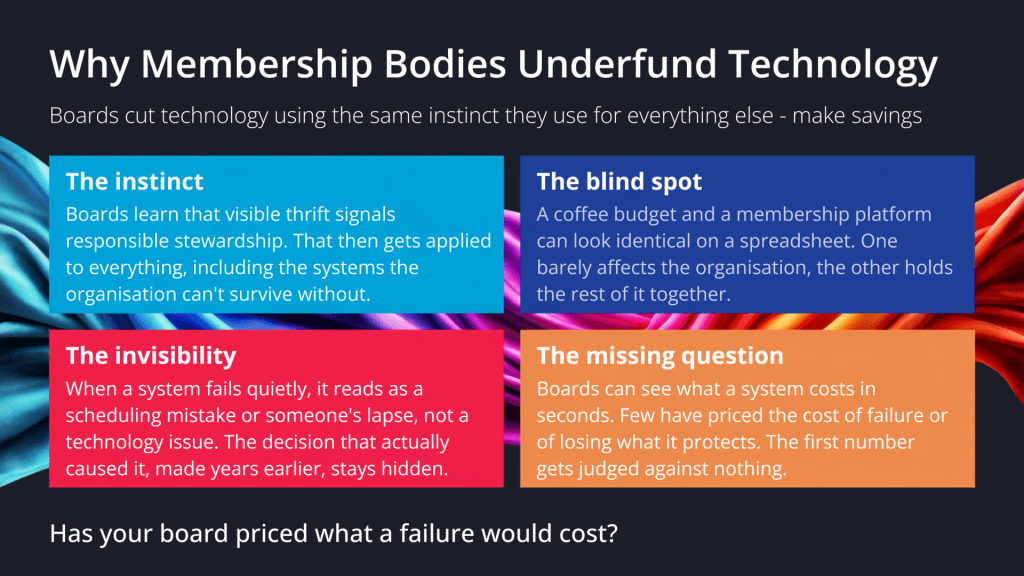
Membership organisations run on a particular kind of public trust. Members and donors want confidence that their subscriptions and gifts pay for the work itself rather than head office overheads, and boards have learned, correctly, that visible thrift signals responsible stewardship.
The trouble is that this signal gets applied indiscriminately. Cutting the office coffee budget and cutting the budget for a properly resourced membership platform look identical on a spreadsheet, even though one has almost no bearing on the organisation’s survival and the other has everything to do with it.
NCVO’s 2024 UK Civil Society Almanac put the share of the voluntary sector’s spending going on direct charitable work at close to 80%, a figure that barely shifts between the smallest organisations on the register and the largest. That figure is doing more work than it first appears to. Sector-wide consistency of this kind rarely happens by accident. It happens because the same cultural pressure is landing on every board, regardless of budget, and technology spend is one of the quietest places that pressure gets absorbed.
Cardonet’s ongoing work on charity IT solutions turns up a version of this story at almost every organisation, whatever its size: a board that never sat down and decided technology was low priority, and yet somehow arrived at exactly that outcome anyway.
Sit with that for a moment. If no single decision produced it, the underinvestment cannot be undone by a single decision either. It has to be examined, deliberately, the way any other governance risk would be.
The failures no one traces back to their cause
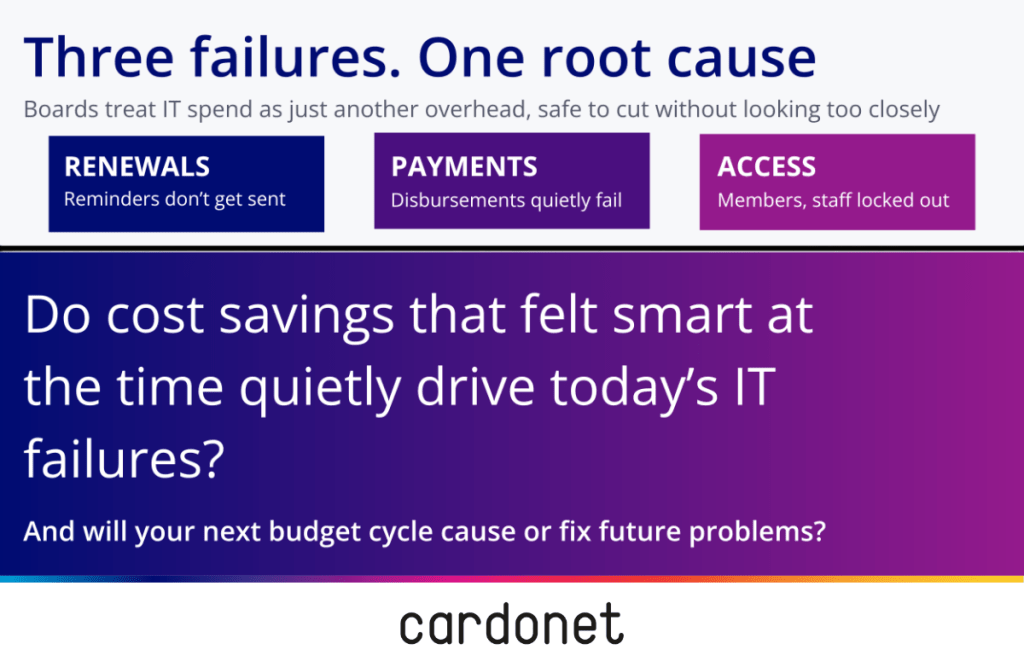
If a regional conference booking system quietly stops sending confirmation emails three weeks before the event the gap can go unnoticed until members start turning up without a ticket and front-of-house staff are left improvising on the day. A grants administrator, working from a spreadsheet no one else can follow, can miss a deadline because the reminder she used to rely on lived in a personal calendar that changed when she updated her phone.
Neither of these looks like a technology story when it happens. Each looks like a scheduling mistake, or a lapse in someone’s attention, and gets filed away as exactly that. What connects them, almost always, is a decision made further back: a platform that was never upgraded because the upgrade would cost more than the board wanted to justify that year, and a workaround that quietly became the real system while being called “temporary.”
This is where the real cost of underinvestment hides. Comparing this year’s technology line against last year’s tells your board very little about how close the organisation is sitting to a genuinely damaging failure. If the small warning signs never get traced back to their source and the large failure has, so far, simply not happened, the bill lands all at once when it does.
A different way to weigh the spend
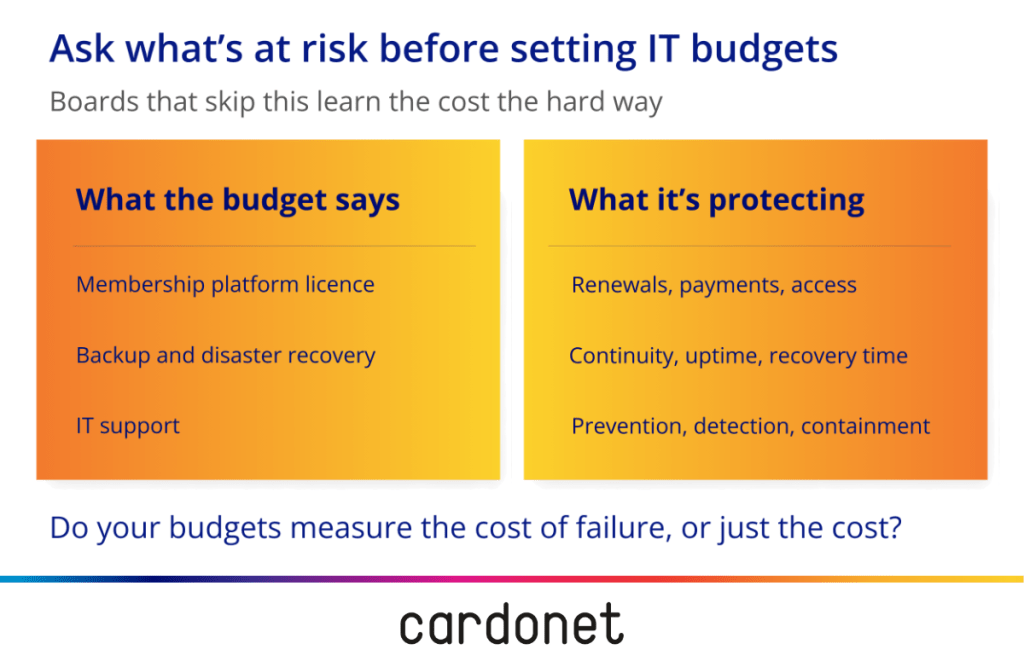
Ask a board what a piece of technology costs, and you will usually get an answer within minutes. Ask the value of what it protects, and the room usually goes quiet.
That second question deserves the same seriousness as the first. A payment processing system, a membership database, and an events booking platform each carry a genuinely different risk if they fail. Folding all three into one generic “IT” line on the budget hides that difference from the people signing it off.
The people who notice a slow, degraded system are not the same people who notice a system that has stopped working altogether, which means a board relying on staff complaints as its early warning system will only hear about failures severe enough to be undeniable. And the real test, the one hardly anyone runs, weighs what it takes to keep a system properly maintained against what an actual failure would end up costing the organisation.
Few boards have ever put a number against that second half of the comparison, which means the first half is being judged against nothing at all.
This is closer to what IT cost optimisation means, as distinct from simple cost cutting. Optimisation asks what a pound of spend buys in protection. Minimisation only asks how few pounds can be spent. Treating the two as synonymous is how a board ends up cutting the wrong things confidently.
The person nobody has thanked properly
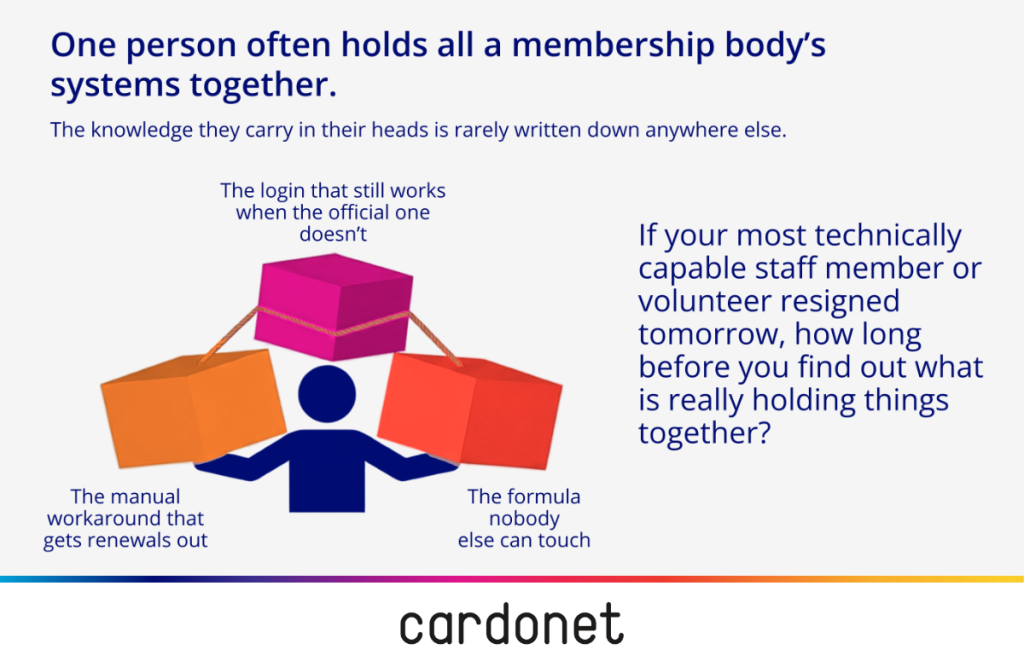
Most membership bodies have someone, usually in a role with a title like membership coordinator or operations manager, who has become the organisation’s real technology department without ever applying for the job. They know which of the three supposed data protection registers is the real one and which cloud folder holds the latest master version of the membership list, because two other folders exist with almost the same name and slightly different contents. There is a manual routine for resetting the online voting portal when it locks a member out during an AGM, because the vendor’s own support line takes three working days to respond (and AGMs do not wait three working days).
None of this is written down anywhere the board could find it. This is the natural result of a system that has never had a proper budget. When someone fills the gap out of competence and goodwill the board never sees it and, so, cannot deal with it. If they go on maternity leave, or take another job, or simply get ill for six weeks, the organisation finds out pretty quickly how much of its operation was running on one person’s memory.
Call it what it is. A governance risk, dressed up as an HR matter, hiding in plain sight on an org chart.
What a proper look turns up
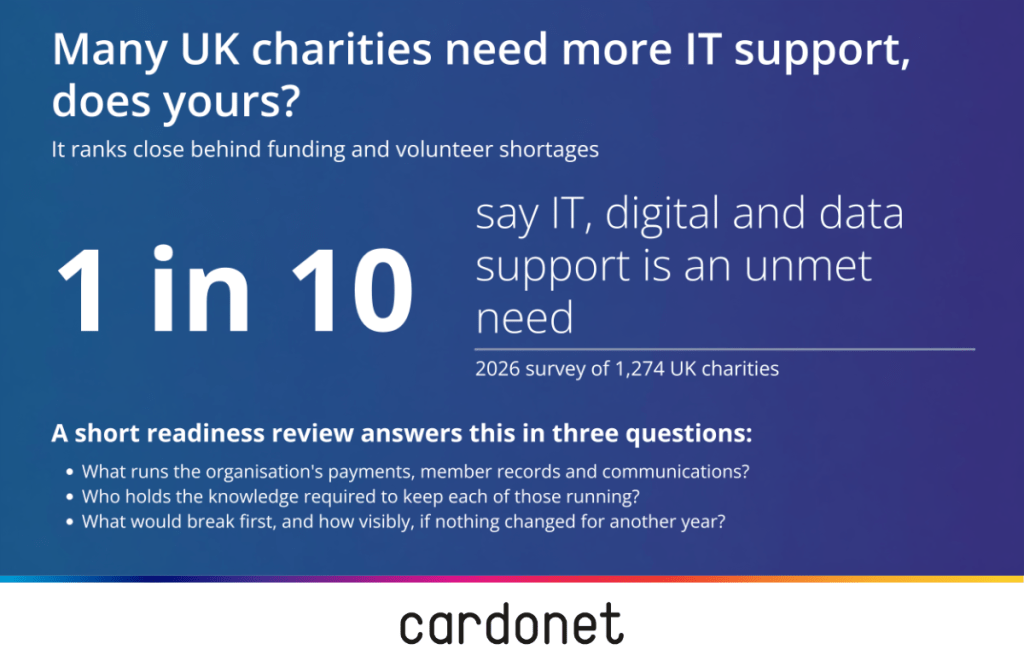
A 2026 survey covering 1,274 UK charities and membership bodies found that roughly one organisation in ten named digital and data support as a pressing gap, ranking just under two much larger concerns: money and people, a finding reported by Business London Press. Set against those louder categories, that share looks modest. Set against how rarely technology gets its own line in a board discussion, it is closer to a scandal hiding in plain sight.
The corrective is simple: understand what is happening before deciding what to overhaul. A worthwhile IT audit sets out to answer three things nobody usually writes down.
- First, an honest map of which systems the organisation depends on day to day, beyond whatever appears on the original procurement list.
- Second, a straight answer to where the expertise to run each of those systems currently sits, and whether it exists anywhere other than inside one person’s head.
- Third, and hardest, a plain statement of what would give way first should this year pass exactly as the last one did, and whether that failure would arrive unnoticed or in full public view.
Most boards can sketch a reasonable answer to the first question without much prompting. The second tends to take longer, since informal expertise rarely maps onto a tidy org chart. The third is where conversations usually stall, because pricing a hypothetical failure is genuinely difficult and uncomfortable, and discomfort is exactly why it keeps getting put off.
The tension worth keeping
None of this is an argument against scrutiny of overhead. That scrutiny is important in a sector whose entire relationship with the public rests on demonstrated trust, and a board that waved it away would be trading one serious mistake for another.
There is no tidy percentage waiting to be discovered that tells any board how much technology spend counts as “enough” without inviting exactly the same scrutiny that fundraising ratios already receive. Different membership bases carry different risk, and two boards acting in good faith can reasonably land in different places on the same question.
A board that has actually looked ends up with a judgement resting on evidence, not a guess resting on habit. A board that has priced its own exposure is making a judgement, a board that hasn’t is simply hoping, and hope, useful as it is in other parts of running a mission-led organisation, has never, not even once, kept a server running through the night.
FAQs
How much should our membership body actually be spending on technology?
There is no clean percentage that answers this safely, and anyone offering you one is guessing. What matters more is whether current spend has ever been weighed against what a genuine failure would cost the organisation. Comparing it to last year’s line answers a much smaller question.
Won’t spending more on IT look bad to members and donors who expect a lean overhead?
Donor and member scrutiny of overhead is legitimate and shouldn’t be dismissed. The distinction worth making to your board is between spending that protects the organisation’s ability to deliver its mission and spending that doesn’t. The first is a governance decision; the second is exactly the admin creep donors are right to watch for.
We don’t have anyone in-house who really understands our systems. Where would we even start?
That gap is more common than it feels, and it usually means one person has quietly been holding the knowledge together without anyone realising it. A proper audit that maps what runs the organisation day to day is the exercise that surfaces exactly where that informal dependency sits.
What’s the actual difference between an IT audit and just reviewing our technology budget?
A budget review asks what things cost. An audit asks what each system protects and what would happen if it failed, which is a genuinely different question, and usually the one nobody in the organisation has answered.
How would we know if we’re relying too heavily on one person for our technology?
A useful test is whether the board could say, with any confidence, what would break first if that person left with no notice. If nobody can answer that, the dependency is probably deeper than anyone has admitted.



You must be logged in to post a comment.