
In most restaurants, the kitchen is not just physical. Orders, payments, stock, bookings and reporting move through a digital architecture that sits behind service, and when that architecture is weak the operational impact is immediate. A restaurant that treats those systems as separate tools usually ends up with hidden dependencies, while a restaurant that treats them as one architecture can design for resilience, security and repeatability from the start.
That is the useful meaning of a digital kitchen. It is the combined system of devices at the edge, the network that connects them, and the platforms behind them. If nobody in the business can sketch that system on one page and show how an order reaches the kitchen or how a payment reaches the till, the business is not really managing its technology. It is living with it.
The architecture restaurants actually run
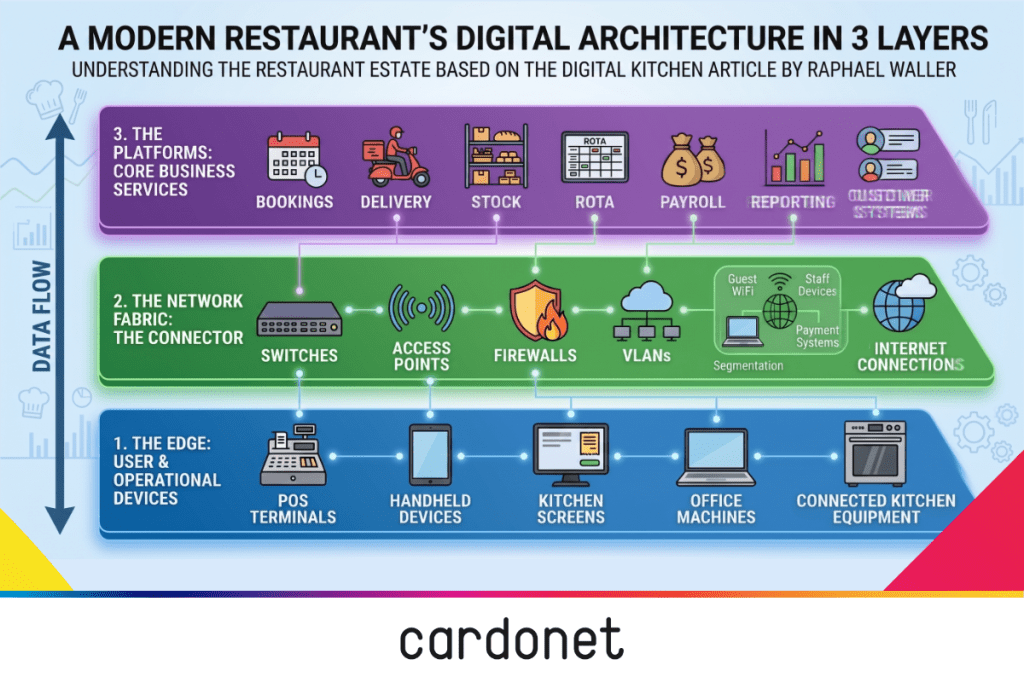
Most restaurant estates can be understood in three layers. At the edge are POS terminals, handheld devices, kitchen screens, office machines and, increasingly, connected kitchen equipment. In the middle sits the network fabric: switches, access points, firewalls, VLANs and internet connections. Behind that sit the platforms that the business now depends on, including bookings, delivery, stock, rota, payroll, reporting and customer systems.
That structure matters because every service path crosses more than one layer. A dine‑in bill might begin on a handheld, travel across a wireless network, hit the POS environment, call a payment service, then send data into reporting and stock systems. A delivery order can cross booking or ordering APIs, kitchen workflows, card processing and back‑office reconciliation before the day is done. Security in that environment is not a product. It is the way those layers are allowed to talk to each other, and the extent to which one failure can be contained before it spreads.
In practice, many restaurant environments are not designed to optimize this, resulting in flat networks, unclear ownership, weak documentation and too much trust placed in components that were never meant to carry such operational weight.
Why weak architecture becomes an operational problem
Restaurant technology failures tend to look unpredictable from the floor because the dependency chain is hidden. At architecture level, the patterns are not mysterious. The common problems are usually the same: guest and operational traffic sharing the same network, a single unmanaged device acting as a critical junction, poor visibility into what is healthy and what is failing, and third‑party platforms connected without enough thought about access or containment.
The NCSC’s guidance after the 2025 UK retail incidents is useful here because it shows how disruption spreads when architectures are too flat or too centralised. Their advice emphasises access controls, monitoring, privileged account review and segmentation because once an attacker or outage reaches a shared dependency, tills, payments and other core operations can be affected far beyond the first point of failure. Aviva’s analysis of those attacks also points to broad operational and financial consequences for affected businesses, reinforcing that weak architecture is not just a technical issue.
For restaurants, the practical implication is straightforward. If guest WiFi, staff devices and payment systems all sit on the same network, that is not a temporary compromise. It is a design decision. If one internet line, one switch or one supplier dependency appears across multiple critical service paths, the business has created a concentration of risk.
A practical architecture review
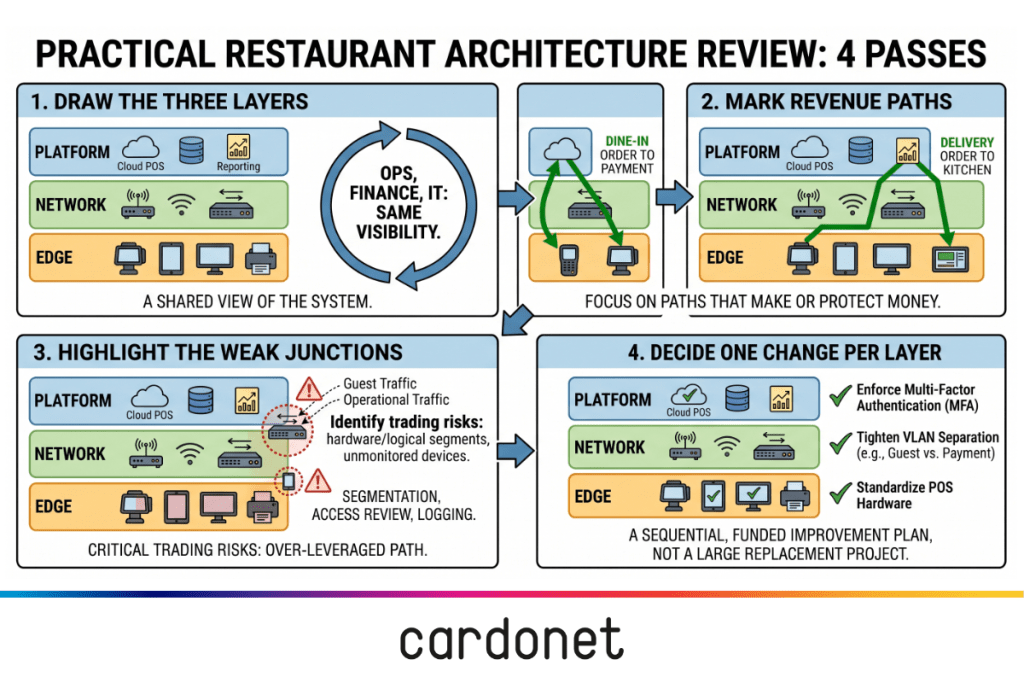
A restaurant does not need a long transformation programme to improve this. It needs a clear picture of what exists now, which service paths matter most, and which junctions carry too much responsibility. The simplest useful review usually takes four passes.
1. Draw the three layers
List the devices, networks and platforms that the site or group depends on. Keep it simple: edge, network, platform. The point is not to produce a perfect technical document. The point is to make the architecture visible enough that operations, finance and IT are all looking at the same system rather than three different versions of it.
2. Mark the paths that make or protect money
Pick two or three service paths that the business cannot afford to lose, such as dine‑in order to payment, delivery order to kitchen, or closing stock to reporting. Trace each one across the diagram. This is where a vague conversation about “the IT setup” becomes a useful conversation about which systems and dependencies actually sit behind revenue, service continuity and reporting accuracy.
3. Highlight the weak junctions
This is the pass that matters most. Mark any point where guest traffic and operational traffic share hardware or logical segments. Mark any device or supplier dependency that appears across multiple critical paths. Mark anything important that is not monitored. Those are the places where architecture stops being an abstract discussion and starts becoming a trading risk.
A common technical pattern in payment and operational incidents is movement from an exposed or weakly controlled part of the environment into a more sensitive one because there is too little separation between them. NCSC guidance for smaller organisations keeps returning to basic controls for this reason: segmentation, access review, logging, patching and sensible resilience reduce the chance that one weakness becomes a broader incident.
4. Decide one change per layer
Once the weak points are visible, the next step is not a shopping list. It is one deliberate change at each layer. At the edge, that might mean standardising POS hardware or removing unmanaged devices. In the network layer, it often means introducing or tightening VLAN separation between guest, staff and payment environments, backed by managed switching and monitored wireless infrastructure. In the platform layer, it usually means enforcing multi‑factor authentication, reviewing admin access and checking which vendors can reach what.
That kind of plan is usually more valuable than a large replacement project because it is tied directly to the architecture the business already has. It also creates a sequence that operators can fund and review sensibly instead of treating IT as a series of unrelated purchases.
What useful resilience looks like
Once the architecture is visible, resilience becomes much easier to define. It is not the absence of incidents. It is the presence of containment, visibility and a clear operational response. In restaurant environments, that usually means monitored critical paths, short runbooks written in operational language, and support coverage that matches when the business actually trades rather than when a generic office helpdesk happens to be available.
The quality of support matters because restaurant technology problems are rarely isolated to one screen. If a site loses connectivity, the issue may involve the wireless estate, the switching layer, payment traffic and multiple cloud services at once. A provider that only thinks in terms of “the till” or “the broadband line” is already too narrow. Restaurant IT support needs to understand the service path as a whole, including guest WiFi, POS security, payment exposure and the way late trading hours change incident handling.
That is also where a repeatable architecture helps with growth. A new site should not require a fresh debate about the basics every time. If the business has already defined its standard edge devices, network separation model, monitoring expectations and access controls, opening another site becomes an exercise in implementation rather than reinvention.
What good looks like
A digital kitchen that is under control usually has the same characteristics, regardless of cuisine or service model. The architecture is documented at a level the business can actually use. The critical paths are known. Guest, staff and payment environments are separated sensibly. Monitoring is focused on the components that carry operational risk. Support hours and escalation paths reflect the fact that restaurants trade in the evening, at weekends and under pressure.
That does not make the estate perfect. It makes it legible. And once it is legible, it becomes possible to harden, support and scale it without relying on memory, luck or one person who “knows how it all works”. That is the real difference between a restaurant that has inherited a digital kitchen and one that has designed one.
FAQs
1. What is a digital kitchen in restaurant IT?
A digital kitchen is the combined architecture of devices, networks and platforms that support bookings, orders, kitchen workflows, payments, stock and reporting. It treats those elements as one connected system rather than as separate tools.
2. Why does architecture matter more than buying better tools?
Architecture determines how systems interact, which paths are critical, and whether a fault in one area stays contained or spreads. Better tools on a weak architecture still leave the business exposed to flat networks, hidden dependencies and concentrated points of failure.
3. What should a restaurant prioritise first?
For most operators, the first priority is visibility and separation: document the current architecture, identify the critical service paths, and separate guest traffic from operational and payment traffic where that has not already been done.
4. Is this only relevant for multi‑site groups?
No. Multi‑site groups feel the pain of inconsistency more quickly, but single‑site restaurants still depend on the same patterns of edge devices, networks and platforms. The architecture is smaller, not simpler in principle.
5. What should a reputable restaurant IT partner, like Cardonet, be able to explain clearly?
A credible partner should be able to describe the estate in terms of service paths, not just products. That includes how POS, guest WiFi, payment security, monitoring, support coverage and access controls fit together into one operational design.




You must be logged in to post a comment.