
Resilience for a private office means the ability to keep functioning through an outage, a failed device, or a disruption at any hour, without the family noticing that anything went wrong at all. Most private offices don’t have that. They have a backup routine, an assumption that it’s working, and no defined answer to what happens if it isn’t.
Why uptime is a distinct problem, not a subset of IT
Privacy is about who can see family data. Cybersecurity is about who can get into the systems that hold it. Uptime is about whether the office can still function when a system, connection, or device fails. These three areas overlap constantly in a private office, but conflating them into one general category of “IT” is exactly how resilience gaps get missed – because nobody owns the question of what happens the moment something stops working.
This is not a theoretical concern for family offices specifically. Forbes’ 2026 analysis of family office technology and data infrastructure found that close to 87 per cent of family offices have adopted cloud-based infrastructure, largely to improve accessibility and continuity for teams operating across jurisdictions, and that a growing share are formalising identity and access management specifically to strengthen operational resilience alongside data protection. Technology adoption has outpaced the operational discipline needed to make that technology genuinely resilient under pressure.
That gap shows up directly in outage frequency data. A 2026 review of disaster recovery statistics found that 55 per cent of organisations reported experiencing outages weekly, and 14 per cent reported them daily – figures that make recurring downtime the norm rather than the exception for teams operating without tested recovery processes. For a private office running lean, with no dedicated IT function to absorb the disruption, that frequency turns a technical inconvenience into a recurring operational risk.
What actually causes resilience failures
Two categories of failure account for most of the serious continuity problems private offices encounter, and neither requires a sophisticated attack.
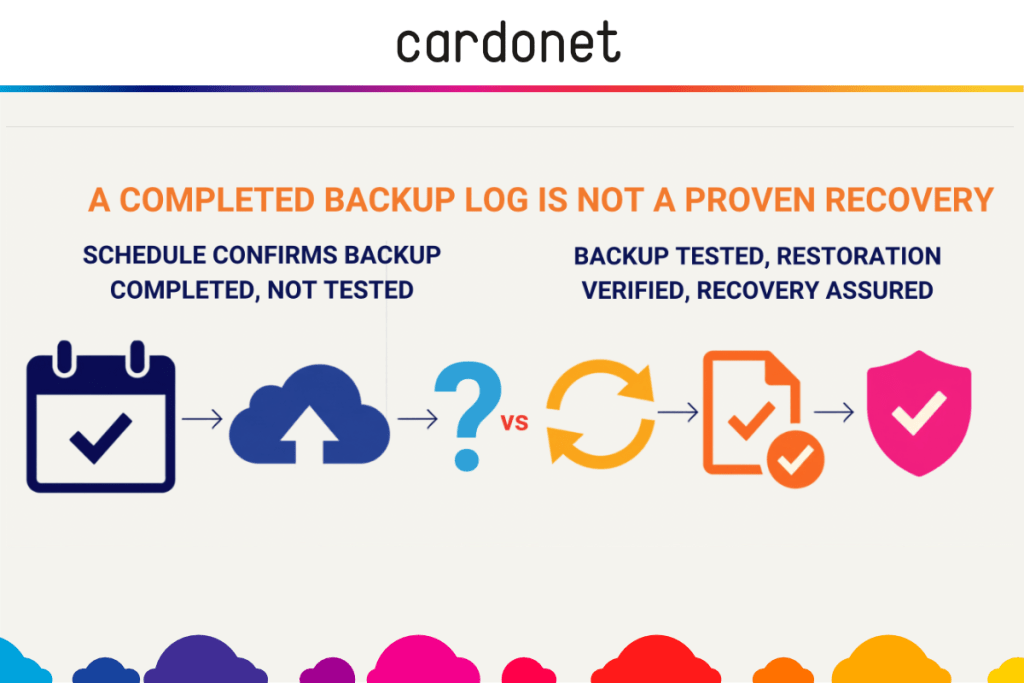
The first is an untested recovery process. SentinelOne’s disaster recovery planning guide notes that retrieval time, restoration time, and validation all add to the real recovery window, and that a backup process which has never been tested under realistic conditions cannot be relied on when it matters. A schedule confirming that backups completed is not the same as confirming they can actually be restored. The same guide notes that 20 per cent of impactful outages cost organisations more than one million US dollars – a figure that reflects how quickly an unresolved failure compounds once systems, staff time, and decision-making are all affected simultaneously.
The second is unclear recovery objectives. Most private offices have never defined, in specific terms, how much data they can afford to lose or how quickly a given system needs to be restored. The SentinelOne guide distinguishes between Recovery Time Objective (RTO), the maximum acceptable length of time a system can be unavailable, and Recovery Point Objective (RPO), the maximum acceptable data loss measured in time between the last backup and the point of failure. Without these defined in advance, a private office has no basis for judging whether its current backup frequency and restoration capability match what the family actually needs – that gap only becomes visible during a real incident, at the point it can no longer be corrected.
Building resilience without a fortress
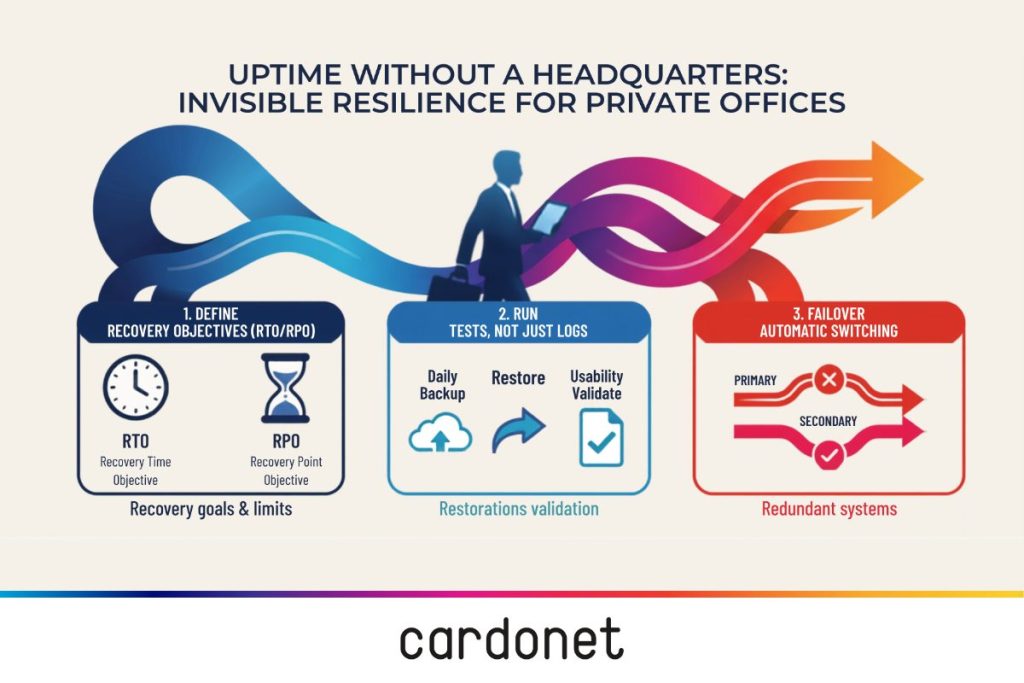
Resilience for a private office comes down to three disciplines, applied consistently rather than treated as separate one-off projects.
- Defined recovery objectives. Every private office should have a specific, documented answer to two questions: how much data loss is tolerable for each category of information, and how quickly does each system need to be restored. These figures differ by data type. Recent financial correspondence tied to a live transaction typically demands a far tighter recovery point than a general archive of past communications. Setting one blanket standard for everything usually means overspending on low-priority systems while underprotecting the ones that actually matter.
- Tested backups, not just scheduled ones. Backup frequency is not the same as actual recovery capability. A system backed up hourly does not guarantee a one-hour recovery point if the restoration process itself has never been verified – retrieval time, restoration time, and validation all extend the real recovery window beyond what the schedule implies. Confirming a backup process works requires restoring from it on a genuine, recurring schedule and checking that the data comes back complete and usable.
- Redundant connectivity and failover. A principal working from a residence, a hotel, or in transit between jurisdictions needs systems that do not depend on a single internet connection, a single device, or a single login remaining available. Failover (a secondary system or connection automatically taking over when the primary one fails) converts a potential outage into something the family never needs to be told about.
The 24/7 reality versus the 24/7 badge
Many IT providers advertise round-the-clock support. Far fewer can explain, specifically, what that support actually involves outside business hours. A genuinely always-on model combines proactive monitoring that identifies problems before anyone reports them, a staffed team actually available through the night rather than an answering service, and the capability to resolve most issues remotely without waiting for the next working day. It also requires clear judgment about when an issue is serious enough to warrant a senior engineer on-site quickly, rather than a phone-based fix for something that needs a physical presence.
A private office evaluating any provider’s 24/7 claim should ask for the actual staffing model behind it, what percentage of out-of-hours issues are resolved remotely versus requiring an on-site visit, and average response times specifically for evening and weekend incidents rather than a blended overall average. A provider with genuine round-the-clock capability should answer these questions directly and specifically, not with a general assurances.
Where an IT partner fits without taking over
None of this requires a private office to build an in-house IT function or maintain infrastructure across every jurisdiction the family operates in. It requires a partner that treats resilience as an ongoing discipline rather than a one-time setup exercise.
That is the model we run at Cardonet for private offices. We define recovery time and recovery point objectives by data category, so the office has a specific, documented standard rather than a vague assumption. We deliver backup and continuity services built around actual restoration testing, not just completed backup logs. We build redundant connectivity and failover into the systems principals and staff depend on while travelling, through our IT security services, so a single failed connection does not become an operational crisis. And we provide genuine round-the-clock monitoring and response through our managed IT services, with the ability to escalate to a senior engineer on-site when an issue is too sensitive or impossible to resolve remotely.
What we don’t do is dictate how the family works or impose a rigid structure that doesn’t match how the office actually operates. We build the resilience underneath. The office keeps making decisions on its own timeline, at whatever hour they need to be made.
Calm, not scrambling
The real test of resilience is not whether a private office ever experiences a failure – eventually, they will. The test is whether that failure is a brief, contained event handled automatically by tested systems, or a prolonged disruption that reveals how much the office was relying on unverified assumptions instead of a tested plan. Getting recovery objectives, backup testing, and failover right converts uptime from something the office worries about into something it stops needing to think about.
Outage frequency data suggests this is not a distant risk – with over half of organisations reporting weekly outages, the question for most private offices is less whether a failure happens and more whether it happens before or after the recovery plan gets tested.
Cardonet has built and tested recovery infrastructure for lean teams operating across multiple jurisdictions for over two decades.
A short assessment of your current recovery objectives and backup testing regime is a practical way to see where the gap sits, before an outage finds it for you.
This is Part 3 of a four-part series on how MSPs like Cardonet support the private offices of high-net-worth families. Part 1 looked at why private offices have become prime cyber and privacy targets, and why institutional-grade protection matters even for a tiny team. Part 2 turned to privacy and confidentiality in practice – where family data actually sits, and how to control it without turning daily life into a compliance exercise. This instalment focuses on uptime and resilience: keeping a private office running across time zones, travel, and urgent decisions, with the right backups, failover, and support in place before something breaks. Part 4 closes the series by looking at governance and succession: how the technical, privacy, and continuity foundations built across this series need to change hands deliberately as family leadership shifts.
FAQs
1. Why is uptime treated as separate from privacy and cybersecurity in a private office?
Because they solve different problems even though they overlap. Privacy is about who can see data, cybersecurity is about who can get into systems, and uptime is about whether the office keeps functioning when something fails. Treating them as one general “IT” category is exactly how resilience gaps get missed, since nobody ends up specifically responsible for recovery.
2. What’s the difference between RTO and RPO, and why does a private office need to know?
RTO (Recovery Time Objective) defines the maximum acceptable time a system can be unavailable, and RPO (Recovery Point Objective) defines the maximum acceptable data loss measured in time since the last backup. Without both defined per data category, a private office has no way to judge whether its current backup and recovery setup actually matches what the family needs until a real incident exposes the gap.
3. Is a completed backup the same as a working recovery plan?
No. A backup log showing completed backups only confirms the process ran, not that the data can actually be restored intact. Retrieval time, restoration time, and validation all extend the real recovery window, and the only way to know a backup process works is to actually restore from it on a recurring, tested schedule.
4. How do we know if our IT provider’s “24/7 support” is real?
Ask for the actual staffing model behind the claim, what percentage of out-of-hours issues get resolved remotely versus needing an on-site visit, and average response times specifically for evenings and weekends rather than a blended average. A provider with genuine round-the-clock capability will answer these directly rather than offering a general reassurance.
5. Does building resilience mean the family loses flexibility in how the office operates?
No — the goal is the opposite. Redundant connectivity, tested backups, and defined recovery objectives run quietly in the background so the office can keep operating on the family’s own timeline, without a failed connection or device turning into a crisis that forces a change in how or when decisions get made.

You must be logged in to post a comment.