
Most hotel teams do not discover the weak spots in their building until their first peak season when the Wi‑Fi dead zones, undersized communications rooms and back‑of‑house bottlenecks finally reveal themselves in real time, and every fix is both disruptive and expensive.
By building your hotel virtually with Building Information Modelling (BIM) and a digital twin before you break ground, you can catch costly design errors early and hard‑wire a future‑proof technology stack into the fabric of the building.
BIM vs digital twin — in hotel language
On most projects, Building Information Modelling is the detailed, data‑rich three‑dimensional model your architect and contractor use to coordinate structure, Mechanical, Electrical and Plumbing (MEP) systems and space planning.
It lives at the design and construction end of the lifecycle, making sure shafts, risers, plant rooms and guest rooms all line up before anyone starts pouring concrete.
A digital twin is what you get when the BIM design is connected to real operational data, occupancy, energy use, environmental conditions, and system status, so it reflects how the hotel actually behaves once you open the doors.
In hospitality, that can mean a live model where you see how Heating, Ventilation and Air Conditioning (HVAC), lighting, guest Wi‑Fi and building systems respond to real guests rather than simply trusting the idealised drawings.
BIM and digital twins are different phases of one information spine running through the hotel’s life.
Guidance from initiatives such as the UK’s Digital Twin Hub and the University of Cambridge’s Information Management Framework explainer makes the same point: treat them as a continuum and decisions about cabling, communications rooms and systems integration naturally carry through into better day‑to‑day operations.
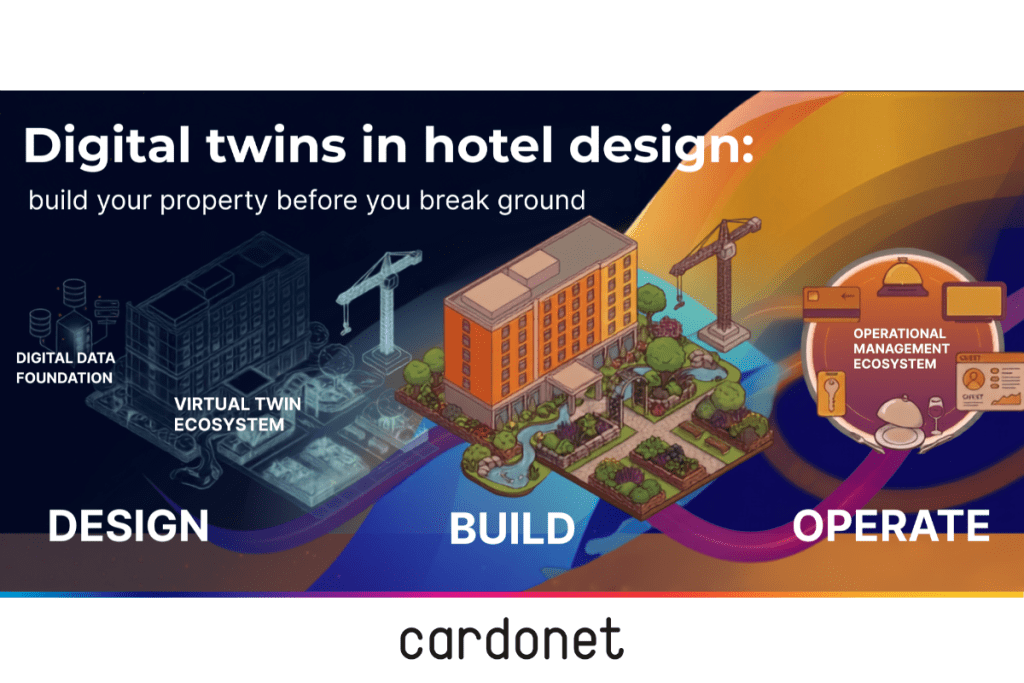
Building the hotel digitally to cut design errors
The biggest technology mistakes in hotels are often locked in during design: where risers go, how many communications rooms you allow for, whether there is enough space and power for future network and security equipment.
A well‑structured BIM model gives architects, MEP engineers, Information Technology (IT) teams and operations a shared view of those constraints instead of leaving each discipline to discover them in isolation on site.
Used properly, BIM lets you place and test the hotel’s digital nervous system long before fit‑out.
You can validate that communications rooms are accessible and adequately cooled, that fibre routes and containment are sized for future standards, and that Wi‑Fi access points and Closed‑Circuit Television (CCTV) cameras have realistic coverage in guest rooms, corridors and public spaces.
For a managed IT partner like Cardonet, that model becomes the place to encode practical standards for hotel networks and systems, rather than relying on a generic “data cabinet by others” note in the drawings.
A hotel‑specific digital twin takes this one step further by allowing teams to simulate how the space will be used.
Hospitality‑focused work on digital twins shows hotels using virtual replicas to test guest flow, queue formation, staffing levels and back‑of‑house movement before committing to a layout.
Even without live data from sensors, it is possible to run scenarios to see where lines will form at reception, how guests reach lifts from the lobby bar, or how housekeeping moves through floors, then adjust layouts or signage to remove obvious friction.
Future‑proofing hotel technology infrastructure
Technology infrastructure decisions made during design will support or constrain every digital initiative delivered across the hotel’s life.
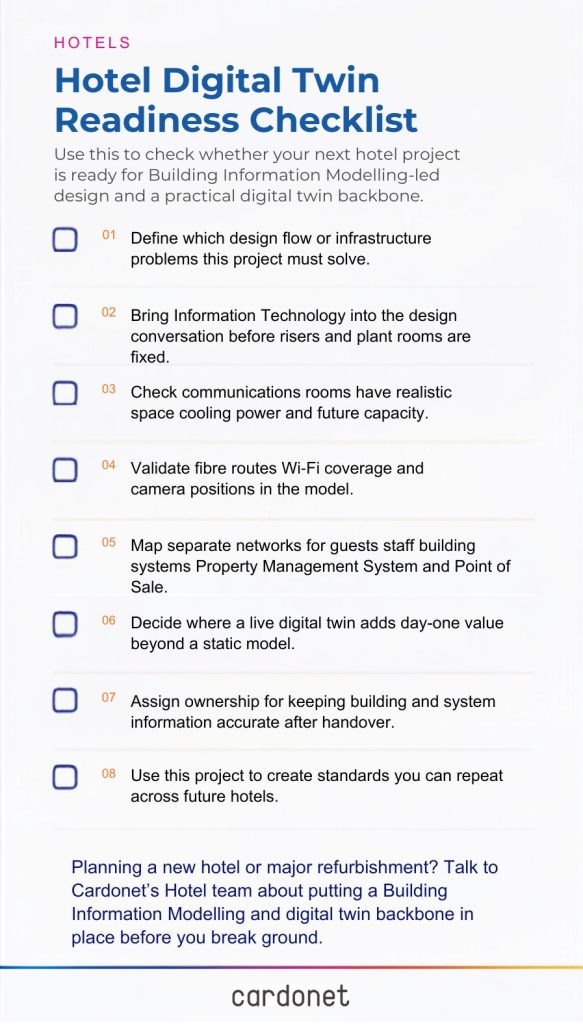
If risers, containment and communications rooms are sized only for today’s systems, adding new guest‑facing technology or analytics later means disruptive re‑work rather than a managed upgrade.
Future‑proofing starts with clear design intent for the IT and Operational Technology (OT) stack, expressed in the BIM model.
That includes realistic space for core and distribution racks, routing for separate networks (guest, staff, Property Management System (PMS) and Point of Sale (POS), building systems), and power and cooling that allow for higher‑density equipment as standards move on.
It also means planning the pathways and junctions needed for cloud PMS, digital keys, building analytics and evolving guest‑room technology, even if every system is not deployed on day one.
A hotel‑focused digital twin then becomes the environment where change is tested before it affects real guests.
You can model the impact of a new guest‑facing app on Wi‑Fi utilisation, explore how additional building sensors will affect your network, or trial revised HVAC schedules for energy savings while still working within a controlled environment.
When those simulations are built on the same information standards promoted by the Digital Twin Hub’s Information Management Framework, the hotel’s data remains intelligible and reusable as the building and its systems evolve.
Governance and ownership — keeping the model alive
There is little lasting value if the model is treated as a project artefact that gets archived once practical completion is signed off.
That is usually what happens when nobody owns the information after handover; within a year the model and reality drift so far apart that teams stop trusting it.
To get long‑term benefit from BIM and digital twins, hotel owners, brand IT, operators and their managed IT partner need clear responsibility for keeping information accurate as changes roll through the estate.
A simple information management framework for the hotel’s digital assets, with agreed naming conventions, versioning rules and a defined common data environment for design and operational information, makes it realistic for teams to rely on the model.
Aligning with national digital twin guidance – for example the standards work coordinated through the Digital Twin Hub and initiatives like the UK Digital Twin Centre – helps hotels integrate new systems and share data safely without reinventing rules for every project.
A managed IT partner that already understands hotel systems is well placed to act as long‑term custodian of this digital spine.
Cardonet’s hospitality IT work is already centred on the systems that make this continuity valuable, including hotel networks, guest Wi‑Fi, PMS, POS, CCTV, access control, cyber security, 24/7 support and network monitoring.
That continuity is what turns a once‑off BIM deliverable into a living asset that supports operations, security and future projects.
From single project to portfolio advantage
The leverage increases once a single BIM model or digital twin is viewed as a pattern that can be reused across multiple hotels.
If information management and design standards are consistent, a successful new‑build or refurbishment becomes a template for future investments rather than a one‑off success story.
That portfolio‑level view fits neatly with the way many hotel groups are trying to centralise IT.
For Cardonet’s hotel and hotel management clients, that can mean turning proven requirements for network segmentation, guest Wi‑Fi, PMS, POS, security and support into repeatable design patterns rather than rebuilding the IT brief from scratch on every project.
When these standards are encoded into BIM templates and digital twin patterns, new properties inherit proven layouts for communications rooms, Wi‑Fi design and systems integration, reducing both design risk and the time to first revenue.
A portfolio of connected digital twins also allows central teams to see patterns that would be invisible in isolated properties.
They can compare energy performance between hotels, spot common failure modes in building systems, and test changes in one property before deciding whether to roll them out to others.
That is exactly the kind of multi‑asset insight the UK Digital Twin Centre highlights when describing how digital twins can help organisations make smarter decisions and reduce lifecycle costs across large estates.
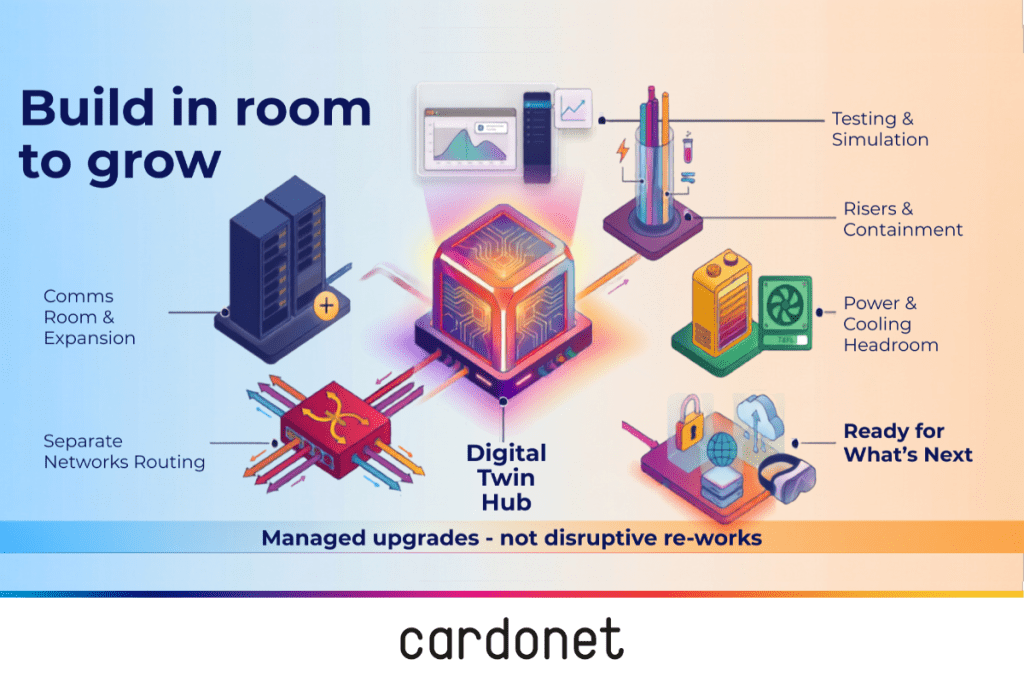
Getting started — a practical roadmap
For most hotel developers and operators, the immediate challenge is not adopting every possible digital twin use case, but using BIM and digital twins to improve the next live project.
A straightforward sequence keeps the effort grounded.
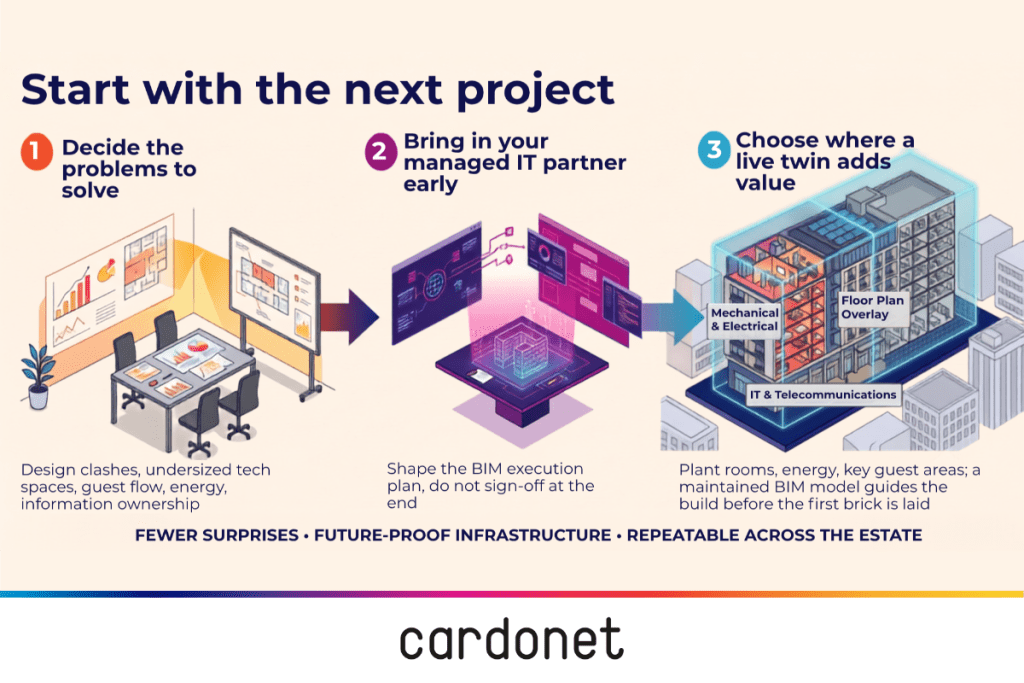
- Decide what problems BIM and digital twins should address on this specific hotel — reducing design clashes, avoiding undersized technology spaces, improving guest flow, tightening energy performance or clarifying responsibility for information.
- Bring a managed IT partner such as Cardonet Hotel Management IT Solutions into the design conversation early enough so that they can shape the BIM execution plan, rather than signing off whatever is handed over at the end.
- Choose where a live digital twin genuinely adds value from day one – for example plant rooms, energy systems and key guest‑facing areas – and where a well‑maintained BIM model is sufficient until the hotel has settled into a steady pattern of operation.
When BIM and digital twins are treated as a single information backbone for hotels, teams move from reacting to problems discovered during the first busy season to rehearsing and refining the building, the guest journey and the technology stack before anyone checks in.
That shift means fewer expensive surprises, a technology infrastructure that can support the next decade of guest expectations, and a set of digital assets that make future projects faster and less risky to deliver.
If you are planning a new hotel or major refurbishment and want BIM and digital twins to work this hard, the practical next step is to bring a managed IT partner like us into the design room early, agree the information standards you will both live with, and use the first project to build a pattern you are willing to repeat.
FAQs
1. Do I need both BIM and a digital twin for a new hotel?
Building Information Modelling supports design and coordination, while a digital twin becomes useful when you want a live operational view once the hotel opens.
2. When should a managed IT partner join the BIM process?
Bring them in as soon as risers, plant rooms and major back‑of‑house spaces are being fixed, not at cabling tender stage.
3. How does a digital twin help after opening?
It gives operations, engineering and IT a shared view of occupancy, energy use and building performance, making it easier to test changes before they affect guests.
4. What usually goes wrong with BIM and digital twin projects?
The common failure points are weak ownership, poor information management and a model that stops being updated after handover.
5. How should a hotel group start without over‑committing?
Use one live project to solve clear problems, then turn what works into repeatable standards for the wider estate.

You must be logged in to post a comment.