
A legacy system is technology that still runs your Membership Body’s critical operations after it has become unsupported, poorly understood, or too limited for your current scale. It doesn’t need to be old — if it no longer fits the organisation it now has to serve, it needs to be retired, regardless of how many years it’s been in place.
The original decision itself is rarely the mistake. The mistake, if there is one, tends to be structural: nobody was made responsible for checking whether the original choice still made sense once the membership base tripled, the supplier changed hands, or the one person who understood the system’s quirks moved on without documenting them. The UK government’s Technology Code of Practice makes this point directly, recommending that organisations build a complete and accurate register of the technology they run, precisely because such a register is usually where the gap first shows up. A sound decision, left unexamined for a decade, does not stay sound; it simply stops getting looked at, which is a different thing entirely.
Membership bodies are especially exposed to this pattern because so many operate lean, without a dedicated IT function whose entire job would be to keep asking whether last decade’s choices still fit this decade’s reality. In the absence of that role, the database, finance tool, and ageing membership management system quietly become load-bearing infrastructure long before anyone consciously realizes it.
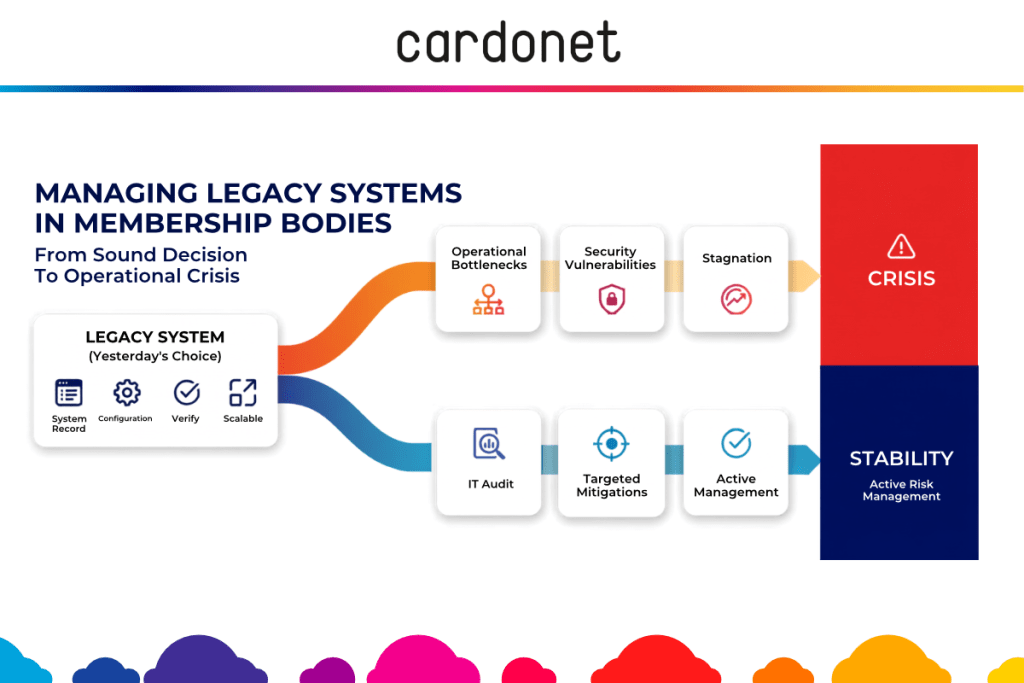
The Three Faces of Legacy Risk
Legacy risk does not remain static simply because the underlying system hasn’t changed. A system rated low risk on last year’s register can carry high risk this year, because everything around it has shifted: your organisation’s scale, the regulator’s expectations, and the overall threat landscape.
Operational bottlenecks
Legacy systems slow down the people who rely on them every day, though rarely in ways dramatic enough to force action on their own. Staff build workarounds because the alternative is simply not getting the work done: shadow spreadsheets, manual double-entry between platforms that ought to talk to one another, and an informal expert who has quietly become the only person who really understands how the system works. Individually, none of these look urgent but, collectively, they consume hours that could be going toward member engagement rather than data wrangling.
Security liabilities that get worse the longer you wait
The NCSC’s guidance on obsolete products makes a point worth stressing: unsupported systems will stop receiving security updates, increasing the likelihood that exploitable vulnerabilities become known to attackers, and organisations unable to replace them straight away will need to revisit risk decisions regularly rather than treating them as settled. This sits alongside a clear legal obligation. The ICO’s guidance on data security requires organisations to process personal data using appropriate technical and organisational measures, a standard an unpatched, unreviewed system will struggle to meet on its own terms.
The jeopardy compounds in a way that’s easy to see only in hindsight. A system your risk register called acceptable three years ago, before a particular vulnerability was disclosed, can become a serious exposure overnight, and your board may have no idea unless someone is deliberately watching for it.
For a membership body holding payment details, professional records, and personal data, an unpatched legacy system sitting quietly in the background functions as an open door, and that opening widens with every month it goes unreviewed. Cardonet’s own analysis of the sector reaches a similar conclusion: membership bodies hold sensitive member data but rarely have formal cyber defences, which makes them a target rather than an unlikely one .
Barriers to growth that boards notice last
This face of the trap rarely announces itself as a crisis. It shows up instead as slowness, which is far easier to live with and therefore far easier to ignore. A legacy membership management system that cannot support new member journeys, online payment options, or a connection to your events platform does more than inconvenience staff. It quietly caps how fast an organization can launch a new benefit, or respond to what members are actually asking for right now rather than what they were asking for when the system was built.
This is the costliest face of the trap precisely because it never arrives as an emergency. Growth does not stall through a dramatic failure but through a series of small deferrals, each one reasonable on its own, until a year has passed and nothing has moved.
Warning Signs Your Membership Body Is in the Legacy Trap
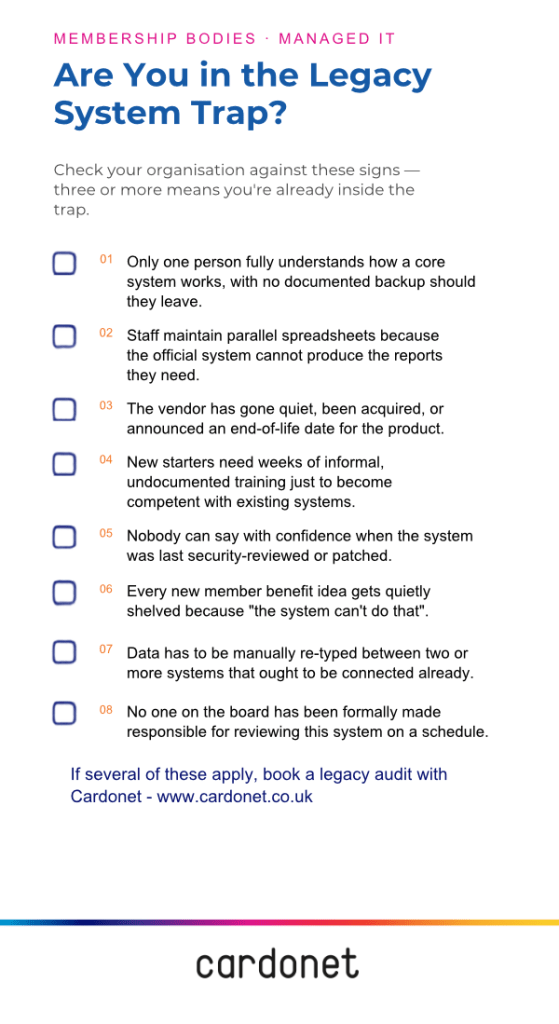
Some of these signs have become so woven into daily operations that nobody registers them as warnings anymore. Check your own organisation against them honestly:
- One person fully understands how a core system works, and there’s no documented backup should they leave
- Staff maintain parallel spreadsheets because the official system cannot produce the reports they actually need
- The vendor has gone quiet, been acquired, or announced an end-of-life date for the product
- New starters need weeks of informal, undocumented training just to become competent with existing systems
- Nobody can say with any confidence when the system was last security-reviewed or patched
- Every new member benefit idea gets quietly shelved because “the system can’t do that”
- Data has to be manually re-typed between two or more systems that ought to be connected already
Any single item here is manageable on its own. Three or more together mean the organisation is already inside the trap, whether the board has found the language to name it that way yet or not. The longer it goes unnamed, the more the underlying risk matrix continues shifting against you, quietly and without anyone’s permission. What was a tolerable gap can become a live liability the moment a regulator tightens its expectations, a supplier withdraws support entirely, or an attacker finds the one weak point nobody was watching. Cardonet’s own guidance for the sector makes a related point about certification and baseline controls: the gap between “acceptable” and “exposed” is often smaller than boards assume .
What NCSC Guidance Actually Recommends
The NCSC’s approach doesn’t pretend every organisation can simply replace ageing systems overnight, which gives a genuinely realistic starting point for resource-constrained Membership Bodies. It sets out a structured approach instead: reduce the likelihood of compromise by limiting what obsolete systems can access, reduce the impact if compromise happens by treating those systems as untrusted, and revisit the decision to keep using them on a regular basis rather than letting it stand indefinitely. A summary of related NCSC guidance on decommissioning legacy systems reinforces a point that deserves more attention than it gets: even rarely used systems must remain secured and monitored, not quietly ignored simply because they aren’t visibly causing trouble at this particular moment.
That distinction matters enormously for trustees. The governance question isn’t really “should we replace this tomorrow?” It’s closer to “do we know precisely what we’re running, do we understand why, and are we actively managing the risk while we work out what comes next?” A board capable of answering that honestly has already closed most of the distance between itself and an organisation that gets blindsided.
Moving Out of the Trap Without a Full Rip-and-Replace
The instinct, once legacy risk surfaces, is almost always to reach for a full system replacement. This is expensive, disruptive, and understandably difficult for any board to approve in a single sitting. It’s rarely the wisest first move, and certainly not the only one available.
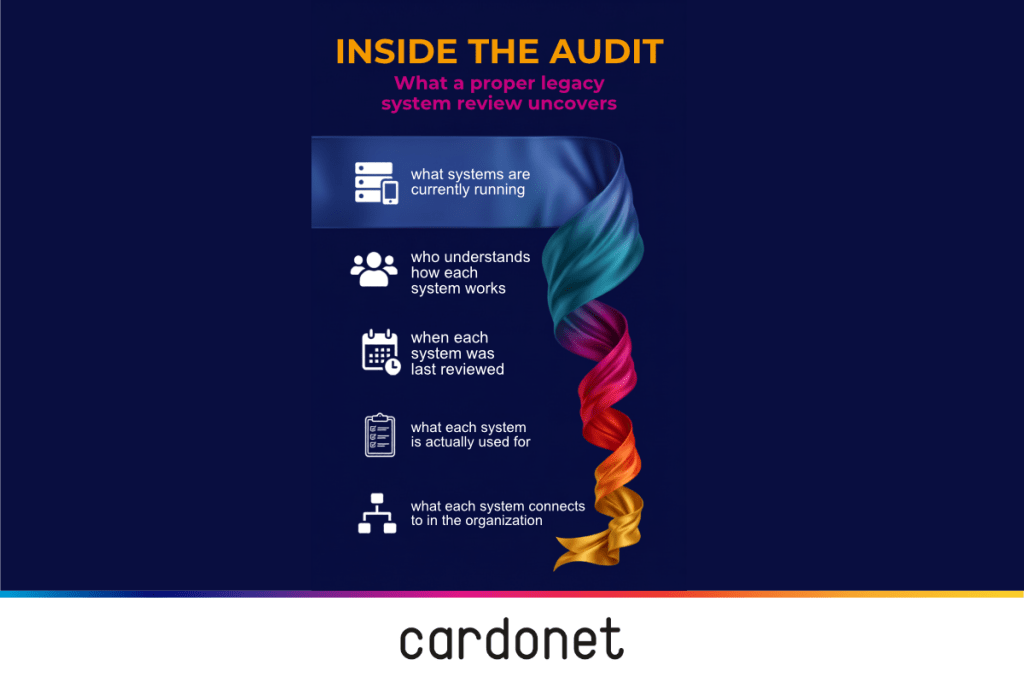
The better starting point is an honest inventory. What is actually being run, how old is it, who genuinely understands it, and what breaks if it fails tomorrow without warning. This single exercise, done properly, tends to surface the highest-risk gaps before a penny has been spent on anything. From there, the priority order should follow where operational, security, and growth risks overlap most heavily, because that overlap is where the real cost is concentrated. A finance-facing membership system holding payment data should outrank an internal scheduling tool nobody outside the office ever sees.
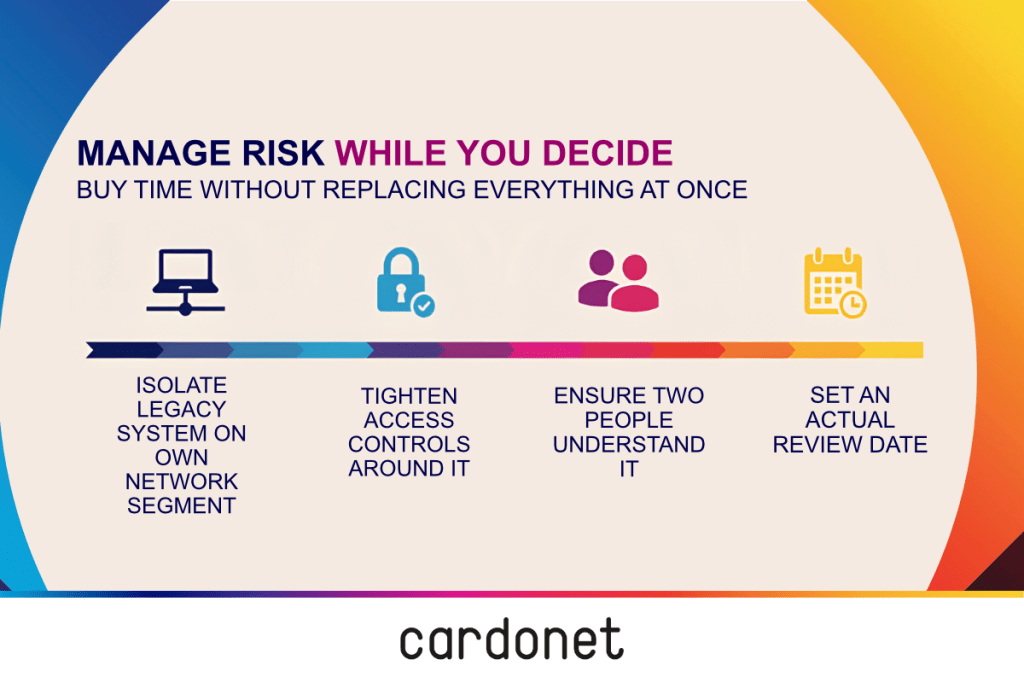
Where full replacement isn’t affordable, targeted mitigation can buy time: isolating an ageing system on its own network segment, tightening access controls around it, ensuring at least two people understand how it functions, and setting an actual review date rather than allowing the decision to drift for another five years unattended. Eliminating every legacy system in one quarter isn’t the goal. What matters is that a Membership Body knows precisely where its risk sits, and is managing it deliberately, rather than discovering it mid-crisis once the cost has already multiplied several times over.
A structured IT audit from Cardonet tends to be the most practical starting point for Membership Bodies in this position. It maps current systems against operational, security, and growth risk, then sets out honestly what genuinely needs to change this year against what can be actively managed for now. That distinction, more than any single piece of software, is what will ultimately get a Membership Body out of the legacy trap for good.
FAQs
1. How do I know if a system is a “legacy system” and not just an older tool that still works fine?
Age isn’t the test. A system becomes legacy when it’s unsupported, poorly understood by your current team, or too small for your membership scale, regardless of how many years it’s been running.
2. We can’t afford to replace our membership management system this year. What should we do instead?
Full replacement isn’t the only option, and it’s rarely the first move worth making. Start with an honest inventory of where the risk sits, then apply targeted mitigation, network isolation, tighter access controls, a fixed review date, so the risk is managed rather than ignored.
3. How often should our board actually be reviewing legacy IT risk?
The NCSC’s position is that this decision should be revisited regularly, not settled once and left alone, since the risk shifts even when the system doesn’t. An annual review is a practical minimum, with an immediate re-check if a vendor announces end-of-life or a key staff member leaves.
4. Is a legacy system really a cybersecurity risk if it’s rarely used?
Rarely used doesn’t mean unwatched. Even infrequently accessed systems need to stay secured and monitored, because an attacker only needs one overlooked entry point.
5. What’s the difference between a legacy system problem and an integration problem?
They’re related but distinct. A legacy system problem is one outdated, unsupported system on its own; an integration problem is otherwise fine systems failing to talk to each other properly.


You must be logged in to post a comment.