
If you run a multi-site restaurant group, you already know where most of your real risk lives. It is not in a rack of kit in a comms room. It is on the floor, in the middle of service, when a manager under pressure opens a message that looks routine enough and clicks before they really look at it.
For a multi-site restaurant group, cyber security training is not an HR exercise. It is an operational control. If your teams cannot recognise a suspicious request, raise it quickly, and understand what should never be sent on the fly, then your firewall is doing half a job. In hospitality, the weak point is rarely the payment platform or the router. It is the rushed decision made between tables, tills, suppliers, rotas, and mobile phones.
Technology either holds up during a Friday dinner service, or it does not. We made that point in other recent posts on restaurant IT and the human firewall. You cannot run a serious operation if every site is leaning on one unofficial “IT person” or a set of undocumented fixes that only the night manager understands.
Cyber is no different. If your defence against a bad email is “we’ve got a sensible GM at that site”, that is not risk management. That is crossing your fingers and hoping the rota goes your way.
Most restaurant groups have invested in the tooling. POS platforms are better. Networks are more segmented. Endpoint protection is running. Many have a managed IT provider and 24/7 support. The gap is human behaviour at the point where something almost normal lands in someone’s inbox, in WhatsApp, or in a ticketing system and they act on instinct.
Human firewall at scale
If you want a human firewall that actually works across a group, it has to survive real trading conditions. That rules out anything built entirely around policy documents and annual courses.
The UK National Cyber Security Centre publishes free Top Tips for Staff training material that covers the basics: strong passwords, secure devices, spotting phishing, and reporting incidents. It is designed to be delivered quickly and reused. That is the right shape for hospitality because it accepts two simple facts: your team’s time is tight, and training has to be concrete or it will be ignored.
Now layer that onto how restaurants really run. Margins are thin. Shifts are long. Turnover is high. Your systems are wired together pragmatically across POS, bookings, delivery, payroll, supplier portals, and devices. Under that pressure, “be vigilant” is not guidance. It is noise.
What moves the needle is much more specific. Teams need a short list of non‑negotiables: information that never gets sent without verification and channels that are never trusted on face value. Managers, area leads, finance and head office staff need different examples, not all treated like generic “users”. Every site should use the same reporting route, so nobody burns thinking time working out who to call this time. Refreshers have to be short enough that they can run regularly and practical enough that people remember them. And managers need to reinforce the right behaviour in service, not quietly bypass it because “there isn’t time”.
The biggest mistake I see is leadership teams equating awareness with behaviour. Someone can pass a phishing quiz and still approve a dodgy payment while they are firefighting on a Sunday. If you train once and assume the job is done, you are kidding yourself. You do not treat service standards that way. Cyber is no different.
Why restaurant teams click
Most of the time, malign social engineering does not present itself as an obvious hack. It arrives as admin. A payment query. A rota tweak. A password reset. A delivery platform message. A supplier statement. A message that looks like it came from operations or finance.
NCSC’s phishing guidance spells out the mechanism clearly: these attacks lean on trust, urgency, and familiarity, not just bad spelling and obvious red flags. That should sound uncomfortably familiar if you run restaurants. Your teams are conditioned to move fast, solve problems, and keep guests happy. That is good service culture. It is terrible security culture if it is left untrained.
Generic awareness training tends to assume that most phishing looks obviously wrong. In reality, plenty of malicious messages look credible enough that a tired manager, five hours into a shift, will give them the benefit of the doubt.
The multi-site layer makes it worse. One site can be disciplined while another runs on workarounds. One GM escalates anything odd. Another forwards documents from a personal account because it is quicker. Our article on the Triple AI Threatalready called this out in another context: inconsistent use and setups across an organisation create complexity and risk. People are no different. If you let each site interpret “safe enough” locally, you will get as many different answers as you have locations.
Then there is the unofficial tech translator. Every group has one. The person who knows how to fix the till, who to chase, which supplier portal always plays up, which devices “just need a reboot”, and so on. They are useful. They are also a single point of failure. If your human firewall depends on that person’s judgement and availability, you are not resilient. You are dependent.
Training that survives service
The right question is not “Do we have cyber training?” The right question is “Will people remember it on a busy Friday night?”
If the honest answer is no, it needs rethinking.
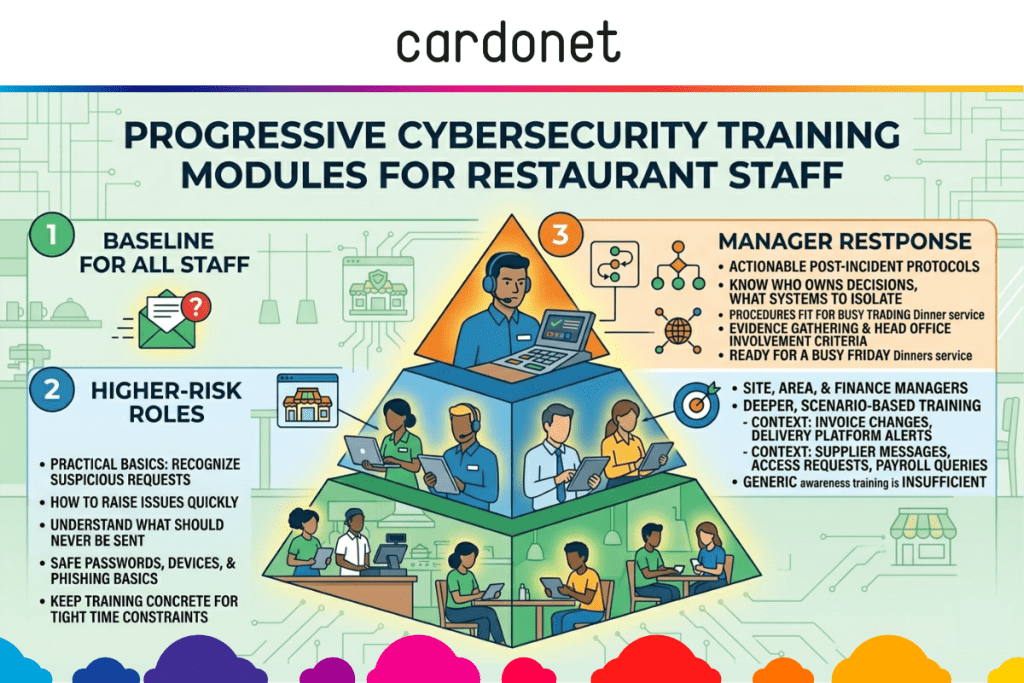
Start with a baseline for everyone. That baseline should explain, in plain language, what suspicious looks like, which information never travels casually, what to do when somebody is unsure, and where to report something without delay. The Top Tips for Staff material is helpful here because it stays practical. For a restaurant, simplicity is a feature, not a flaw. If it is too complicated, people will not use it when it matters.
Then build a second layer for higher-risk roles. Site managers, area managers, finance approvers, and head office administrators do not need generic theory. They need to recognise the patterns that target them: invoice changes, delivery platform alerts, payroll queries, refund requests, rota links, unexpected access prompts, and urgent authorisation requests. If your examples could apply to any office job in any sector, they are not sharp enough.
The third layer is where most groups fall down: what managers actually do when somebody raises their hand.
In a lot of estates, if you ask “What happens if someone reports a suspicious email during service?” you will not get a clear answer. But you should. Someone at the site needs to know who owns the decision, what gets shut off or isolated, what evidence is needed, and when head office needs to be involved. If your managers cannot answer that in plain language, your process is not fit for purpose.
A simple operating principle works: if the training collapses during a busy service, it is not good enough. A 40‑minute annual course may look impressive on a compliance report, but it will not change how a manager behaves when they get a weird request at 7:10pm. Short, grounded scenario refreshers tied to actual incidents or near misses stand a much better chance.
There is a clear parallel with POS and card security. Cardonet’s article on restaurant POS security talks about network separation, device control, and monitoring as ways to reduce the blast radius when something breaks. You should think about human controls in exactly the same way. Clear approval rules and clear reporting routes cut down the number of places a bad decision can cause trouble. Vague ones do the opposite.
Reporting without blame
Every restaurant board report says the same thing: “We encourage staff to report suspicious behaviour.” But when you look at what actually happens on the ground, that promise does not always hold.
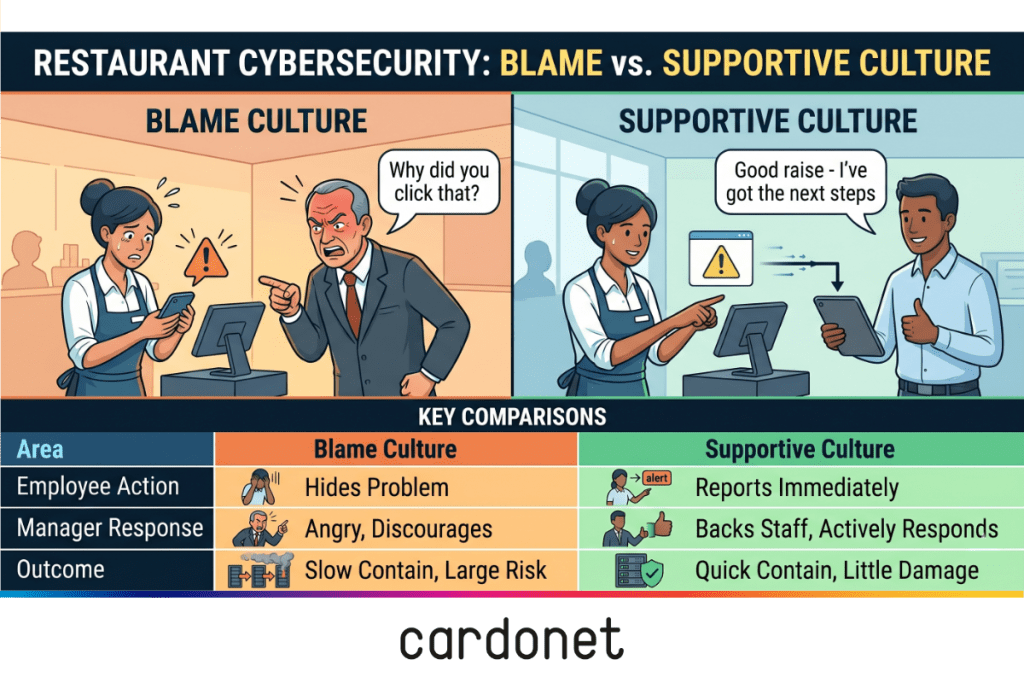
NCSC’s staff training builds “reporting incidents” into the core content for a reason. It is the same logic behind their “if in doubt, call it out” message: reporting early shrinks the problem. A clicked link is not ideal. A clicked link reported within minutes can often be contained. A clicked link ignored until tomorrow because somebody was worried about getting a telling-off is a different scale of issue.
The technical steps are easy compared to the human ones. The obstacles are embarrassment, fear of slowing things down, and bad experiences of being blamed.
If you want reporting to work, everybody needs to know the route and managers need to respond properly when someone uses it.
The route can be simple: a dedicated mailbox, a phone option into IT support, a clearly printed instruction in the back, whatever fits your setup. The point is consistency. Staff should not be burning brainpower working out who to call this time.
And when someone does the right thing and flags something, managers need to back them. If the response is “Why did you click that?” you have just trained the team to stay quiet next time. If the response is “Good that you raised it – forward it here now,” you are reinforcing the behaviour you want.
Most operators already apply this logic in food safety and service recovery. You want issues spotted early, raised quickly, fixed properly, and learned from. Cyber needs to sit alongside those disciplines, not float around as a specialist IT topic that lives in another part of the business.
A workable reporting routine might look like this in practice: stop and do not reply, approve, or forward anything. Forward the suspicious message to the agreed address or call the support route straight away. Say if you entered credentials or opened any files. Let leadership and IT own the technical part from there. Then share patterns back out so one site’s close call helps protect the rest of the estate.
This is where multi-site estate data can actually help you. A single restaurant might only see one or two incidents. A group can pick up campaigns across several sites if reports come into one place and someone is watching.
What good looks like
You can tell very quickly whether a group has taken the “human firewall” idea seriously or just written about it.
In a serious group, new starters hear about cyber in their induction alongside health and safety and service standards. Managers question unusual requests as a matter of habit, not as an exception. When somebody nearly gets caught, it turns into a useful story for the rest of the team, not a private panic. Head office can talk about patterns because incidents are being logged centrally, not handled one by one in isolation.
The training itself is short, regular, and obviously connected to real work. No one needs a glossary to understand it. No one needs to make a special calendar event for it. It fits into team meetings and pre‑shift briefs.
On the technical side, you are not relying on people alone. Cardonet’s cyber security and managed IT services exist for a reason. Proper firewalls, monitoring, backups, and support wrap around the human layer. A well‑trained team on top of a fragile network is still at risk. A strong network with poorly trained teams is also at risk. The only sensible option is to strengthen both together.
When we look at a restaurant group through this lens, we are interested in a few simple things. Does every new starter get told the same basic rules on day one? Do managers and finance people see realistic examples based on the messages they actually receive, not just generic cases? Can any staff member explain how to report something suspicious without thinking too hard? Are short refreshers happening often enough that people remember the content? Is expected behaviour consistent across sites, or are you still relying on “good people” in “good sites” to keep you safe?
If most of those answers are positive, you have the start of a proper human firewall. If they are not, the exposure is already there. You just have not seen the cost yet.
This is the choice. Either you design and drill the behaviour you want, or you accept what you get and hope it is good enough. The difference will show up in the size and frequency of the cyber incidents you end up managing.
Why This Matters
When cyber behaviour varies widely from site to site, the impact shows up in familiar ways: downtime at the wrong moment, payment issues, delayed decisions, stressed managers, and senior leaders losing time to avoidable fire‑fighting. Every extra site multiplies the effect.
The UK Government’s latest Cyber Security Breaches Survey makes the backdrop clear enough: just over four in ten UK businesses – 43% – reported at least one breach or attack in the last 12 months, with phishing and impersonation still among the most common attack types. That is the landscape you are operating in, whether you spend any time on cyber or not.
From a business perspective, getting this right is not about ticking a compliance box. It is about protecting revenue, protecting reputation, and reducing the amount of noise that gets in the way of growth and guest experience.
Protecting Your Restaurant Group
If you only have capacity to move a bit on this in the next quarter, we would focus on three practical steps.
First, walk a site. Sit with a manager, an ops lead, and IT. Map out where in a real week someone might be hit by a fake invoice, a suspicious login, or a message pretending to be head office. Do this with real systems and real devices, not in a meeting room. Turn what you learn into a small set of house rules.
Second, replace the “annual training day” mindset with short, role‑focused sessions. Use the NCSC Top Tips for Staff content as a baseline and then rewrite the examples so they sound like your operation. Pick a simple reporting route and make it the same everywhere.
Third, line the people changes up with your technical controls: your cyber security services, your restaurant POS security (including the controls covered in this article), and the managed IT support that keeps everything up and running. The end goal is straightforward: when something odd happens, people behave in a predictable way and the technology responds as it should.
If you watched how the business behaves on a busy weekend, would you still feel comfortable with your cyber posture? If not, that is a sign that the human firewall is not really built yet.
FAQs
1. Why are restaurant teams a cyber security risk if the technical controls are already in place?
Because most incidents start with somebody doing something small that turns out to matter – clicking, approving, sharing, or staying quiet when they should have escalated. Firewalls and endpoint tools are essential, but they cannot decide which emails to trust or which payment changes to reject. Training and a clear reporting route turn individual judgement into consistent behaviour.
2. How often should a restaurant group run cyber security training?
In a multi-site group, “little and often” beats “big and rare”. High turnover and busy schedules mean a single annual session is usually forgotten by the time peak season rolls around. Short induction modules plus regular, scenario‑based refreshers tied to actual incidents or near misses work much better.
3. Which roles need more than basic awareness training?
Managers, area managers, finance approvers, head office administrators, and anyone who can authorise payments, change details, or access sensitive data all need deeper, scenario‑based training. They see different threats from front‑of‑house staff. Treating everyone the same is cheap but ineffective.
4. What should staff do if they think they clicked something suspicious?
Stop immediately. Do not reply or forward the message. Use the agreed reporting route – whether that is a dedicated email address, a phone option into IT support, or both. Tell them clearly if you entered credentials or opened a file, so they can respond at the right level.
5. Is this mainly a problem for very large chains?
No. Smaller groups see the same attack patterns. The difference with scale is that inconsistency becomes more expensive. One weak habit in one site is bad. The same weak habit repeated across twenty sites is a business problem. That is why larger groups need a defined baseline, a shared playbook, and a clear reporting route.

You must be logged in to post a comment.