
Membership bodies, charities, and sports clubs sit on a gold mine of data that criminals can use. The question is no longer whether your organisation is big enough to matter but rather whether your systems, accounts, devices, and suppliers are vulnerable to exploitation. The UK position is clear: the Information Commissioner’s Office (ICO) expects organisations handling personal data to put appropriate technical and organisational measures in place, and Cyber Essentials is the government’s recommended minimum cyber security standard.
Cyber Essentials certification is now a baseline credibility test for cyber security for charities, sports clubs, and other membership bodies. It is not a substitute for UK GDPR compliance, privacy governance, or breach reporting discipline.
That is why this matters commercially as well as operationally. Government procurement has long used Cyber Essentials as a mandatory requirement for certain contracts involving personal information and relevant IT services, and the same logic now shapes due diligence questions from members, funders, enterprise partners, and insurers. If your organisation cannot show basic control over access, patching, configuration, and internet-facing systems, the concern is not only cyber risk, it is whether the organisation can be trusted with sensitive information at all.
Cyber Essentials certification explained
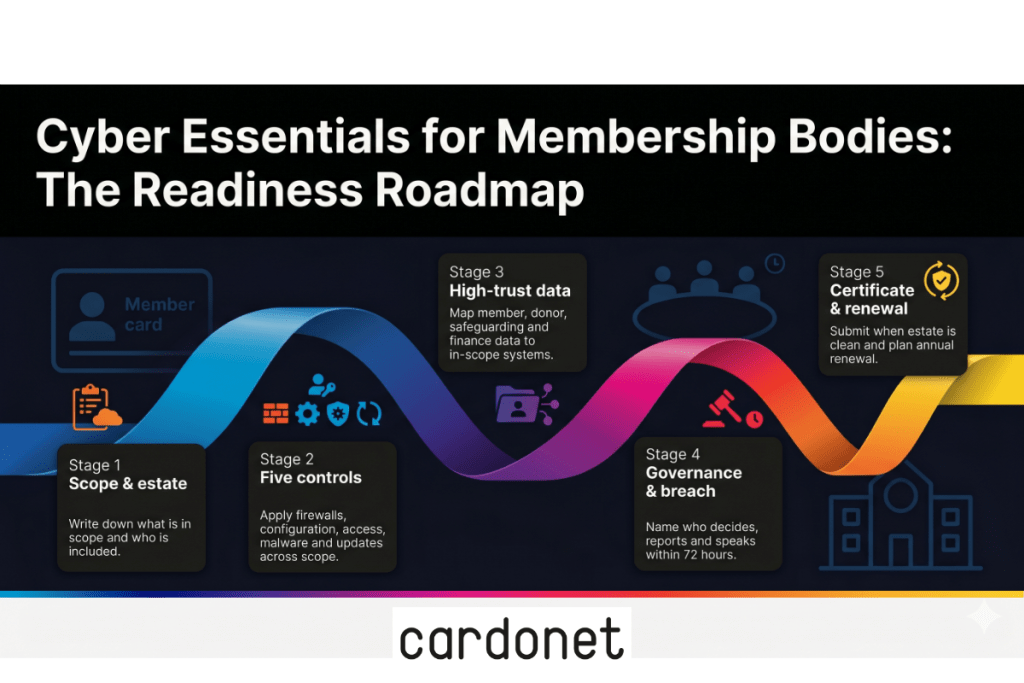
Cyber Essentials is a government-backed certification scheme built around five technical control areas: firewalls, secure configuration, user access control, malware protection, and security update management. The NCSC presents it as the minimum standard of cyber security recommended for organisations of all sizes.
For membership bodies, charities, and sports clubs, that makes it directly relevant. These organisations often run on mixed estates – laptops owned by staff, personal devices used by trustees or volunteers, cloud email, finance tools, CRM platforms, event systems, shared storage, and outsourced support. Certification forces the organisation to define what exists, who has what access, and whether the basics are actually being controlled.
What Cyber Essentials covers
Cyber Essentials is concerned with baseline technical hygiene. It is meant to reduce exposure to common internet-based attacks by requiring the organisation to demonstrate that core controls are in place across the systems and services.
In practice, that means checking things many organisations leave vague for too long: whether unsupported devices are still in use, whether administrators have too much access, whether cloud settings are secure, whether software updates are being applied properly, and whether boundary protections are doing their job. For a membership body, that can extend across membership platforms, payment systems, staff devices, remote access tools, trustee accounts, shared inboxes, and collaboration environments.
Its practical value is easy to see: it creates an auditable baseline for the systems and accounts that expose your organisation to the most common forms of compromise.
Privacy risk for membership bodies
Membership bodies do not just hold operational data. They often hold high-trust personal data that can be misused quickly and at scale – member directories, payment records, disciplinary files, accreditation histories, event attendance, trustee papers, and email threads full of personal and commercially sensitive detail. Sports clubs and charities often hold the same kind of risk, sometimes with safeguarding or special category data in the mix.
That creates a direct privacy issue. The ICO’s security guidance states that organisations must process personal data securely using appropriate technical and organisational measures, and the UK GDPR’s integrity and confidentiality principle requires protection against unauthorised access, accidental loss, destruction, or damage. If systems are weak, the legal and reputational problem is not abstract, it is the exposure of identifiable people and the consequences that follow.
Cyber Essentials helps with the technical baseline. It does not decide whether your retention periods are lawful, whether your data sharing is proportionate, whether trustees are using personal email inappropriately, or whether your breach process can stand up in the first 72 hours. Those remain leadership and governance issues.
What Cyber Essentials does not cover
Cyber Essentials is not full compliance. It does not certify that an organisation meets every requirement of UK GDPR or the Data Protection Act 2018. The ICO’s standard is wider and risk-based, covering policy, accountability, access governance, organisational controls, and the handling of personal data throughout its lifecycle.
It also does not remove breach reporting obligations. The ICO states that if a personal data breach is likely to result in a risk to people’s rights and freedoms, the organisation must notify the ICO without undue delay and, where feasible, within 72 hours of becoming aware of it. If the risk is high, affected individuals must also be informed without undue delay.
It does not fix supplier sprawl, unclear ownership of SaaS tools, poor offboarding, or weak board oversight either. Those are common failure points for membership bodies because responsibilities are often distributed across staff, volunteers, trustees, and external providers. A certificate can confirm a baseline. It cannot compensate for unmanaged organisational risk.
How to get Cyber Essentials certification
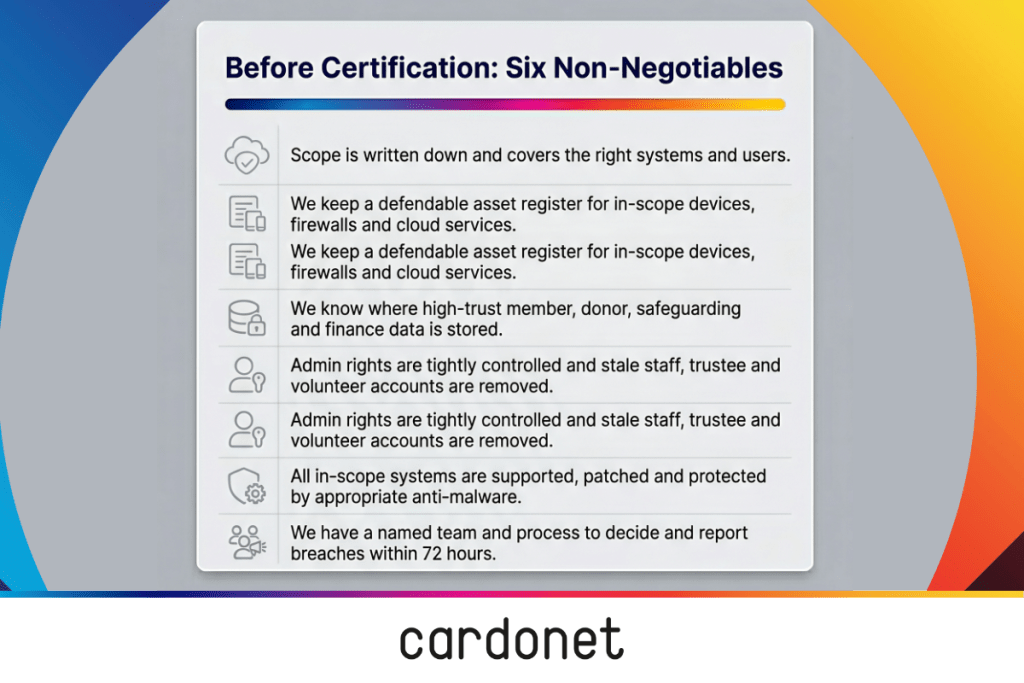
- Set the scope first. Decide whether certification will cover the whole organisation or a defined part of it. List every user group, device type, cloud service, admin environment, and business system that sits inside scope. If the scope is unclear, the answers will be weak and the remediation work will drift.
- Build an asset register you can defend. Record all laptops, desktops, servers, mobile devices, firewalls, routers, and cloud platforms in scope. Include ownership, operating system, support status, and whether the asset is used by staff, trustees, or volunteers. Unsupported devices and unmanaged endpoints need to be removed, replaced, or excluded before assessment.
- Map where personal data sits. Identify which in-scope systems contain member, donor, volunteer, safeguarding, payment, or governance data. Mark which systems are business-critical and which carry the greatest privacy exposure. This ensures the Cyber Essentials work is aligned with the organisation’s legal risk, not treated as a detached certification exercise.
- Audit administrator access in detail. Review every privileged account across Microsoft 365, Google Workspace, CRM, finance systems, membership software, remote access tools, and network equipment. Remove unnecessary admin rights, close stale accounts, stop shared admin use, and separate day-to-day accounts from privileged ones where possible.
- Check secure configuration line by line. Remove default accounts where they are not needed, disable unnecessary services, lock down exposed settings, and review device build standards. For cloud platforms, confirm that security settings match current policy rather than vendor defaults or legacy decisions.
- Fix patching before submission. Confirm that operating systems, browsers, productivity tools, remote access tools, endpoint security tools, and firmware are all supported and updated within policy. One neglected machine, one outdated firewall, or one unsupported application can weaken the whole submission.
- Review anti-malware and boundary protections. Make sure malware protection is active where required and that firewalls or equivalent controls are configured and monitored properly. This needs to be validated through evidence, not assumption.
- Treat leavers and volunteers as a separate control issue. Membership bodies, charities, and sports clubs often carry access risk through seasonal workers, trustees, committee members, and volunteers. Check joiners, movers, and leavers carefully. Remove access that is no longer justified, especially where member data or shared inboxes are involved.
- Prepare your breach process before the questionnaire goes in. Name the people who decide whether an incident is a personal data breach, who contacts the ICO, who speaks to insurers, and who owns member communications. The ICO’s timeframe starts when the organisation becomes aware of the breach, not when internal confusion ends.
- Choose the certification route early. IASME provides the route to find a Certification Body. You then work with your IT partner to determine whether the criteria are met. Use that support early if scope, remediation, or interpretation is uncertain.
- Submit only when the estate is clean. The right sequence is remediation first, submission second. If your answers depend on exceptions, informal workarounds, or “we’re planning to fix that soon,” the control is not ready.
- Plan for annual renewal. Cyber Essentials certificates are time-limited, and IASME’s certificate search shows only certificates issued within the last 12 months. Treat the certification as a maintained baseline, not a one-off milestone.
Legal and board duties
For boards, trustees, and senior leadership teams, the issue is broader than certification. The ICO’s position is that organisations must protect personal data with appropriate technical and organisational measures and must be able to act quickly if a breach creates risk to individuals. That is a governance obligation as much as an operational one.
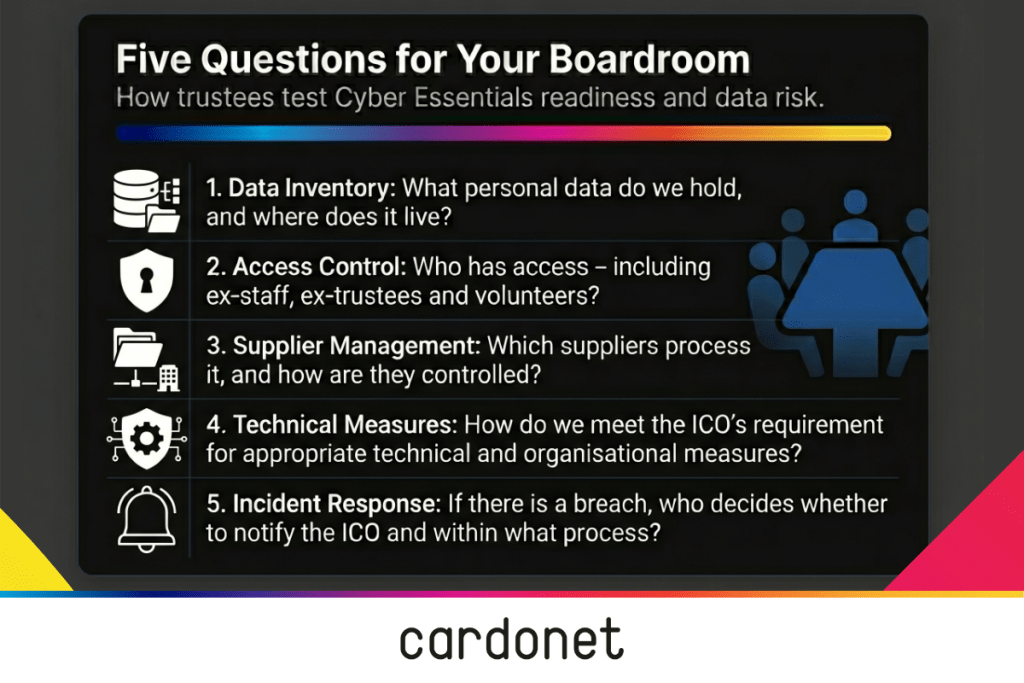
In membership bodies, the board-level question is simple: does the organisation know what data it holds, where it sits, who can access it, which suppliers process it, and what happens if it is exposed? If the answer is uncertain, the gap is not only technical. It is managerial.
What good looks like after certification
A credible post-certification position is clear and testable. The organisation knows which systems are in scope, which accounts are privileged, which devices are unsupported, where member data lives, how volunteer access is controlled, and who owns breach escalation.
It also has an operating rhythm: access reviews, patch reporting, asset review, policy updates, cloud configuration checks, and incident response testing. Cyber Essentials establishes a minimum baseline. Trust is built by proving that the baseline is maintained and extended into privacy, governance, and supplier control.
If a funder, insurer, enterprise partner, or procurement team asks whether your organisation holds Cyber Essentials certification, that question should trigger a full internal review, not a hurried form-filling exercise. Define the scope, clean up access, map the personal data, fix unsupported systems, and make sure the organisation can report a breach within the ICO’s timeframe if required.
Use Cyber Essentials certification as the line in the sand. For cyber security for charities, sports clubs, and membership bodies, it is the point where vague reassurance stops and evidence begins. Get the baseline right, close the privacy gaps around the data you hold, and make sure your organisation can prove it deserves the trust it asks members and partners to place in it.
FAQs
1. What is Cyber Essentials certification for membership bodies?
Cyber Essentials is a UK government-backed cyber security certification scheme that sets a minimum baseline of protection against common internet-based attacks, built around five technical controls. For membership bodies, charities and sports clubs, it provides an externally recognised standard showing that basic controls over firewalls, secure configuration, access, malware protection and updates are in place across a defined scope.
2. Does Cyber Essentials make a charity or membership body GDPR-compliant?
No. Cyber Essentials helps demonstrate that baseline technical controls are in place, but it does not prove full UK GDPR compliance. The ICO expects organisations to implement appropriate technical and organisational measures, manage personal data throughout its lifecycle and handle breaches in line with the 72-hour reporting requirement where risk to individuals exists.
3. Why is Cyber Essentials important for charities and sports clubs?
Charities and sports clubs often hold sensitive personal data about members, donors, volunteers, beneficiaries and children, making them attractive targets for cybercrime. Cyber Essentials reduces exposure to common attacks, supports legal defensibility and increasingly acts as a credibility marker for funders, insurers and partners assessing whether the organisation can be trusted with sensitive information.
4. How hard is it for a small membership body to get Cyber Essentials?
Difficulty depends on how organised the environment is, not on size. Small membership bodies that can define their scope, list devices and cloud services, control admin access, keep systems supported and patched and manage volunteer and trustee access can usually work through the assessment with structured preparation and, if needed, support from an IASME-approved Certification Body.
5. What should our board ask before starting Cyber Essentials?
Boards and trustees should ask five questions: what data do we hold, where does it live, who has access, which suppliers process it and what happens if it is exposed. If the organisation cannot answer those clearly, it is not ready for a credible Cyber Essentials submission and needs to fix governance, access and breach handling first.

You must be logged in to post a comment.