
Can a distributed creative team hit deadlines without late-night panic, version chaos, and endless “where’s the latest file?” messages?
Yes, but only when operating rules come first and tools come second.
It’s Thursday evening. The client deck is due tomorrow morning. Someone updates slide 7, another person tweaks the narrative, a third person “just fixes a typo”. Now there are three “final” files, two comment threads, and one approval that’s still stuck with someone who hasn’t seen the right version.
28% of working adults in Great Britain hybrid worked between January and March 2025, which makes distributed delivery a default for a lot of teams, not a special case.
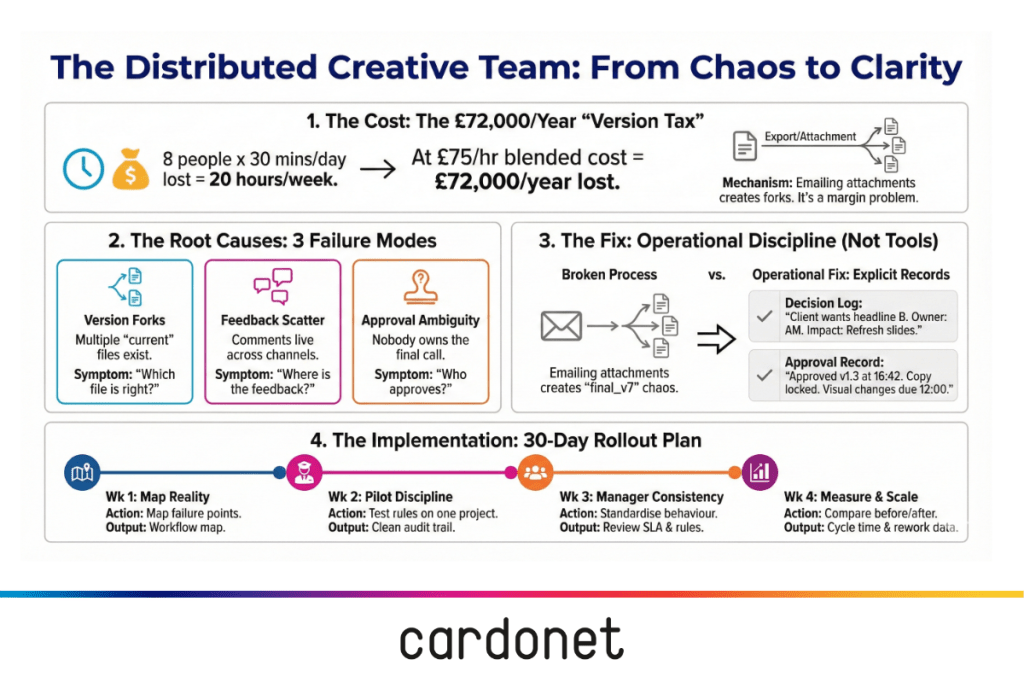
Quick maths. If eight people lose 30 minutes a day to version chasing, duplicate edits, and feedback hunting. That’s 20 hours a week. At a £75/hour blended internal cost, that’s £1,500 a week, roughly £6,000 a month, and around £72,000 a year. Swap in your headcount and blended cost and you’ll get your number in 30 seconds.
The three failure modes
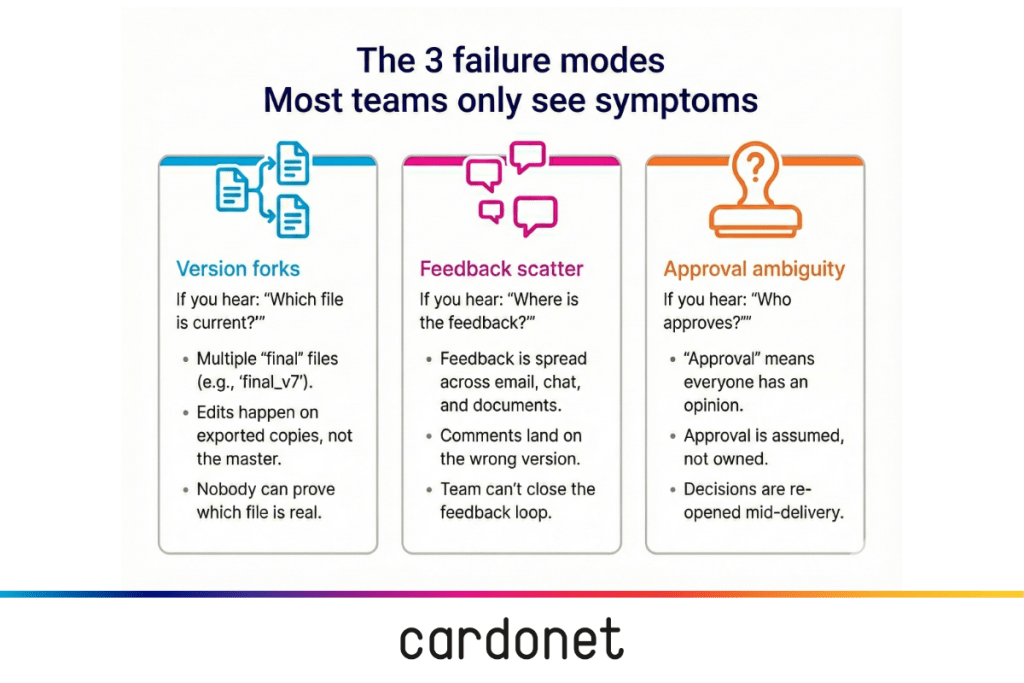
Most distributed creative delivery issues collapse into three patterns:
- Version forks: multiple “current” files exist and nobody can prove which is real.
- Feedback scatter: comments live across channels so the team can’t close the loop.
- Approval ambiguity: nobody owns the final call, so the deadline owns you.
Fix these and most teams feel calmer inside a week.
Five operating rules
The fix isn’t “more collaboration”. It’s fewer ways to get confused.
One source of truth. There’s one place for the brief, timeline, and decision trail. If it isn’t recorded there, it didn’t happen.
Defined review and approval loop. Everyone knows who approves, where feedback goes, and what turnaround looks like. That clarity is what stops last-minute pile-ons.
Co-authoring rules. Nobody emails working files. Exports are for review and delivery, not a new master that creates a fork.
Async by default. Status is written. Meetings exist for critique, trade-offs, and decisions you can’t make in comments.
Handoff standard. Every handoff includes context, the current link, open questions, and a named next-step owner. Handoffs are where momentum dies, so treat them like a process.
If you want academic backing for the idea that creative output is shaped by interaction and coordination, not just individual talent, a systematic review of collaborative creativity is a useful reference point.
What “good” looks like
Monday feels different when this is working. A brief update happens once, in the right place, and nobody needs a follow-up call to confirm it. Decisions are easy to audit because they’re logged in plain English with an owner and an impact note.
A decision log entry looks like: “2025-12-15: Client wants headline B, not headline A. Owner: AM. Impact: refresh slides 3–6 before internal review.”
Approvals are equally explicit. “Approved v1.3 at 16:42. Copy locked. Visual changes: two items, due tomorrow 12:00.”
Briefing without rework
Most distributed projects don’t derail at the end. They derail at the start, then limp to the deadline.
A usable brief is short and specific: objective, deliverables, deadlines, approver, constraints, and source assets. The key isn’t the template, it’s the rule: the brief lives in one place and changes are recorded, not “passed around”.
Ideation that produces decisions
Virtual ideation fails when it produces activity instead of outcomes. The fix is simple: every session ends with decisions, owners, and next steps written down.
Timebox the ideas, pick a direction, record the decision, assign actions, and set the next review time. If the session doesn’t create a decision trail, it wasn’t a working session.
Production without attachment chaos
Version chaos has a predictable pattern: someone exports a copy “just to be safe”, edits happen in parallel, feedback lands on the wrong version, and the team spends hours reconciling changes under deadline pressure.
That’s not creative work. That’s admin disguised as collaboration.
If your workflow includes personal information (even names or email addresses), treat transfer properly – ICO guidance on encryption and data transfer is a solid baseline for thinking about protecting data in transit.
Reviews that don’t stall
Reviews slow down for one reason: nobody knows what “fast” means. Set two service levels and make them normal.
- Standard review: feedback within 48 hours.
- Fast-track review: feedback within 24 hours, used sparingly and agreed up front.
Now delivery becomes plannable. You can also escalate without it getting personal, because you’re pointing at an agreed rule.
Client review without data accidents
Client feedback goes wrong when it’s spread across places and tied to the wrong version. Make it obvious what the client is looking at, keep feedback in one place, and record approval in a way you can prove later.
Safe sharing fails in boring ways: hidden data, wrong recipients, and links that stay live longer than they should. ICO guidance on disclosing documents securely is useful because it explicitly covers scenarios like sending documents to a customer and checking for hidden personal information before disclosure.
Approval and handoff
Distributed teams get stuck when “approval” means “everyone has an opinion”. Name a single approval owner, name a backup, set a response deadline, and define what happens when the deadline is missed. That one change removes a surprising amount of chaos.
Handoffs should be boring. Every handoff includes: the source-of-truth link, the working file link, a short decision recap, open questions with owners, and the next milestone time. If the team has to reconstruct context from chat, the handoff failed.
Archive for the future
Archiving isn’t admin. It’s insurance.
When the client comes back in six months, you should be able to answer in two minutes: what was approved, which file is the master, and what changed. If you can’t, you’ll redo work you already paid for.
Why this matters
When this is working, you don’t just hit deadlines. You protect margin, reduce friction, and stop training clients to expect chaos at the finish line.
It also makes the work better, because your team spends time on creative decisions, not admin.
If late nights are becoming “normal”, treat it like operational risk rather than culture. HSE guidance on fatigue is clear that excessive working time and poor fatigue management increase risk.
Protecting your business: next steps (30 days)
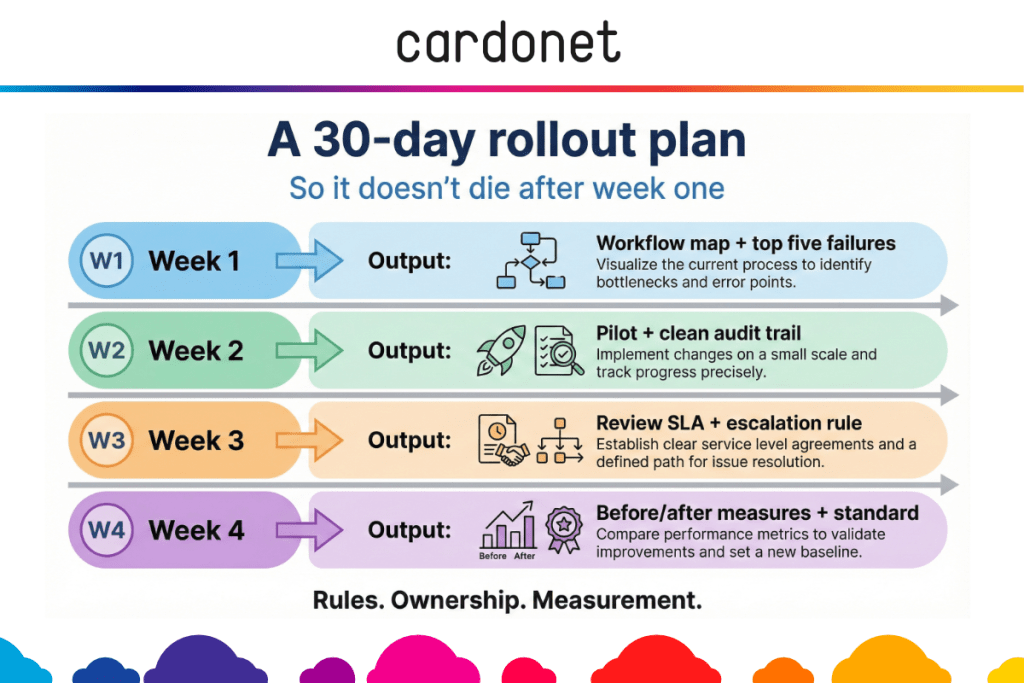
Week 1: Map where versions fork, where feedback scatters, and where approvals stall. Output is a single-page workflow map with your top five failure points.
Week 2: Pilot one project using the five rules with a decision log and a single working-file rule. Output is a clean audit trail from brief to approval.
Week 3: Standardise manager behaviour. Output is a published review SLA and escalation rule used by at least two managers on live projects.
Week 4: Measure and scale. Output is a before/after table for the pilot showing approval cycle time, rework hours, and meeting hours, plus an agreed standard way of working.
FAQs
How do we stop “final_v7_really_final” files?
Stop sending attachments and define one working location for each deliverable. Exports are for review and delivery, not new masters.
Do we need more meetings to stay aligned when remote?
Most teams need fewer meetings and better written updates. Move status to async updates and keep calls for critique, trade-offs, and approvals.
What’s the quickest win to reduce rework?
Consolidate feedback into one place, attached to the work, with a defined response time. This stops you paying twice when comments land late or in the wrong place.
How should we handle large creative files that don’t co-author well?
Use controlled storage with version history, clear ownership, and a simple checkout or lock rule when needed. The goal stays the same: one current version and a clean trail.
How do we share work with clients without creating data risk?
Use access controls, share only what’s necessary, and avoid links that stay live forever. Start with ICO guidance on disclosing documents securely and build a quick “pre-send” check into your process.

You must be logged in to post a comment.