

Are hotels spending enough on managed IT services?
No, they’re not. And I’m not just saying that because that’s what we do.
Hotels spend 4.2% of revenue on technology, but most of that goes to maintaining failing systems rather than preventing problems from arising. Meanwhile, UK hospitality businesses face median downtime costs of £600 per hour, with recent research showing that payment system failures are costing UK retail and hospitality businesses £1.6 billion each year.
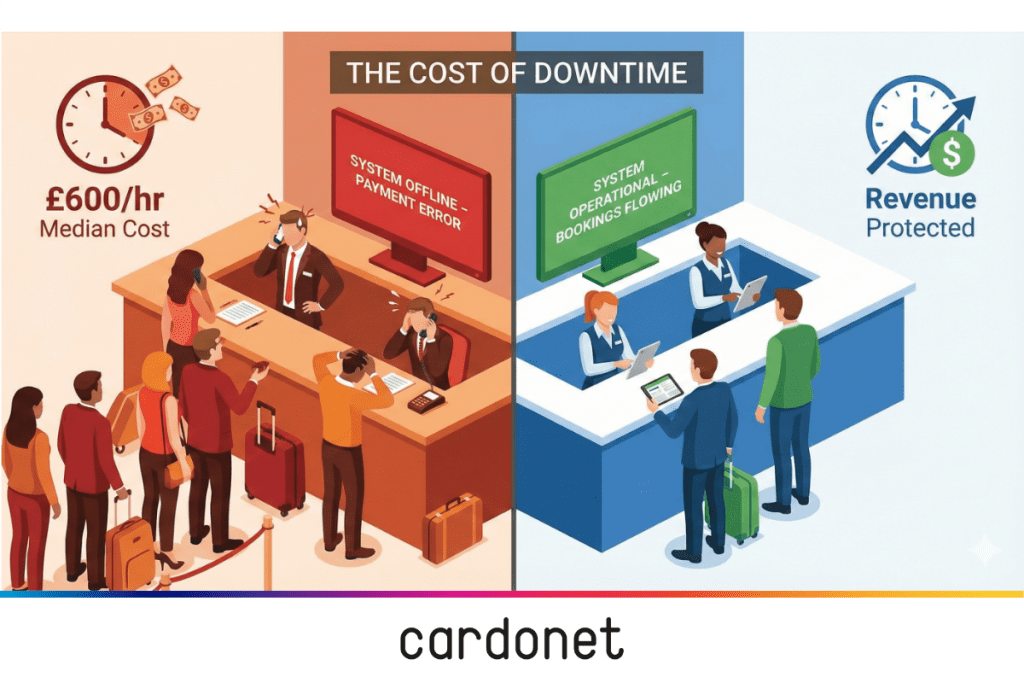
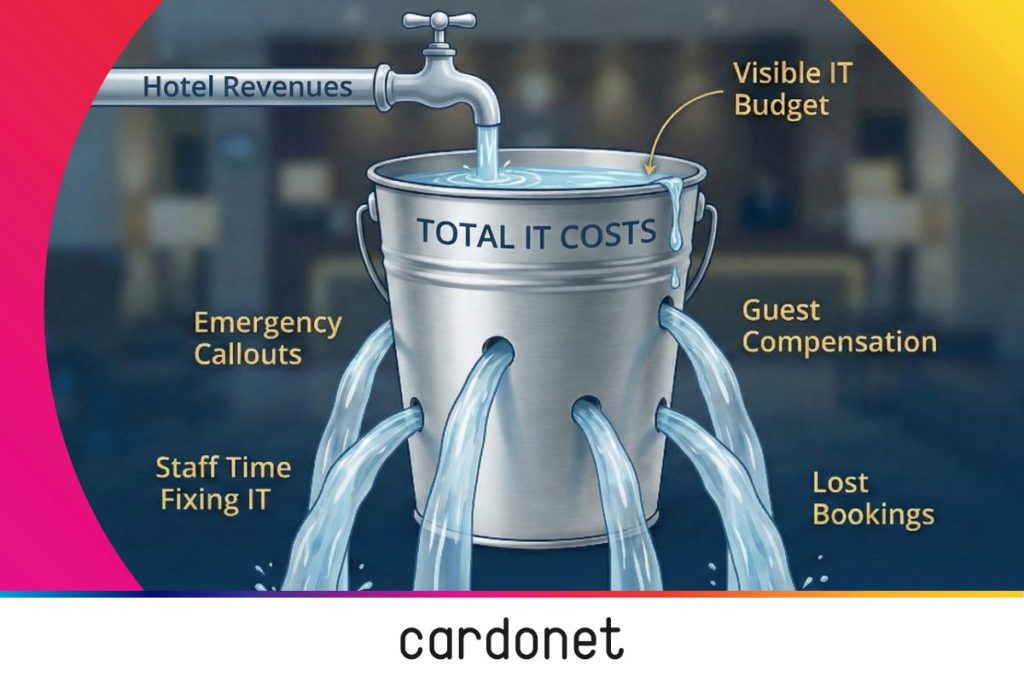
But the real cost isn’t recorded in the IT line item in the budget – it’s the additional guest compensation, negative reviews, and lost bookings that come from spending on the wrong things. Those costs may be carried in other lines, but they’re still IT-related costs.
I’ve worked with hotel businesses for over 25 years. I’ve seen properties spend tens of thousands on lobby renovations while running IT systems held together with luck and hope. They think they’re being smart with money. They’re not. They’re just hiding the real costs in different budget lines.
Key Takeaways
- Hotels allocate 4.2% of revenue to technology, with 63% going to maintaining existing systems rather than preventing failures
- Cornell University research found that a one-point swing in online ratings impacts room rates by 11.2%, with a 1% increase in reputation score driving 1.42% increase in Revenue Per Available Room (RevPAR)
- More than 81% of hotel guests experienced poor Wi-Fi during recent stays, with nearly one-third of negative reviews citing connectivity issues
- Research analyzing 53 million hotel reviews found over two million explicitly mentioned internet, Wi-Fi, or connectivity issues
The Real Cost Nobody Calculates
Hotels track everything. Revenue per available room. Occupancy percentages. Food cost percentages down to the decimal point. But ask a hotel operator what inadequate IT costs them, and you get blank stares.
They know what they pay their IT provider, they just don’t know what they’re paying as a result of the IT provider not being good enough.
What Downtime Actually Costs
Recent research found that UK hospitality businesses face a median downtime cost of £600 per hour – that’s £10 per minute. However, for a hotel, that is just a start. The real costs come because:
- Guests can’t check in
- Bookings can’t be processed
- Payment systems don’t work
- Room keys won’t program
- The restaurant POS stops functioning
Consider what happens when a booking system goes down during peak season. A 50-room hotel at 75% occupancy normally processes roughly 15-20 new bookings per day during busy periods. If the system is down for a full weekend – Friday evening through Monday morning – that’s potentially 40-60 lost booking opportunities. At £125 average daily rate, that’s £5,000-7,500 in direct lost revenue.
The Compensation You’re Already Paying
When IT systems fail, hotels compensate guests. This compensation carries a financial cost, but it happens quietly, across dozens of small decisions every week, and includes things like:
- Room upgrades for guests who couldn’t connect to Wi-Fi
- Comped meals for guests affected by POS system failures
- Free nights for guests who couldn’t check in on time
- Vouchers for guests frustrated by connectivity problems
Consider a typical scenario. A hotel compensating four guests per week for IT-related issues at an average compensation cost of £150 per incident totals £31,200 annually. That’s more than many properties budget for IT services – yet they wouldn’t track it as an IT cost.
The Review Penalty Nobody Tracks
Here’s what kills hotels: the long-term damage from negative reviews.
The Cornell research found that a one-point swing in online ratings impacts room rates by 11.2%. The same study showed that a 1% increase in a hotel’s online reputation score drives a 0.89% increase in average daily rate, a 0.54% increase in occupancy, and a 1.42% increase in revenue per available room. The inverse is equally true. Poor ratings limit pricing power and force hotels into discounting just to maintain occupancy.
When Wi-Fi fails, guests don’t just complain to reception. They write reviews. Those reviews mention the property name, the connectivity problems, and their frustration. Future guests read those reviews and, especially for the corporate market and people travelling with kids, they book elsewhere.
As noted earlier, the research analyzing 53 million reviews found over two million explicitly mentioned internet, Wi-Fi, or connectivity issues – roughly 4% of all reviews. For most hotels, that’s enough to impact their overall rating and revenue performance.
Properties with excellent service and beautiful rooms can struggle with occupancy because their online reviews are filled with IT complaints. They will have to spend thousands on marketing to overcome the damage, never calculating that fixing the root problem would cost less.
Why Hotels Spend on the Wrong Things
Hotels aren’t making deliberately bad decisions. They’re making decisions based on incomplete information.
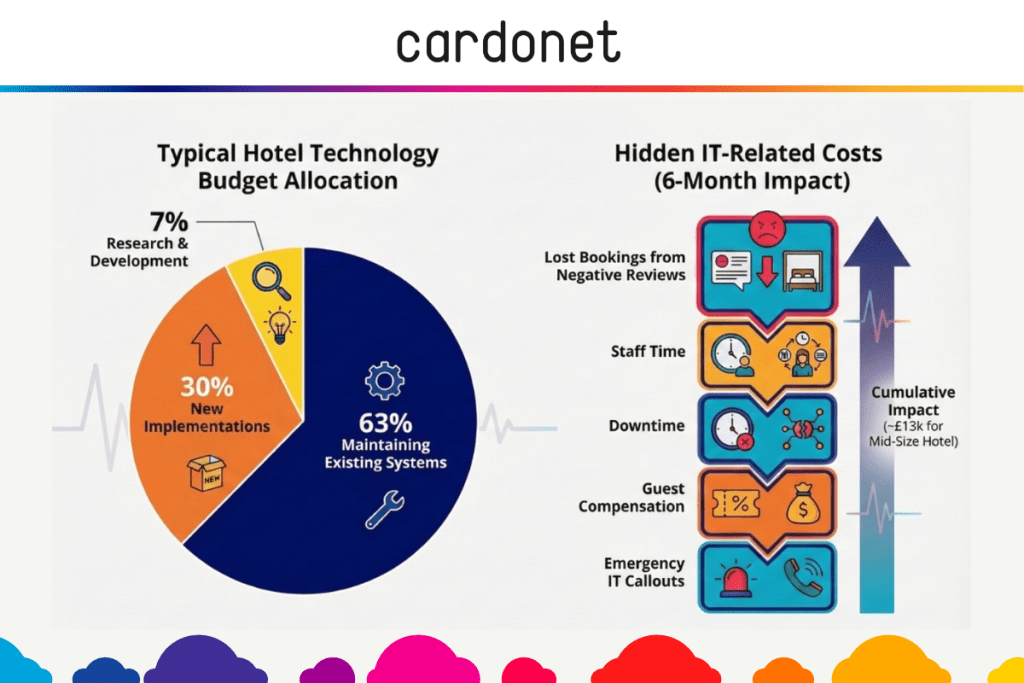
The research mentioned earlier shows the typical hotel technology budget breaks down like this:
- 63% maintaining existing systems
- 30% on new implementations
- 7% on research and development
That maintenance-heavy allocation tells me hotels are keeping old systems limping along rather than investing in reliable infrastructure.
The False Economy of Break-Fix IT
Consider the math on break-fix IT support versus comprehensive managed services.
Making some basic assumptions, here’s what break-fix typically looks like over six months for a mid-size hotel:
- ~£2,700 in emergency IT callouts (6 incidents at £450 each – comparable to other trade emergency callout rates in the UK)
- ~£3,000 in guest compensation for IT-related issues (£500 per month when systems frequently fail)
- ~£5,000 in other direct and indirect downtime costs
- ~£2,250 in staff time dealing with IT problems instead of serving guests (15 hours monthly at £25 loaded hourly rate)
That totals nearly £13,000 over six months – and doesn’t include the cost of lost bookings from negative reviews or the opportunity cost of unreliable systems.
Comprehensive managed services for the same property may cost slightly more upfront, but managed services will prevent most of those hidden costs. The downtime doesn’t happen. The emergency callouts don’t happen, and compensation and lost bookings drop dramatically.
When hotels actually calculate total cost including all the hidden expenses, managed services deliver better value. The question isn’t whether you can afford managed services – it’s whether you can afford not to have them.
The Question Nobody Asks
Hotel operators need to ask themselves what percentage of their negative reviews mention IT problems. Most don’t know. They track occupancy obsessively. They monitor food costs daily. But they don’t measure how many booking inquiries never convert because someone read a review about Wi-Fi failures.
The Cornell study documented specific impacts:
- On rating impact: A one-point increase in TripAdvisor rating leads to an 11.2% increase in room rates. For a hotel with a £125 average daily rate, that’s an additional £14 per room.
- On RevPAR impact: A 1% increase in online reputation score drives a 1.42% increase in revenue per available room. For a 50-room hotel at 75% occupancy, that’s approximately £3,300 additional monthly revenue.
- On booking behavior: The research found that online reputation impacts all distribution channels – not just online bookings, but phone reservations, group bookings, and corporate negotiated rates.
This isn’t theory. It’s measured financial impact from one of the world’s leading hospitality research institutions.
The Hidden Multiplier Effect
Poor IT doesn’t just cost money directly. It multiplies costs across the entire operation.
When the booking system is slow:
- Front desk staff take longer with each guest
- Check-in queues get longer
- More guests complain
- More compensation gets paid out
- More negative reviews get written
- Fewer future bookings come in
- Occupancy drops
- Prices get cut to fill rooms
I’ve seen this pattern repeated again and again. It starts with an IT problem that seems minor. Wi-Fi that’s slow in some rooms. A booking system that occasionally freezes. Management decides it’s not worth addressing because it doesn’t happen often enough.
But each incident damages the guest experience. Each damaged experience increases the chance of a negative review. Each negative review reduces the hotel’s ability to maintain premium pricing.
What Hotels Should Actually Do
I’m not suggesting hotels overspend on IT. I’m suggesting they spend strategically on what protects revenue.
- Add up everything:
- Your current IT provider
- Emergency callouts
- Guest compensation for IT-related issues
- Staff time managing IT problems
- Estimated impact of negative reviews mentioning IT
- Most hotels find the total is substantially higher than expected.
- Prioritize Guest-Facing Systems
- Wi-Fi infrastructure should be first priority. As the research showed, the overwhelming majority of guests experienced poor Wi-Fi during recent stays. That’s not a minor issue – it’s a revenue problem.
- Invest in enterprise-grade access points with proper coverage. Budget for complete Wi-Fi infrastructure refresh every 3-4 years, not only when it completely fails.
- Implement 24/7 Monitoring
- Problems don’t only happen during business hours. When something goes wrong at 2am, you need it fixed before the morning check-in rush.
- That’s not luxury. It’s revenue protection.
- Plan for Redundancy
- Single points of failure are revenue risks. Critical systems need:
- Backup internet connections
- Redundant power
- Failover capabilities
- The cost of redundancy is always less than the cost of downtime.
- Single points of failure are revenue risks. Critical systems need:
- Track IT-Related Guest Issues
- Measure what you manage:
- What percentage of negative reviews mention connectivity or system issues?
- What’s your average compensation cost per IT-related complaint?
- How many hours per month do staff spend dealing with IT problems?
- If you’re not measuring it, you can’t fix it.
- Measure what you manage:
Questions to Ask Your IT Provider
Most hotels ask about price and response times. Those matter, but they’re not the most important questions. Ask potential service providers instead:
- How do you prevent downtime, not just respond to it?
- Reactive IT support is expensive. You want a provider who monitors systems continuously and fixes issues before they affect guests.
- Ask for specific metrics on what percentage of problems they resolve before anyone notices.
- What’s your actual response time for guest-facing systems?
- A four-hour response time might be acceptable for a back-office system. It’s not acceptable when the booking system is down during check-in.
- Ask for guaranteed response times for critical systems, not average response times for all issues.
- How do you handle vendor management?
- Hotels work with dozens of technology vendors – PMS systems, booking engines, payment processors, Wi-Fi providers, phone systems.
- Managing those relationships takes significant time. Does your IT provider coordinate with all of them, or do you need to play referee?
- What’s included in your monitoring?
- Some providers only monitor whether servers are powered on. Others monitor performance, capacity, security threats, and potential failures.
- There’s a massive difference in value.
- How do you prove your value?
- Ask for monthly reports showing:
- Issues detected
- Problems prevented
- Cost savings delivered
- If a provider can’t demonstrate their value with data, they probably aren’t providing much value.
- Ask for monthly reports showing:
I’ve been managing IT services since 1998. I started part-time while studying engineering at Queen Mary University of London. I’ve worked with the full range of establishments, from 15-room boutiques to giant conference centres and the conversation is always the same, at first. “IT is expensive, and we need to keep costs down.”
But I argue that hotels don’t have an IT spending problem. They have an IT value problem. They’re spending money – often quite a lot of money – just not getting reliable service in return.
The truth about hotel IT budgets isn’t complicated. Underspending on managed IT services doesn’t save money, it just moves the cost to guest complaint compensation, negative reviews, and lost revenue.
Those are much more expensive places to spend it.
Set up a time to meet if what I have talked about resonates with you. I love to discuss hotel technology.


You must be logged in to post a comment.